The Gift

Here’s what I’ve learned from wrestling with a blank page: writer’s block isn’t really about writing…or not writing for that matter. It’s about everything else. It’s about the schedule of the day ahead. It’s about the conversation I had with an old friend moments ago… or even months ago. It’s a voice that whispers, “This one has to be good.” It’s about the gap of expectations – the space between potential and perfectionism. 

Maybe writer’s block is really just a necessary pause – that space between stimulus and response where wisdom edges its way in. We have to walk around our ideas – see them from various perspectives – especially in unexpected ways. 

Liz: We were talking about what I call writer’s block, but you said you get it even in a non-creative situation. Can you say more about that?

JD: Yeah, not so much creative, but I always try to find something unique or different or something that somebody’s not thinking about, deeper insight into whatever the topic or the business or the issue might be to bring something to the forefront. So you’re not always having the same conversation about the same thing. You’re digging in. In an operating environment, you’re actually identifying and solving an underlying problem in the business or taking advantage of something that’s going well. So what are those things? How can you identify them? Then what are you doing about them? Either to fix them or to leverage off of it.

Liz: So do you try to tell the story of the thing that’s going well?

JD: First of all, what is it that’s just out of the norm so we’re not having the same conversation all the time? Then what are you going to do to fix it? Or what are you going to do to lever off of it? Or when I was in the field a lot, I used to call it, give the client a gift. Tell them something about their business that they don’t know and that you have taken the time to understand or draw insights into from them.

Give them a gift. I’ll get back to how that applies in the business world, but I have to pause. When Jon Grandstaff, JD as I still call him, said those words on our walk, I stumbled. They had that big of an impact on me. These walks are a gift. Individually and collectively they have been a gift to me – grounding me, inspiring me…. stoking my curiosities and highlighting the simple magnificence that comes from someone’s story. I didn’t intend for them to be a gift to the person with whom I walk, but I have found that they are. It is a gift to slow down a hectic day for a walk. It is a gift to be seen. It is a gift to know someone wants to share your insights with the world because they are so profound. As JD says, I tell them something about themselves that they didn’t see as remarkable and draw insights for others.

And some walks offer unexpected gifts to readers and listeners. You hear something that screams, “You are not alone” and maybe you see something in your life a little differently. 

Let’s return to JD’s explanation of how this applies to business – perhaps, you are asking yourself what business? – I ask myself that too. I’ll try to get to that answer for you… think of it as a gift coming later.

JD: give the client a gift. Tell them something about their business that they don’t know and that you have taken the time to understand or draw insights into from them.

Liz: Can you think of an example?

JD: In the business we’re in, and you’re in the field with clients, I’d always try to look deeper into the data to tell them something about health care utilization or trend or spend areas or provider behavior that may be questionable, that maybe they didn’t know about themselves. We can be that consultative strategic partner and just not the typical vendor relationship. So you’re of value.

Liz: I love that you were pulling a story from data. Do you live in numbers and data?

JD: All day, every day.

Liz: And yet you recognize that the best connection when you’re with a client or now with your team is more in the storyline.

JD: You have to tell a story from it. What does it tell you? Why? Why do I care about that? It’s the old “so what” conversation.

I love being in the field with clients, understanding what’s working well, what’s not, what their needs are, trying to move a conversation to the next level, get something done with them. 

Liz: Why did you like that?

JD: I always wanted to be seen as a problem solver because I never was a sales guy. But I was always looking for ways to grow businesses and grow work that we’re doing with clients, but more from the perspective of being of value.

Being of value. Isn’t that what we all want? I remember Angi Evans admitting her thoughts on retirement, “I matter. In a certain segment of the world. I matter. People notice if I’m not there. I think I will miss that. I’ve become very used to mattering in the world.” 

There was something about her honesty and vulnerability that has stayed with me. We don’t just want to belong somewhere – we want to belong in a way that matters and not just for our utility but because we made a difference in a project, or in a life. 

I remember thinking years before my father retired, “I wish he would slow down.” I voiced that to a friend of his. He disagreed, “Your father has meant so much to so many people, he wouldn’t know what to do with himself if he didn’t work.” For a brief moment Dad was lost when he walked out of the CEO’s office at Wheeling Hospital. Now what? He didn’t wander far from his patient-centered life. He volunteered at a free clinic and remained a trusted medical advocate for friends and for me. I’d ask him about every ailment my daughters or friends had. I’d ask him for advice on kids at school, for referrals for teachers, and for guidance on our health insurance. The last one always eluded us both.

We should have asked JD. Turns out his business is healthcare finance.  As a woman who just navigated private pay through COBRA for herself and her daughters, I have some thoughts on health insurance, but I thought better of disclosing as much and asked JD for his opinion.

Liz: So what’s your take on health insurance in general as an individual, as a dad, as a family member? 

JD: I guess thinking about it, it’s one of those necessary evils in life. It’s so expensive and so cumbersome and so difficult. But if you didn’t have it, it would probably be pretty awful at the end of the day and detrimental to many of us. So I don’t know.

Liz: That’s an interesting comment.

JD: It would take so many families and individuals down financially and otherwise. They would not take care of themselves because they couldn’t afford to do it. Even with health care itself already being expensive, they would just not take care of themselves.

Liz: There was obviously a time that there was just a doctor and a patient, and there was a transaction. And somewhere along the way, insurance was born.

JD: Now that you say that, I never have really thought about that. But I assume it was somebody thinking they could do it better or more efficiently or more cost efficiently with this concept of accumulating people into groups and group rating individuals to get better cost. That’s the whole structure of HMOs and PPOs and having networks that you can put people together and spread cost around and you can drive volume to providers that justifies them giving breaks on costs.

Liz: The idea is I just pay a little bit regularly, and then I never get blindsided by a big bill, but I’m also in turn helping other people when they need it.

JD: Yeah. This year, you may not have much of a health care need, and you take certain fewer dollars out of the system, but somebody else has cancer this year, and they’re taking a lot out, so they can average that across a number of people, but keep it low for everyone.

Liz: And you work at the level above all that. Your support is of the insurance companies themselves.

JD: For the insurance companies, inherently …but I like to tell the story that we’re actually, to some extent, working on behalf of the individuals and the members. Because to the extent that we can help manage costs for the providers, it means that the health insurance companies now don’t have to charge such high premiums. If you don’t have to charge high premiums, you can care for more people.

Liz: That’s a good spin on it.

JD: Again, how do you tell the story? It’s about tying into what is my client’s reason, what’s their so what and their why, and their mission and objective is to, most always, provide great world-class care for their members. How am I a part of that conversation? How am I supporting their objectives? In terms of that gift and how I tie what I do to what clients need and want. 

Maybe it’s my athletic background or team environment, but I’m all about the team and collaboration. And as I say, sometimes all hands stacked in the middle.

Liz: You mean that moment before you go?

I couldn’t even find the words for the huddle – that moment of pure alchemy before a collective, explosive roar… before hands fly skyward and bodies scatter into formation… before individual goals manifest again. The individual strength in that close circle doesn’t just add up—it can multiply.

JD: Everybody’s got to be on the same page. Everybody’s got know the why. What I don’t do very well… I call it the ‘got you game,’ and I’ve had some very direct conversations with peers and other people about that whole thing.

Liz: In my life, I’ve noticed that direct conversations between people, even if they’re painful, are the only way to move forward. And if you can’t have those direct conversations, then it’s probably not the right place for me. Rick likes to say, ‘Bad news only takes so many minutes, and then it’s over. Stop fretting about it.’ 

JD: I mean, to the point, whatever I said earlier about being willing to face the brutal facts, whatever they are. I mean, we used to have a saying in my old company. We’d say that bad news doesn’t get better with time. So just speak it and live it and be brutally honest with yourself.

Liz: Oh, be brutally honest with yourself. Say more about that.

JD: You, as an individual, have to be willing to acknowledge and accept whatever it is, good or bad. Everyone will always accept the good, but you have to be willing to look at the bad as well and then challenge yourself with ‘Why was it bad? What am I going to do about it?’

Liz: Except sometimes, can’t we, without someone else… an outsider helping us, can’t we pick the wrong answer to ‘Why was it bad?’ Pick the victimization role? It was bad because of them instead of what I did? 

JD: Sure. I try and not always make it about someone else. But all right, so what was our role in what they did? Someone else may have ultimately done whatever. But aren’t we ultimately accountable with them?

Liz: And you can’t change them. You can only change you.

JD: But if we had a better process, a better tool, a better way of this, a better that … better whatever… could we have kept them out of that scenario altogether? Maybe not always, but we should always challenge ourselves.

Liz: I think if I’ve learned anything in the past two years is just to hold space because you don’t have all the information, and if you’re quick to judge or act without all the information, you’re going to be wrong. So if you hold space, there’s something else coming and I can work within this parameter of what I have, you’ll be more successful. 

JD: Well, and a lot of that comes from a certain level of trust as well. 

One invisible thread weaves through every successful collaboration, productive meeting, breakthrough innovation or just a good walk: trust. Whether you’re leading a team or navigating a difficult conversation, trust serves as the fundamental currency in the transaction. Without it, even the most talented teams crumble under miscommunication, and defensiveness. With it, trust creates a safety net that allows people to take risks, share ideas, and navigate hard times. During one of my hardest times, it was JD I trusted to be a steady, logical presence. It was he who was my safety net.

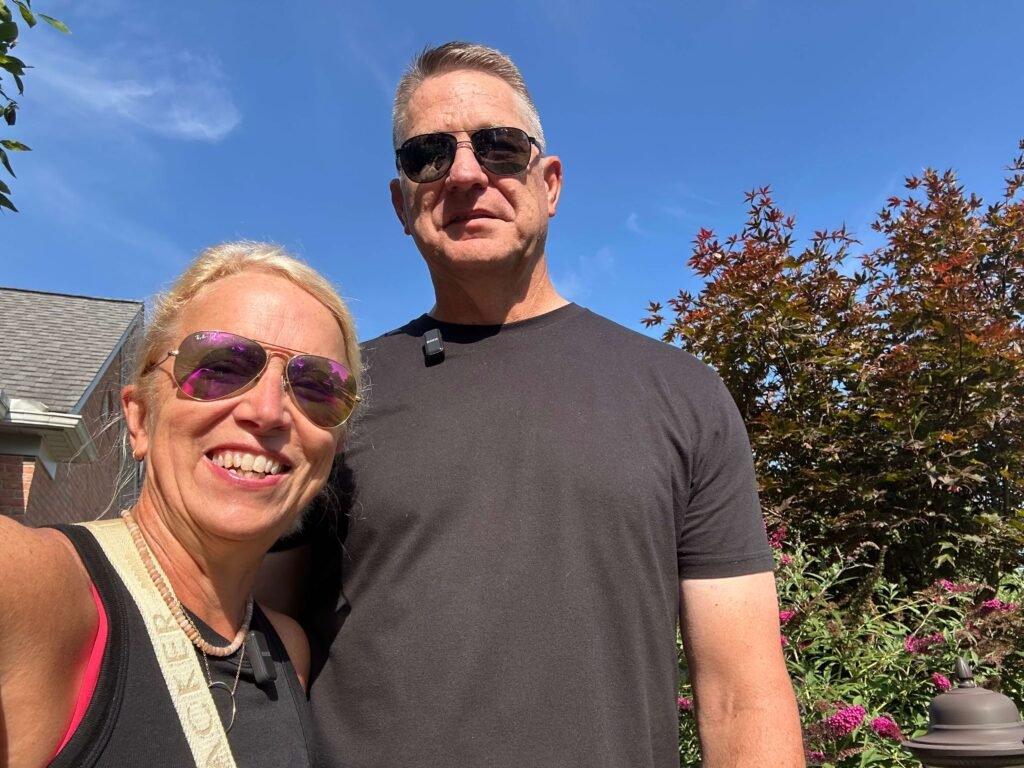
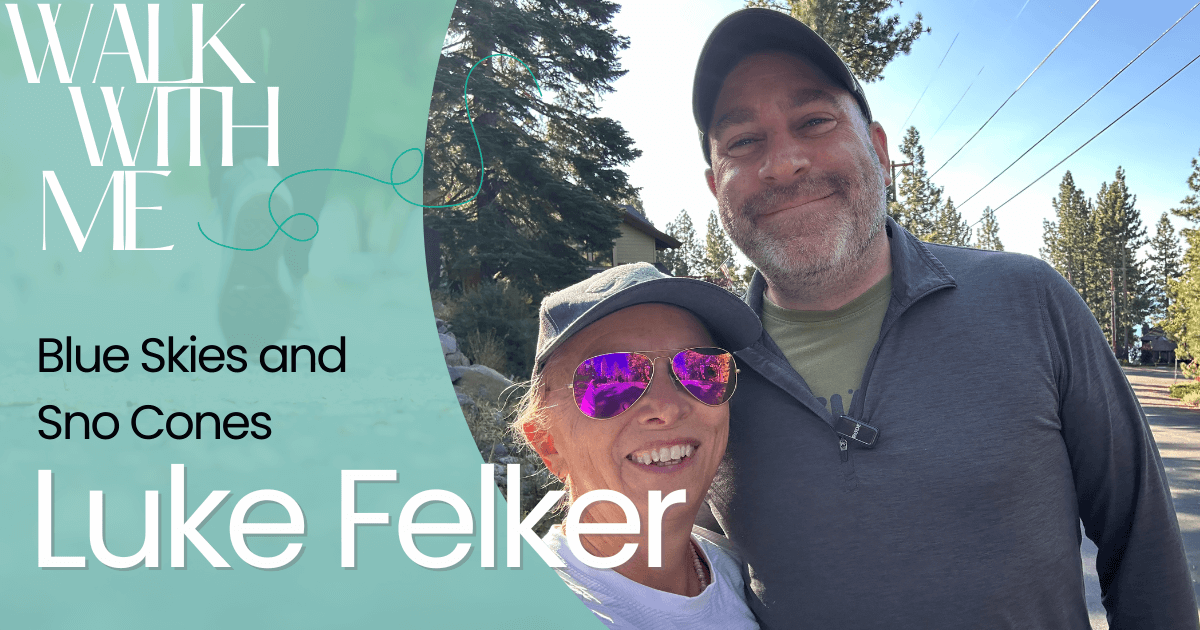
Liz: I think I’ve learned more about you on this walk than I even knew I would learn. But there was no question in my mind when I felt lost in a storm, You were a lighthouse. And it’s not just because you’re so much taller than I am… There’s going to be a moment where we stop and take a picture, and it’ll be clear to anyone who hears or reads this that we are not of the same size. 

JD: We’ll find a rock for you to stand on. 

Liz: Yeah, right. Might need more than a rock… but I just felt like, here’s a steady hand that I can hand the controls to. And I’m very appreciative of it.

JD: Well, thank you for trusting me in that. I don’t know that I deserved it. I’m appreciative that you trusted me.

Liz: No, of course you did. And the truth of the matter is, none of us think we deserve those, I don’t know, recognitions, or acknowledgements. But you said yourself it works better when you see the transaction between people as a gift you’re giving. And I don’t think we all think that way… but should. 

Maybe writer’s block isn’t about having nothing to say. Maybe it’s about learning to listen to what wants to be said, and then finding the courage to say it imperfectly, authentically, one word at a time…or two.. such as thank you. JD, your steady consistent rational hand gave me peace and helped me navigate through a storm or two. Never as loudly or as clearly as the time you leaned forward as we rode an escalator and you whispered, “as long as you have your girls.” Now those seven words were his greatest gift.


Liz Hofreuter

Founder GEN-Ed

Not your typical researcher or consultant, Liz connects lived experience to transformative leadership. To uncomplicate leadership and education, every story matters and she is just getting started.

Blue Skies and Sno Cones

Are you old enough to know Mary Tyler Moore? Do you remember the still image of her broad smile captured as the video freezes on her throwing her hat into the Minneapolis sky while spinning around to look into the camera with eyes that welcomed you to join in her joy? 

When I look at the image I am struck by the woman in the background. You can almost feel the generational clash radiating in the moment. There’s Mary in the center, practically glowing with liberated energy, while the woman in the blue headscarf embodies the boundaries she wouldn’t dare to cross. Her whole ensemble contains her – the opposite of taking up space. You can see the generational fault line. Tension creeps in. The writers could only push so far—they’d give us a professional woman, but she would have to be palatable and gracious. Even as Mary blazed trails as a career woman, she still apologized time and again for taking up space. Still…it was a step on the continuum. Obviously, it touched my young heart as the song serenaded, “We’re going to make it after all.” 

I hadn’t thought of that moment of television history in decades until I witnessed Luke Felker make almost the same gesture in Chicago a few years ago. He was joyful – no resplendent –  to be walking the streets of the windy city reveling in a quick respite from being a Head of School and the weight of expectations that accompany it. As heads we lead and influence that generational continuum – it’s heady work – pardon the pun – so we need time to find ourselves relishing the joy of a moment – Mary Tyler Moore-style. 

Luke is my Head of School soulmate. He is my 2 AM call… which is awkward because we have been on very different time zones for 11 years now. He is my Mary Tyler Moore with a lilt in his voice as his words flow unrestrained in pure excitement for the work. When life kicks him in the teeth, as it does all of us, I swear the entire world tilts off its axis. And being a Head of School at The Bay School in San Francisco, CA – especially during COVID – knocked the wind out of him a time or two. His silence would cause alarm momentarily.

Luke: Even if we haven’t spoken in the last month, whatever the case is, knowing you’re out there in the world generally makes me feel better. It’s going to be okay. She’s out there.

We’re going to make it afterall.

Liz: When things were really rough at one point during my divorce, I remember I got a card from you and you said, “I wish I could take you for coffee.” And you sent me just enough on a Starbucks gift card for a cup of coffee. It was just the simplicity of, ‘I see you. I know this is a hard time. I wish there were something I could do. Have a cup of coffee.’ 

We buoy each other. We build on each other’s energy. It has been crucial to me to have a colleague that I trusted with my strengths, my ideas, and the depths of my challenges and my fears. He shares many of them… as do many of the colleagues who live as heads of schools. Listen in.

Luke: Life is fragile. Schools are fragile, and some schools are more fragile. When you have no money in the bank, it’s a really logical fight or flight… it embeds in us in ways that… One of the things I share with a couple of really wonderful leaders I work with all the time is we’ve all got to take ourselves… in the balloon again. 

Liz: In the balloon? 

Luke: In the balloon. Well, imagine our work as heads or our work as educators. We’re often right on the ground with kids, whatever the case is. And on occasion, we all need to come up to see. I have this amazing CFO who has not been in schools before Bay, and I feel like he has the ability to ask a question where I’ve forgotten that was possible because I’ve been in schools so long, or let’s say, not exceptionally wealthy schools.

And I’m like, Oh, my God, that could happen here.

Liz: But to the balloon, we think of a hot air balloon, and so you think of blue sky. So I think there’s two reasons to get in the balloon. 

Blue sky thinking is like giving your imagination permission to soar without limits, a creative space where you temporarily set aside budget constraints, technical limitations, and that little voice saying “but that’s impossible” – while embracing the hint of “what if it weren’t?”

Luke: Oh, my God. Yes. Well, that’s part of the work that… I mean, that’s what’s been so much fun about working with you is that I feel like we readily go back and forth from land to sky, and there are people in your world who are going to do that with you and that allow you to pause to see things you wouldn’t have seen otherwise. And I think that’s part of what keeps me sane. And why did I come back to ISACS all those years when I was in California? Anything that gets me out of my bubble allows me to see things from a different perspective. 

Liz: Just get out of the typical box, for lack of a better word.

Luke: It’s myopic. I adore my CFO. I have to resist talking to him every day. This might be crazy, and… Sometimes he’s like, Okay, I’ve learned more about how the school works, and this is a craziness that is. Sometimes I’m like, ‘Oh, my God, you’re right. Why have we done this? Why does every other school do this?’ He’s like, ‘It’s insane.’

Liz: I like that you said, “This might be crazy, and” instead of, this might be crazy but.

Well, because… AND accepts the crazy. 

Luke:tension is not a negative, it’s a descriptive phrase, and that’s some of the best work we do … If we’re not in tension, we’re probably too far on one side of the spectrum in terms of how we might be leading as a school or a program. You can’t have tension all the time, and you can’t have people being mad at each other all the time, blah, blah, blah. But it’s been like a self-help skill for me ”Oh, tension is a part of my day.”

Not just any tension…we are talking about generational tension. It isn’t the enemy—it’s the very curriculum of our schools. Of course Mary’s breakthrough joy carries the weight of what came before. Of course there’s friction between the woman who tosses her hat in the air and the one who keeps hers pinned down with a proper scarf. I shouldn’t smooth over these differences or dismiss them as obstacles, but rather lean into them with curiosity.

Why does Mary still feel she has to smile apologetically for taking up space? What complex inheritance makes her grateful for scraps of opportunity? Why does her very accommodation—that lingering need to make everyone comfortable with her liberation—stir something unsettled in me?

This is where growth lives: in the uncomfortable space between generations, where the old rules haven’t fully died and the new ones aren’t fully born. Each generation carries both the wounds and wisdom of those who came before. The headscarf generation knew survival; Mary’s generation dared to dream beyond it. Both truths can coexist, creating productive friction.

As educational leaders, we’re constantly navigating these generational crosscurrents—honoring what sustained previous generations while clearing space for what the next generation needs to flourish. How could there not be tension when we’re literally midwifing the future while honoring the past? That tension can be our compass, pointing toward the essential work of helping each generation build on what came before while becoming fully themselves.

Luke: We’re doing generational work around which the communities of the world have been built. I mean, I’ve said things like this to our staff before in a slightly more focused way.  I just want to name it, it’s no wonder we might feel fill in the blank, because this isn’t even just about teaching or the way America doesn’t view teachers. I’ve really actually tried to hit the word generational because I think it also reaffirms for teachers that this is something far more than the moment. We’re not just serving ice cream. Not that that’s not an important job, but we’re trying to connect past and future. That’s really heavy.

Liz: At times, the very best thing we can do is serve ice cream.

Luke: Yes, that’s true.  If ice cream is your jam, Godspeed. For those who have chosen education, how do we help them experience and see the larger arc? Because day to day, it can feel like #$%. We need ice cream. We need snow cones. Something that I’m really proud of. This is a year, too, where I feel like I’m coming to terms with the things I can be proud of and that I can name without being bashful or like, Oh, well, I tried my best. I think I’ve really brought some joy to a very intense philosophical school that took everything really seriously. We have four snow cone days a year that happen on random days. During the pandemic, I was like, On Amazon, we’re getting a #$% snow cone machine for the first day we got back.

Liz: Isn’t that funny? I promised a popsicle party our first day back.

Ice cream cuts straight through the complexity of life, untainted by cynicism or fear.  It offers uncomplicated joy that can be measured in scoops.

Luke: And again, it’s not about the snow cone, per se. We need little bursts of things, and kids need it. And to be really clear, adults need it, though they’re less quick to admit it. I think that’s part of the complexity. I mean, it’s part of the beauty of the role. Why do I stay after this many years? Where else could I travel from the dirt all the way up to the blue sky, back and forth with all of these different people dealing with the future of our world, while actually also working with the board where I get to experience really interesting people from a whole bunch of other industries. 

Liz: Angi Evans says nobody else gets to work with three-year-olds to 70-year-olds on a daily basis.

Luke: Yeah, and God forbid, you run out of coffee at Grandfriend’s Day. I learned that lesson once, never again. Grandparents eat coffee. It’s an indelible life lessons. I think that’s, again, part of the challenge of the role. It is partly pastor, it is partly tactician, it is partly business manager. 

Liz: I think that goes back to support. I can create all kinds of head networks, but it’s still that person that you need that knows the job, that you can say the things you’re not allowed to feel, and they’ll say the things back, whether it’s hard or not.

Luke: Yes. Time a Million. 

The Head of School simultaneously holds space for the older board member who believes “children today need more discipline” and the young parent demanding restorative trauma-informed practices. You’re constantly translating between generational languages, validating the lived experiences that shaped each perspective – including your own – while gently nudging everyone to move the needle forward for the sake of generations to come. No wonder we need an unhurried hug hello as I found in James’ office a walk or two ago.

Luke: That’s given me another level of access to sanity… it is finding those two or three people that are always there.

The two other people who are always there and who know the work. Our trio: James, Luke and Liz. In the life-changing work we do, you need a team with which to face off against the generational forces at play.  It’s not quite superhero work, but I swear every Head I know deserves a cape. For our trio, I like to think of Batman and Robin, who were incomplete with Batgirl. I’m Batgirl.

Luke: You’re that friend. You make the connections with people.

Luke: I’m constantly reflecting on what you do, how you do it, what you did with Edge, I found and find so inspiring. And there’s still a piece of me who’s like, I can’t even… It scares me. But my point is seeing what you’ve done with Edge or seeing how you lead a WCDS or just talking with you about other schools. It builds the capacity to believe like, “Oh, wait, I could do that. It’s not insane”

Liz: Let’s look up and see. Let’s put a man on the moon. 

Luke: Well that’s again part of it, that is the inspiration. On some level, if we zoom out, whatever percentage of things are going to make it or not, we move forward.

The percentages of things that will make it. 100% isn’t feasible. We wouldn’t want it to be. There would be no failures from which to learn. Still, we are timid before we leap into that sky which isn’t always blue. 

I love the quotation from Erin Hanson,

And you ask “What if I fall?”

Oh but my darling,

What if you fly?

I always wanted to write those lines on the beams of the shelter where parents waited for our youngest students at WCDS. I thought it would be good inspiration for them as there was always a bird’s nest balanced atop one of those beams. I liked working at a K-8 because it was all about childhood – the innocence of possibility – the hope for the future – the joy of what the day brings as embodied in a bird’s nest. Luke understands. He taught…

Luke: First grade, I taught it for five years. I loved it. I don’t think I could have done it for my whole life. I clearly love crazy jobs, which first grade is. But I don’t think I would have been professionally fulfilled forever. And those years formed me. And it’s so #$% joyful. The whole world is opening up to them, learning how to read. How #$% cool is that?

Liz: And it makes you learn all over again. Yes.

Luke: And we can tell her how to read and go to the pumpkin patch on the same day.

Liz: But come on. When the first graders are still on the playground and not in music when they’re supposed to be because they found a bird’s nest. 

Luke: I know. 

Liz: It is as exciting to the teacher as it is to the first graders.

Luke: Damn well it should be.

Liz: I woke up this morning with this feeling of, I’ve got to tell Grace she should teach for a little bit. I don’t know. I think everybody should spend a little time teaching somebody something they don’t know for a year …or five.

Teaching lets you embrace the joyful complexity of standing at the generational crossroads— you’re part of an ancient chain of learning. This generation of students teaches you as much as you teach them, reshaping your understanding as you guide young people toward their potential. You become a living bridge between what was, what is, and what could be. It matters…one student at a time.

Luke: To be able to have this conversation today feels so cleansing and empowering, coming back to the reality that if someone doesn’t like it, God speed. Like, great, all good. 

Liz: If the head isn’t well, the first grader is affected. And that’s not okay, because to Ella Landini, junior year is not a dress rehearsal for senior year. It is the only junior year she ever has. And the teacher she has damn well better care that my kid learns. I walked with a guy who used to be a teacher… I said, what do you want the teachers of your children to know or to do? And he got real emotional and said, ‘love my kids when they’re not with me.’ And isn’t that what our job is? – we make all the employees feel loved and supported and happy so that they make everybody feel like it’s okay.

Luke: You need people to bring you back to love, to get you out of the policies, the procedures, the fact that we deal with the 2% worst of whatever is happening, because the kids can feel it. I think about how I want to show up. This walk helps to renew the “I can’t wait to be there tomorrow,” I’ll say something ridiculous and silly that they don’t completely understand. But they’ll know, “Okay, that guy, he’s looking out for us.” 

Liz: And when you talk about tune back into that love, it’s tune back into that childhood that still lives within us.

I like the idea of child-like wonder: that Mary Tyler Moore-ish unabashed joy that comes from seeing the world through each new generation’s eyes while carrying forward the wisdom of those who came before. I am grateful to think about tension – the ‘both and’ of yesterday and tomorrow. The reminder that all of our generational crossroads are embedded with learning and therefore growth… and that we never navigate these transitions alone. We can send out the bat signal to those colleagues who understand that we’re simultaneously keepers of tradition and agents of necessary change. With them we can take off into the blue sky – how lucky to be accompanied by a creative and strategic genius like Luke Felker.

We are going to make it afterall.

And speaking of the sky… I’ve been trying to articulate the simplest moonshot message as to the purpose of the work Luke and I do. I know it involves the essence of joy. I know it involves a better future. I know it uplifts potential. I don’t quite have it, but then again I haven’t quite finished my walks even though I’ve done 51 of them.


Liz Hofreuter

Founder GEN-Ed

Not your typical researcher or consultant, Liz connects lived experience to transformative leadership. To uncomplicate leadership and education, every story matters and she is just getting started.
A Teacher and a Coach

This is a walk where the lines between teacher and student blur. 

This is the walk that made me understand the Zen philosophy of “beginner’s mind.” In leadership, beginner’s mind is that rare gift of approaching each challenge with fresh eyes. Unencumbered by the weight of “how we’ve always done things,” we can have bold vision. It’s the strategic humility to learn something new. Such leaders understand that the moment we stop being students, we stop being effective teachers. 

This is Kermit Cook, the CEO for Penn Foster Group, who finds himself reimagining education for the 80,000 students who walk through their digital doors each year—students the traditional system couldn’t quite reach. 

The first word describing him on LinkedIn is teacher. Mine is learner. It’s ironic because I was Kermit’s teacher. Within two years of graduating college, Kermit decided to be a teacher himself and applied to Teach for America (TFA).

Kermit: It turns out if you put St. Louis as your top choice for TFA, you get St. Louis. I coached basketball. I taught physics, and I ended up coaching tennis, even though I’m not a tennis player. I’m a terrible tennis player. The athletic director comes up and says, ‘Hey, Coach Cook, will you coach tennis for me this spring?’ And I said, ‘Well Coach, if you can’t find anybody else, I’ll help you out, but I don’t really know what I’m doing with tennis.

Liz: You know that’s a yes in a school.

Kermit: Exactly. He responded, Great, you’re hired. 

There is a line in an independent school contract…and other responsibilities as assigned by the head of school – the catch all. It means you’re driving the van through the parking lot on Grandparents’ Day even if you are the Director of Admissions or folding chairs after the assembly… or coaching tennis.

Kermit’s school wasn’t in the independent ecosystem, it was Gateway Tech magnet school.

Kermit: The school had a very good career education program. That actually directly leads to where I am today. But they had a health care pathway where you had retired nurses who were teaching students. They could roll right into an apprenticeship as a medical assistant.

They had this really cool partnership with the airport, Lambert Airfield, where we had old airplane engines in the basement of the school. And again, retired airline mechanics would teach these kids. And the kids when they finished that program went straight into an apprenticeship at the airport and ultimately became a licensed airline mechanic. It opened a door.

One of my tennis players, 

yes…I am laughing at his ownership of coaching tennis all these years later when he was admittedly a reluctant coach at best. 

Kermit: One of my tennis players, Keith, is a senior engineer of GE Aviation today. He was a C minus physics student. He had a learning disability. He really struggled with math, with physics. He got through with a C minus because he just worked hard and got in all the assignments on time and came in at 7:00 in the morning before school started. But the airplane engines he just got and he loved it. That experience was just so eye-opening to me about the importance of a path that it wasn’t a traditional two or four-year degree… ultimately, that’s why I’m at Penn Foster. 

That is one of those other “duties” that we willingly perform in education – show up at 7:00 to walk a struggling student through the maze of learning because none of us want to be in the business of surviving school. In my first six years of teaching, a day didn’t go by that Denny Hon’s wasn’t the first car in the parking lot. He identified struggling students throughout the school, and he tutored them. One of those students became one the best teachers I know, Joe Jividen. He credits Denny with getting him through math although Joe was never in one of Denny’s classes. Joe has told me that Denny had one non-negotiable – show up. The day you missed was the last day he would work with you. Now “Coach Joe” – so named in that same vein of other responsibilities as assigned by the head – sorry Joe – is carrying on that tradition – he shows up; he cares.  

Not everyone has Denny Hon pulling them in before school.  There are so many roadblocks to making that a reality. Our traditional systems, for all their good intentions, are riddled with spaces between the floorboards—places where a kid can disappear without anyone noticing the absence. We’ve built these elaborate structures with their rigid schedules and predetermined pathways, but have we installed enough safety nets for the ones who stumble? 

Kermit: I would argue in the world of education, I’ve seen a lot of stifled innovation in what the actual education model is … because there’s so much constraint around the infrastructure and the way the funding works and the legacy of something. But taking the traditional system and saying, ‘Okay, we need to be able to get somebody all the way through a high school degree for a total of $1,500,’ you’re insane.

How insane? You should know the public school average to educate a child is $13,500 per student per year.  If you are doing the math in your head, that’s $54,000 over the course of a high school career. Penn Foster’s price tag is only 3% of that.

Liz: Well, the other thing I’ve learned is you have to put limits on for true innovation. It’s within the constraints that you can get creative. 

The constraints: from my limited research we have 2.1 million students ages 16 – 24 that did not complete high school or earned a high school credential. They did not find their way in public schools. Their socio-economic status left private school out of reach. As a high school drop out their economic forecast is bleak… thus our economy’s forecast becomes bleaker. Who drives innovation that meets students with what they need in a radically different model? Who can navigate that dilemma? Who possesses the beginner mind to see a bold vision? A man whose

Kermit: …collisions of experiences are taking you where you need to go.

Kermit Cook, the son of two educators, a teacher himself, and a professional with 13 years in private equity asks those questions. Clearly, private equity is a different path than most school leaders take. When he was faced with the decision to follow his passion at TFA or follow a radically different path, he found inspiration from his mother.

Kermit: Right at that time, mom and dad moved, and mom decided to retire from teaching and go to seminary full-time. I distinctly remember the conversation when she said, ‘Let’s cut through it this way.  I have, God willing, another 20 years, and that’s plenty of time for a whole new career.’ She was almost 60 at the time.

As his mother had the courage to follow a new path after a full career in independent education at The Linsly School,  Kermit made a career choice that would stretch his thinking, but ultimately led him back to his passion for teaching and learning.

As my friends in education said, I decided I could do better for the world in private equity for 13 years.

Liz: I fully believe that the path you take leads you to where you’re supposed to be because you can’t be doing what you’re doing if you don’t understand private equity.

Kermit: That was the conversation I needed at that moment to just have this perspective that careers are long. The choice I make tomorrow doesn’t define who I am for the rest of my life. And exactly what you said, going to KKR, the doors that would open from there compared to TFA were just massive. 

… and with KKR in Hong Kong, Australia and the United States and

Kermit: at a factory in Malaysia, getting food poisoning every now and then. And so that is one of the beauties of that experience … I would work side by side with companies like that for a year and a half to two years. And then we get to a spot where I work myself out of a job. We hire the right permanent person, and then I get to see another leader’s style because I go work with the next company. So I worked hand in hand with 13 CEOs and leadership teams who I worked with over that time really intensely.

Liz: All right. So you know this is coming. Distill it. Thirteen CEOs, what were the top qualities that took you aback? I mean, wow, this works.

Kermit: I reflected on this a lot before I stepped into my current role. The qualities that I thought really worked actually came back to TFA’s Teaching as Leadership course. So it was 

  1. Set a big hairy audacious goal. 
  2. In the TFA context is to know your students and know your students’ families. In the corporate context, I think of that as knowing your people and investing in the culture. Have a culture that’s aligned to what the big goal is. 
  3. Work purposefully and relentlessly towards the goal… 
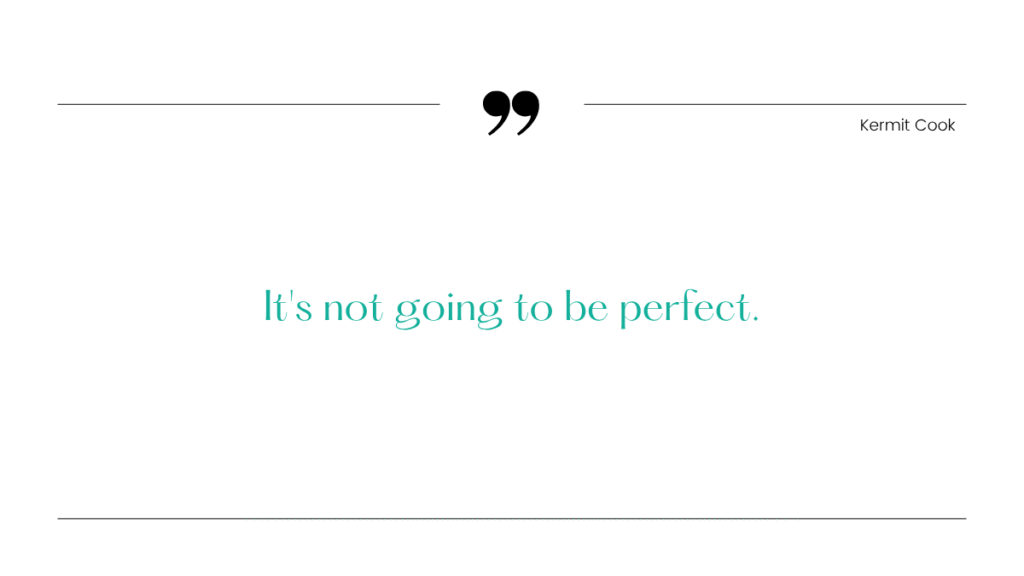
  4. and then learn. You’re going to screw stuff up along the way. It’s not going to be perfect. Pull up on a regular basis and create that as a real mechanism for the organization that people are comfortable with screwing up as long as you learn from it and share it broadly.

Liz: The big, hairy, audacious goal needs a really clear story around it. I would assume in your comment on culture, you’re putting clear communication and trust in culture.

Kermit: Yes.

Liz: Because that’s what makes the culture.

Kermit: You absolutely need clear communication and trust. 

A BHAG asks, ‘Wait, what if we actually could?’ It’s an audacious dream that refuses to be reasonable. When John F. Kennedy declared we’d put a man on the moon, he wasn’t just setting a target—he was issuing an invitation to reimagine what was possible. The beauty of a BHAG isn’t in its achievability but in its power to pull people beyond incremental thinking into transformational action. But to understand the vision of the BHAG, you have to know the context and respect the history of the organization.

Kermit: So Penn Foster was founded in 1890 as a correspondence course for coal miners to help them get more safe jobs. Primarily serving immigrants in the Scranton, Pennsylvania, area. And I tell you, when I go to Scranton, it feels a lot like Wheeling. The mission …even today, while we’re now online and reaching many more people… is still fundamentally the same. It’s helping people who are in positions where the traditional system isn’t really built for them get to better jobs. And so we will enroll roughly 260,000 students this year. We’re an accredited high school and career-focused college.

Liz: What’s the big hairy audacious goal? 

Kermit: The big hairy audacious goal, we graduated 70,000 students in 2023. We’re going to graduate 150,000 by 2029. And we’re not going to do it by enrolling more students. We’re going to do it by improving the outcomes for the students who are already enrolled. Our goal really comes down to doubling our completion rates within five years. It would get us to a roughly 60% completion rate, which is on par with two and four year schools across the country as a fully asynchronous program, serving learners with some of the circumstances that are most challenging to continue to progress in their learning. That’s the BHAG.

All of these students who’ve never realized, ‘Hey, failure is how you learn.’ They’ve internalized failure means I can’t do it. That’s probably the biggest challenge we have in getting people through.

Liz: Give me a tangible example of what support you now give to students or you plan to give to students.

Kermit: A tangible example that is both the support, but also just actually giving a great learning experience. Our vet tech program … in the first semester, you have to pass biology… our 90-day completion rate for that biology course was 8%. Imagine most of our learners are working parents, working one or two jobs, minimum wage, squeezing it in, studying at night. You get to the sixth course for a four semester program, and three months later, you’re still stuck in it. How long are you going to stay? You’re going to quit. 

We basically had taken a college-level biology textbook, put it online, attached some assignments and essays and writing assignments that had nothing to do specifically with vet tech because the organization was using biology across a few different programs. They just used that same course and said, ‘Good luck. Here you go. Here’s your biology text.’ 

Kermit: So no wonder. We redesigned that course to be vet tech-specific. You’re not spending time writing essays about the Krebs cycle…with that new biology course… we launched it. Big surprise. You go from a completion rate of 8% to 62% within the first few months. And then our team keeps working on it and refining it, and seeing where people get stuck.

From a culture perspective, one of the principles we spend a lot of time talking about is discovery – don’t think you know what the right answer is. Go put it in front of learners, see how they engage and learn! Learn from that and then continue to refine. So our learning design team now has a principle. Instead of, oh, we’re going to update a course, we’ll put it out there. And then in five years, when re-accreditation comes up, we’ll revisit it and see how it’s working. We put a course out, and with the data that we have, we can watch how students are engaging… Where are they getting stuck in the process? Where do we need to add proactive support rather than waiting for them to call us?

Liz: And that’s part of the beauty of this asynchronous learning, because you literally know compared to… I had no idea what you were going through when I put a blue book in front of you.

Did I mention Kermit was in my Junior English class? I loved watching a student come alive with ideas during an in-class essay. Blue books carried the weight of everything my students poured onto those pages in some allotted time. Each one was a window into a mind at work—unfiltered, unrehearsed, smudged, at times illegible and always authentically human. I knew which students had truly grappled with the material and which ones were bullshitting their way through unprepared territory. AI will give us insights into the data – the content that stumped the argument – the patterns of sentence structures… but will it match the confidence, hope, support and resilience swirling in the air as it did when Kermit sat in my classroom? Will an AI tutor session feel like it did at 7:00 a.m. in Denny’s classroom?

Kermit: We’re now using AI agents that can reach out and say, ‘Hey, Liz, I see you submitted your English essay, and it didn’t pass. Would you like to set up-time with one of our writing coaches?’

Liz: Is the writing coach a human? 

Kermit: Yes. 

Liz: Okay. But it could be…

Kermit: Well, we actually now have just partnered with a company called Learnosity to build an AI writing tutor to do scaffolding. What’s most amazing is how we see learners engage with it. I saw one learner, well I saw the transcript, one learner literally put in, ‘Are you really an AI?’ And he said, ‘Yes, I’m an AI, Powered by Penn Foster.’ He’s like, ‘Okay, because I’m really nervous about writing. And I always failed in school. I’m not sure how I’m going to do with this.’ And then it’s like, ‘Okay, well, let’s just get started. What’s on your mind?’ And so that they have a chance in a very low stakes way to throw things out there and not feel judged.

Did you catch it? Kermit referred to the AI as he and then it. A brave new world indeed.

Liz: Interesting, that piece of, are you AI? Because I don’t want to be judged by a human.

Kermit: A hundred percent. That’s very true.

And this goes back to your point of talking with some of the learners. I call half a dozen learners every month who graduated to say congrats and talk about their experience. We just had an in-person graduation in Atlanta. Every chance I get, I try to talk with learners. One of the things I took away is, “Man, I got to that writing assignment, and I haven’t written anything that didn’t have an emoji in it in five years.”

Most of the students we are serving hit a wall in the traditional classroom, so they have learned that they can’t do it.

Liz: There wasn’t a Denny to grab them and put them in front of him at 07: 00 AM. It was just an F.

AI will never replace Denny Hon, but isn’t this a powerful use of it? I’m impressed not only by Kermit’s work for students, but his honesty about what’s missing.

Liz: My only question is, are you paying attention to the fact that I would guess you have a large percentage of students with an undiagnosed or diagnosed learning difference?

Kermit: No, we do a terrible job of it today. Absolutely terrible.  And we do want to work on it. It’s very front of mind, but it’s like we’re getting a foundation right. That’s next. 

Penn Foster is a for-profit education company. That means it needs to make a profit while serving the mission of educating under-served students. 

Kermit: Because Penn Foster’s financial model is a pay-as-you-go model. 90% of our students enroll for $20 and pay effectively $50 a course as they progress. And if they drop out, they stop paying.

Dropping out hurts mission and profit. Kermit, the teacher and coach at heart, isn’t going to quit on one of his students any more than Denny Hon did…even if there are 80,000 of them. To prepare for that,

Kermit: I went online. I read every student review I could. I enrolled in high school in medical billing and coding and in elementary education. And I said to myself, ‘Holy cow, there is so much we can do better. There is so much we can do to improve the experience for these learners.’ But at the same time, I saw videos of students who are holding up their credential saying, I’ve got this job as a pharmacy tech because I went through this program, I never thought I would be here.’ And so I knew there was this goodness underneath. And it’s just if we could get the culture of the organization focused on outcomes, where we could go.

He became a student of his school. To all my friends and colleagues who are in school leadership, I ask, have you done that? I hadn’t…yet.

Kermit: When I kicked off my presentation to the board of Penn Foster as part of the recruiting process, I started with, first thing you need to know: I’m a teacher and a coach at heart. And so this is not going to be a presentation. This is going to be a class discussion. 

And everyday is yet another class discussion – a discovery of what the students need. Every day is a reimaging of the traditional educational system where students learn that failure is just part of the process of learning. Where students don’t survive school, but find pathways to their passions… like aviation engineering.  And that leaves us…

Kermit: …where we started with Keith becoming an airplane mechanic.

Keith and Kermit are still connected today and I would dare to say Keith has taught Kermit a thing or two about learning, about constraints, about creative engineering, about an innovative model for education. The teacher became the student… and 80,000…soon to be 150,000… other students are benefitting every single year.

My best teachers —whether in classrooms, boardrooms, across my dinner table or just walking next to me —share one unmistakable quality. They approach each day as if they’re still figuring it out. It is a courageous “beginner’s mind”—a state of wonder to ask questions – to learn and to help others learn.  

Indeed there is more to learn. Maybe 50 walks wasn’t quite enough.


Liz Hofreuter

Founder GEN-Ed

Not your typical researcher or consultant, Liz connects lived experience to transformative leadership. To uncomplicate leadership and education, every story matters and she is just getting started.
Lessons from the Bow Ball

“Ready All.” 

All eight flexed at the catch, blades squared and almost buried by water. The slide compressed, knees bent, bodies coiled. Eyes locked on the shoulder of the teammate in front of you – save the stroke whose eyes are locked with the coxswain. 

“Row.” 

Eight oarswomen simultaneously lock onto their riggers as legs explode against footboards—legs, back, then arms. The shell, initially dead in the water, lurches forward. At the finish of the first stroke, blades feather cleanly emerging from the spring water in unison, hands dropping away as bodies slide forward for the second stroke. A process that will be painfully repeated for six minutes without recovery.

As the coxswain, I feel the boat respond —that initial jerk gives way to flight as the hull begins to run between strokes, the bow cutting through the water as momentum builds stroke by stroke. When the oars catch precisely as one, the boat lifts and seems to fly on top of the water. It is transcendent to experience the propulsion of such collective power. To increase hull speed, the race plan calls for a power ten at the 500 meter mark of this 2000 meter race. As if not already giving everything they have trained for since September, the rowers are asked to dig deeper for ten strokes. 

“Power ten in two. One. Two.” 

And we lift out of the water as if beginning again.

To sustain the effort, knowing full well the competition can hear my voice, I look across the lanes and begin naming the seats in the opponent’s boat. 

“I’m even with the seven seat and climbing.”  

“I’m walking through their engine room.” 

The collective power moves us through the seats of other boats like climbing rungs on a ladder. 

“Yes,” I scream with a guttural echo that now makes my dog cower.  

Then, I nod, cock up the left eyebrow and smile slyly at the stroke, who is doing her best to control the stroke rate as the power surges at her back. I turn my neck just enough to ascertain I no longer sit across from a rower, but am almost equal to the bow of the closest competitor. 

“Bow ball!” 

We have taken the lead by a boat length. Thoroughbreds a full length across the finish line at the derby. “Bow ball” connotes our race plan, our collective effort is working. 

Jane: When I look back at it, just the willingness to be disciplined, so disciplined, especially at that age, and then achieve really great things and surprising things, I can always lean back on that. Because life does, as we just said, life does life, and there are challenging times. I remember that because we rowed and because we committed to something so completely, and we achieved great things, anything is possible.

Liz: And there has to be trust. When I think about the fact that you, as a rower, can’t even see where you’re going, it blows my mind. We don’t ask many athletes to perform backwards.

Jane: Backwards, tied in, like literally injured if you stop. You can be thrown from the boat.

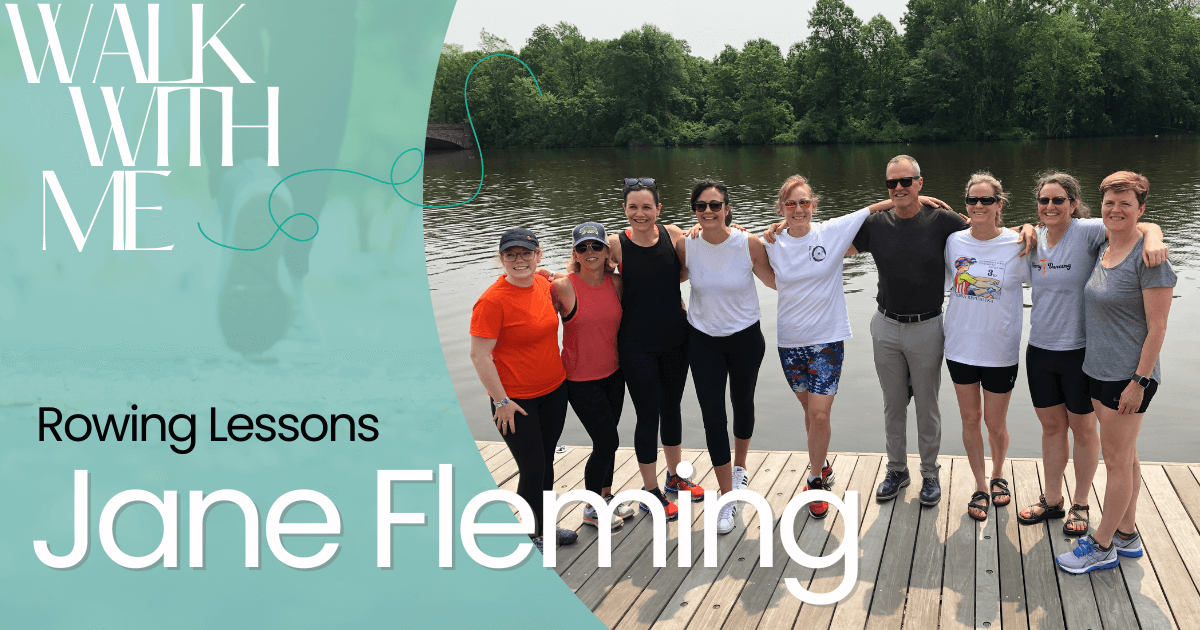
Jane Fleming was the third seat in that boat I was coxing. While we were only teammates for four years, we lived a lifetime in that boathouse and on the water of Lake Carnegie.

In 1904, Princeton University President Woodrow Wilson was courting steel magnate and philanthropist Andrew Carnegie for a major donation to support academic programs—specifically hoping for funding of a law school. His tour of Old Nassau took a turn when Carnegie announced, “I know exactly what Princeton needs, and I intend to give it to her.” Carnegie told the surprised Wilson, “It is a lake.” The cooperative effort of Rowing, Carnegie hoped, would provide a better model for global relations. I tend to think he was correct, but of course I am biased. That lake attracted a different type of person. 

Jane: It was in us. I know you enough to know that you like to win, and you like the challenge of trying to figure out how to win. And I think I’m the same way. My competitive edge has softened as I’ve gotten older, but I think that I like to be excellent, and I like to push myself into new experiences. I think that rowing, of all things, was always a new experience because you were never physically or mentally the same every day, and yet you were being asked to achieve at the same level every day.

Liz: And add to that the weather. We rowed in some conditions that there shouldn’t have been a race.

Jane: Absolutely.

Liz: Including the one when we won the national championship.

Jane: Yeah, I’m convinced it’s because we were allowed to eat.

Liz: But you know what? That’s selling ourselves short. That’s not right.

Jane: Talk about that experience. That was a choice. We did not need to row that race. A bunch of us got together because we all wanted to challenge ourselves. For me, at 6 foot, dropping to weight was no easy task. But I think there was just something so fun about trying to achieve a national championship. I must say it’s one of the greatest bragging rights ever.

Liz: I couldn’t agree more.

Jane: Achievement is wonderful for everything we’re talking about. It’s the work put in. It’s about mission accomplished,  working as part of a team to do something. But then you get it, and it’s great, and it goes into a bragging somewhere in the past. But really in and of itself, it isn’t a thing.

Liz: There was agency, there was confidence, there was collective risk-taking, and then a dedication of time because we were done.

Jane: It’s time and choice, and choice at a time when all of our peers were wrapping up and celebrating and partying and doing all the things that college kids do, we decided to go left when everybody was going right.

Walk With Me - Liz Hofreuter and rowing crew

Our small crew made a different choice—while everyone else was sleeping off another night of beer pong, we were up at dawn, lacing feet into a shell, chasing something that made no sense to anyone else. There’s something intoxicating about being part of this small band of the obsessed, this little group that’s willing to sacrifice reunions for something bigger, something that most people will never understand until the day we crossed that finish line first. A crazy left turn away from ordinary paid off and ruminates in your mind as you face every choice thereafter.

Jane: But I think life is choices, right? I think our life is a result of the collective choices we’ve made, good or bad. I think that the willingness to, when they’re bad choices, to remedy is the stuff that makes a satisfying life, at least.

At 37 or something, I said to myself,  I’m good with making mistakes. I just don’t want to make the same mistakes. 

Liz: I love that. Fail forward.

Jane: Fail forward because making the same mistakes over and over again at some point, I think it does crush the spirit. 

Liz: Right. I had a lot of good friends say, You can’t change what happened. So go back and decide how you chose the people you did that with. So you make good choices of who you’re going to go right with when everybody else is going left. So that you don’t follow the wrong people or have the wrong people follow you. I’ve always thought about making choices and wanting a team. 

Jane: So interesting you talk about that because my business partner and I talk about that all the time, that success is 99% picking the right people. Because the other thing I was thinking about how rowing resonated for me is that it was a really wonderful lesson in being part of something rather than the something. And I think that I have a big ego. I think we all do. And my whole life has been about eviscerating that and realizing that all I can do is be part of a team. Another wise woman always says, I just want to be another bozo on the bus.

That brings me to the most salient memory I have of crew. It’s not the adrenaline rush of walking through Radcliffe to their bow ball.  It’s not the exhausted collapse looking up into the sky after crossing the finish line first. It’s not being pulled from the icy waters of the Connecticut River after beating Dartmouth. It’s hearing Curtis Jordan’s voice emanating from the megaphone, “Pull the boats together.”

Liz: The other piece that I think is humbling in a way that I don’t know any other sport has is when you pull the boats together and switch a single person and head race again. 

As coxswains we ease our shells alongside each other in the middle of the lake, oars lifted on the near side and stabilizing against the water on the other. Rowers reach for the oar of the corresponding seat and pull the two shells together as one. 

“Hands on.” 

Oarswomen reach across and hold the gunnel of the other boat. And then we collectively wait to hear what pair is unlacing and trading seats in a feat of balance and grace while your heart beats out of your chest across the fragile shells. Your eight had just won a head-to-head race. If he switches you, just you, will it change the outcome?

Jane: Always. Because I was never the strongest, and I was never the lightest. So it was one of those positions where I was a combo player. So I got switched a lot so that Curtis could figure out what the combination of human beings would work the best. I loved those. I loved that. I did. There was something about the truth of it that I really appreciated. I really appreciated that there was a purity in it. We’re going to switch one person and we’re going to see. Because I also realized that even though it was me being switched, it wasn’t just my job. All I could do is do my best and hope I work well with the teammates that I was rowing with. 

I was coxing the JV boat. Our captain was coxing the Varsity eight. We had just lost a head race by a seat. Someone was about to be tested. Some change was coming. The anticipation hung in the air. Curtis instructed, “Switch the coxswains.” All 18 heads lifted, 36 eyes turned toward his launch in amazement. The coxswains?

Liz: I can tell you, I was switched. I did a head race, which was not typical, and that’s how I landed in the varsity boat. Curtis pulled us together, and you never knew who he was going to switch until you were pulled together. And I got in that boat.

You know how you crunch down? Well, as a coxswain, you crunch into the smallest ball, right? 

As we pushed away from the other boat, I found myself looking straight into the eyes of Sarah Horn, varsity stroke.

Liz: I remember it just being eye to eye as if we were little kids in a blanket fort, and I had to have been as doughy-eyed as possible. And she said, “Get us there. We’ll get you there.” 

You know when you wish you could fill someone with all the confidence you have in them. You want to instill in them the mountain of faith that they might be questioning.

Liz: That’s what she was doing. She was giving me all her confidence. And, man, I remember we won. And I remember you were in that JV boat and I was looking over and thinking, ‘No, I don’t want to lose them. I like them.’ I liked being the underdog. I liked being the JV coxswain. I didn’t want to switch up, but I got called and I had to go.

Jane: What a lesson, right? To step up into what you’re supposed to do. We all have things we’re excellent at and things we are mediocre at. I’ve always thought that it’s a bit of a shame when people walk away from what they’re excellent at.

Liz: Mmm. Ouch. That lands hard. Because I was a good head of school, and I did walk away. It’s been a rough year of, at times, thinking, did I leave too soon? But I really did feel that same calling for, there’s something else I’m supposed to be doing now.

Jane: Well, I guess, what I’m talking about is not necessarily the actual task, but the spirit of what somebody is supposed to be doing on this planet. And you’re still teaching, and you’re still showing up in a form of education and showing up for yourself. And I think all of that’s so invaluable.

I think we’ve all achieved great things. We’ve been, I hope, in service to the world in a way that’s positive. All we can do is to pick ourselves up every day and show up and let life happen and show up in ways that are positive. I know that that sounds trite, but actually… For all the thinking and all the words and all the philosophies, I do think showing up is probably nine tenths of it.

Liz: I don’t think it’s trite in this day and age. To show up positively, that’s a big calling.

Jane: So I believe if I walk out the door and participate in life and participate in the world, things get shown to me. And opportunities come up to be positive, to affect people.

Liz: What’s an example that is salient to you right now of an opportunity that showed up for you?

Jane: I think it’s really interesting. I just finished this Disney Kids project. Zombies 4. And it showed up in the middle of the strike.

Oh right, I should tell you that Jane Fleming is a founding partner, executive and producer at Court Five Productions which develops and converts diverse intellectual property into filmed entertainment. Previously, she was a senior executive at New Line Cinema, ultimately holding the position of Senior Vice President, Business Development. Since that time she has been a prolific producer of independent films with her partner Mark Ordesky including the EMMY-winning Disney+ series, “THE QUEST.”

Jane: We had developed a relationship with the team over at Disney, and they had called and said, ‘Would you ever do this kid’s franchise?’ And if you watch it, it’s a really fun integration story for kids, but it’s for kids 8 to 12. And my business partner did Lord of the Rings. So we sat there and we looked at it and we were like, ‘You know what? For this thing, it’s the best in class. It’s really good at what it does.’ And so, of course, we’ll say yes. And honestly, it was one of the best jobs we’ve ever had.

Liz: Really? Say more.

Jane: It was, again, a really great team. And we were finding young talent, 14 and 16-year-olds, who got to step into themselves in such a spectacular killer way. We got to set the table for all of that to happen and then to support them all the way through this process. It’s been just so gratifying to watch young people step into something pretty extraordinary.

I really love what I do because there’s this moment that happens when you’re about two weeks before production and you walk around all the different departments and everybody is doing the most amazing work all in service of this one end goal. And it’s just electric because as a producer, you’ve played a pretty big role in hiring them and getting them there, putting them together. And they’re having joy as they work towards something that somebody dreamt up and wrote down. That’s amazing. So for the kids, it’s especially salient because the excitement is so infectious. Many of them, it was their first big movie for Disney. It was just joyous. It was a musical, which, come on.

It’s doing gangbuster business. I’m nervous right now, but again, it’s like winning the national championship. It’s great. You get a little charge off of it, right? It’s great bragging rights, but it doesn’t necessarily make the quality of your life better. What makes the quality of our life better is the opportunity to keep doing what we love, the opportunity to connect with old friends like we’re doing right now. 

Jane: I have to say, I’ll do this on the record, on the recording, you are one of those really special people in my life who I never see. But it’s so funny. I was thinking how naturally, I didn’t ask you what you were going to talk about. I was like, ‘No, I trust Liz. We got it.’ And even though we haven’t talked in, I don’t know, two years, three years. It’s just like yesterday.

Liz: Or really talked in 35 years.

Jane: Well, that’s the truth there, which is pathetic because I adore you and I really respect you and I’m inspired by you, honestly.

Liz: I have to tell you, when I was leaving the independent school and I wasn’t going to be starting an EdTech software for learning differences, I was really trying to figure out, where do I go? Who do I reach out to? And immediately, the muse, the universe, whatever, put your name in my mind. You have to talk to her. And I didn’t know why. Here is a connection you have put down in your life that you need to pick back up. And it’s inexplicable why some people are like that in our lives.

Jane: I know. It’s just if you quiet down enough to listen and you go with the flow like we did with rowing, we start flying. You start flying.

And in the boat when you find the rhythm that looks effortless from the shore, you fly. Just beyond the bow ball is open water. That’s the true moment of flight when the coxswain proclaims, “Open Water.” Now there is space between one boat and another. Our boats started even and now there is open water between the stern of our boat and the bow of theirs.

The call “open water” doesn’t mean you can relax. We have this race won. Instead, “open water” translates into the next step – reach farther, stay together, push harder – but with open water it no longer feels punishing on the body – it is exhilarating. It is flying.  It is no longer about the competition and where they are in relation to us. It is just the nine of us. It is intoxicating. Just as open water inspires, it demands more. And with these people on this race day, there is inexplicably so much more to give.

Jane: And as you said, when it works, I don’t know if anybody can describe that feeling. I know a lot of writers have, I think, tried to do so, but I don’t think anybody’s actually ever achieved it because it’s one of those transcendent moments that you can’t really describe to anybody.

It was never about the win. It was always about being part of something bigger than ourselves. 

In the years that followed, I have quietly carried the truth of that palpable anxiety of proving my worth head to head, and that tangible ecstasy of the whole being greater than the sum of its parts. 

Everything I needed to know about leadership and life, I learned in the back of a boat with a microphone strapped to my sweatband. 

“Let it run.”


Liz Hofreuter

Founder GEN-Ed

Not your typical researcher or consultant, Liz connects lived experience to transformative leadership. To uncomplicate leadership and education, every story matters and she is just getting started.

Lead with Laughter

I love to laugh…even more than I like to make people laugh. Laughter is quite literally medicine for both our minds and bodies. When we laugh, our brains release a cocktail of feel-good chemicals while our hearts beat faster and our core contracts, boosting our immune system and lowering stress hormones. But perhaps most importantly, laughter connects us. We remember our capacity to find joy…simply by letting ourselves be delighted by the world around us.

Liz:The most distinctive thing about you to me is your laugh. It just brings me joy. I mean, I’m glad I now have it recorded so I can just have it on repeat when I want it. Are you as happy as you seem?

James: You know what? I am. I really am. I rarely have a bad day. I think that’s also one of the reasons why I love working at a school because you can find reasons to laugh and to have joy. 

I always used to say that I had the best job in the world. Even on my very worst days I could go hula hoop badly with a group of preschoolers and laughter would win the moment.

James: I joke a lot with my team. You will hear me coming because I am probably laughing or joking around or doing those kinds of things. I don’t take myself too seriously, and I don’t think that even on the toughest of days, that it has to be so serious where you can’t find laughter. I remember Geoff Campbell had this incredible belly laugh. We’d get in meetings and we’d start laughing. And we would say, it’s like an instant vacation. Because it is that thing that just completely takes away whatever the space is around you, and you’re consumed by this overwhelming feeling of joy. 

I am a genuinely happy person. I really am. I think part of that is just, who wants to be around someone who’s not. If I’m being honest, I don’t. And in positions where I’ve been, I think that also puts people at ease. If I’m laughing and having fun, I think it makes people feel like they can, too. And that’s part of the work. The work is hard enough. We have enough pieces that we’re always monitoring and trying to deal with. So why not be able to have a little fun?

Liz: I think it’s a mistake in this job to take yourself too seriously.

James: Oh, yeah. No question about that.

James Calleroz White is a Head of School. Indeed he is leading the Dwight-Englewood School, his third headship at an independent school. I met up with him on only his third day of school there. As my Uber drove away, I stood on the sidewalk, bags in hand, and stared in disbelief at my worst nightmare – no less than a fleet of emergency vehicles. My heart fell to the concrete beneath my feet. There was an eerie silence that hung in the air that was broken only by the distant and distinct sound of James’ laugh. I didn’t know there had been a single car accident on campus. I didn’t know no one was hurt. My mind raced to the worst possible scenario, but I was lifted straight out of that narrative by the strong, infectious laughter of my friend. I knew everything was ok. That’s what his laughter does. It transports you. And if you laugh with him, you do find yourself on an instant vacation.

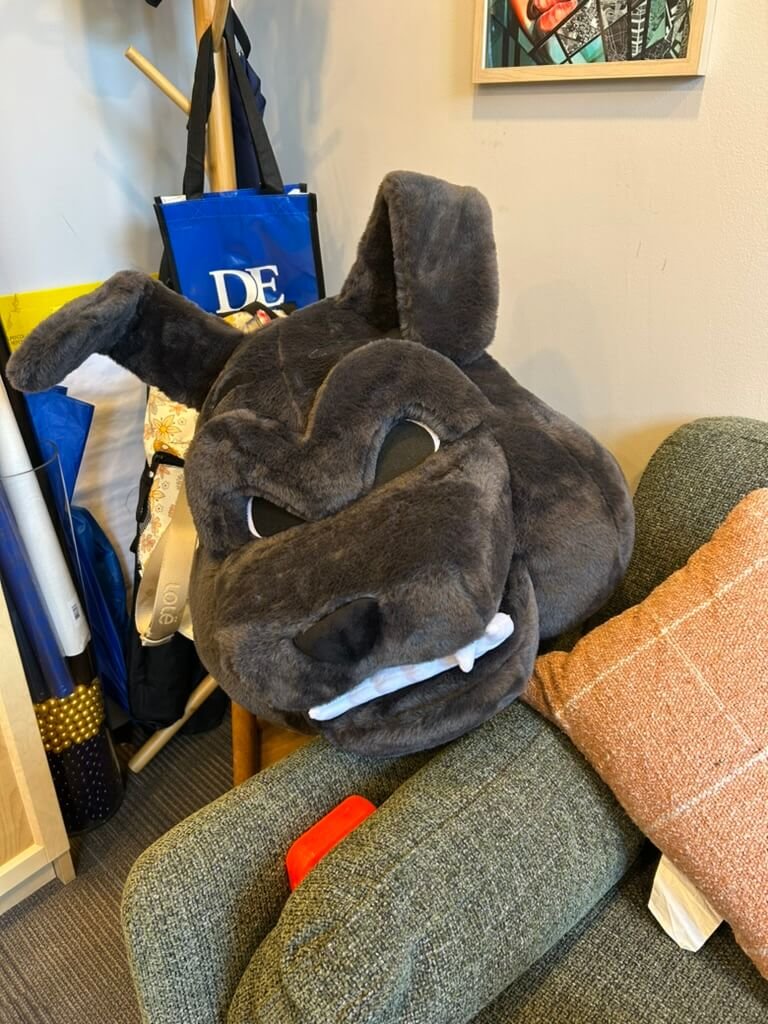
I waited for him in his office sitting next to the orphaned head of DE’s mascot stirring a mix of whimsy and melancholy to observe it divorced from its body and its purpose. I thought to myself, “James wears that,” and indeed he does. Of course I heard him coming long before I saw him, but when I saw him, I rose to greet him and we hugged – an unhurried embrace, a brief pocket of familiarity in the midst of it all. Our hug held a pause – a stillness where everything felt momentarily suspended and peaceful. Nothing external had changed, but everything settled with an old friend just being there solely for the Head of School – it is unfortunate how rare that unconditional support is for a school leader.

Liz: To the guy who doesn’t take it too seriously, who likes to laugh, talk to me about what COVID did to that.

James: It was horrible. It was probably, for me, one of the worst experiences because you didn’t feel like you could laugh. And when you did laugh, you had a mask on. It made me go from relationships to simply tasks.  I’m a person who believes in relationships. This idea of connection. When you talk about laughter, laughter is connection. You talk about being with people. Those are the connective tissues. When COVID happened, it immediately became about tasks: making sure you wear a mask, making sure you stay six feet apart, making sure the classrooms are sanitized. 

I write like I talk – it’s who I am, right? So I write from a heart space a lot of the time. And when I look back on all the communications, none of that was there. It was all about blue days, red days… so for someone who finds so much joy, it was really difficult.

James: Probably one of the hardest things was when I actually had to get the faculty on a Zoom call to tell them that we were coming back in person. And it was the first time in my life that I felt I was letting people down. Because I knew how scared they were. While I don’t know that I was scared, I knew how much I couldn’t control.

Liz: We were living a science experiment.

James: We absolutely were. 

Faculty members said to me, ‘How are you going to feel when one of us dies?’ And so when you live in a world of joy, that’s not a lot of joy that comes in those conversations. For me, It was probably the first time that I can remember, really, that I felt it was personal. And I felt it even though I knew it wasn’t, because most of the time, I joke and say, ‘Hey, they’re not mad at James. They’re mad at the head of school.’ But this was one of those where I was like, ‘No, it’s James. It’s not the head of school. It’s James.’ And in my heart, I knew that wasn’t true. But for the first time, I really felt that.

It is palpable. I do not know a Head of School who does not have a core memory from the pandemic. My first one was being the last person on campus on Friday, March 13, 2020. I stood in the office looking out of the back window where there were normally children digging in the dirt accompanied by the soundtrack of laughter that would please James. What I saw were empty buildings, and I thought, “This is it. I will be the Head of School when Country Day ceases to exist.” As if transforming in a film montage sequence in front of me, the buildings began to look abandoned, the weeds higher, the rocks of the amphitheater cracked… like the dystopia of an unused wooden roller coaster decaying in an abandoned amusement park, my school, my alma mater would not survive this pandemic…and I would be the one to navigate its closure. It was all so real to me even though none of it came to pass. 

While the promised two-week closure turned into three months, I woke up everyday ready for the unexpected… ready to pivot… ready to care for every single family in our community. In times of crisis, there is one decision maker, one voice, one face and it was mine… just like it was every other heads’.

Liz: How did you take care of yourself?

James: Not well. I didn’t sleep much. I don’t sleep a lot anyway, but I didn’t sleep much. The relationships that I had with my wife, it was really strained. Because I held on to so much, and I felt like I shouldn’t burden others. And what that did is that created a combustion of sorts that had nowhere to go. Health-wise, probably one of the worst spaces I’ve been in. You think like, Oh, you have all this time. You can be outside. No, that was not the case. And so that was really difficult … tough.

Listen, I think that from a trauma perspective, I don’t know that any of us will truly ever really realize, at least in our lifetime, how much it impacted us.

We did the best in terms of what happened during COVID. School heads, public, private, and so forth, we did more to save this country than I think anyone will ever, ever give us credit for. 

Liz: I couldn’t agree more. And yet, we were not trained to do it. 

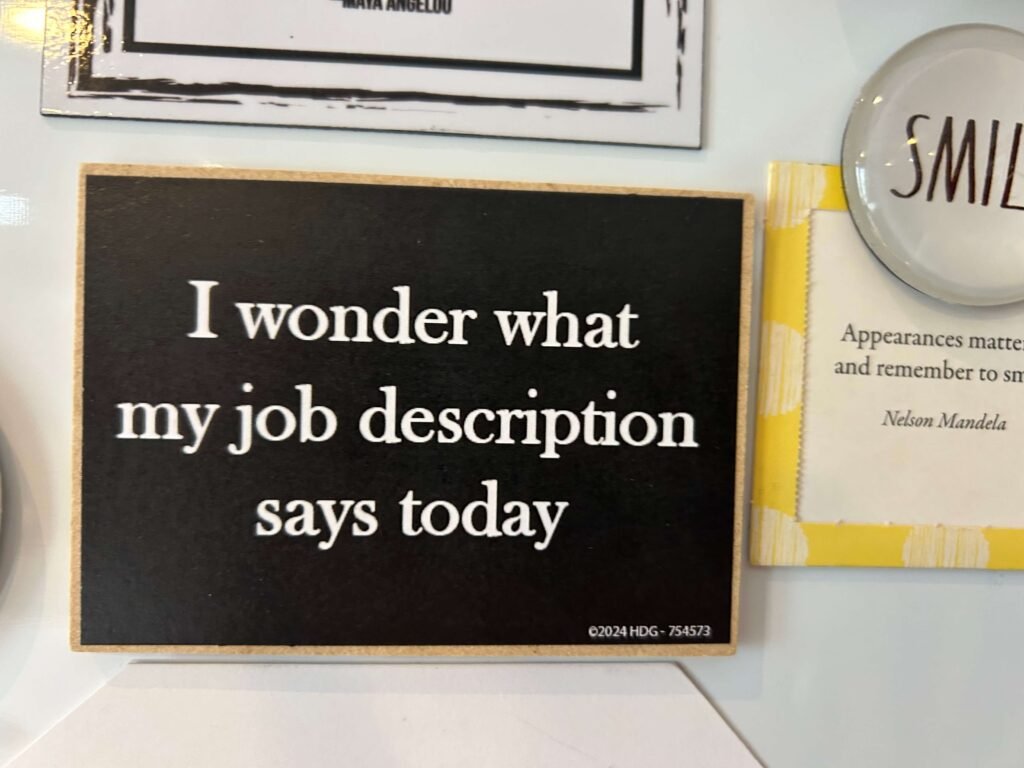
James: Listen, this was not in the manual. Not in the manual. Not in the job description. Oh, my goodness.

Liz: So many things not in the job description.

Jack of all trades. In the moments before we met up in his office, James had been a first-responder, a mechanic, a therapist, an advisor, a trusted friend. During COVID we were scientists, researchers, public health officials, and so on..

Liz: The other thing we know as heads of school is you can’t be all things to all people.

James: But they want us to be. I tell my team all the time, my job is like the Wizard in the Wizard of Oz. 

Liz: But no curtain. 

James: But no curtain, right? It is an illusion. 

Liz: Why is it an illusion? 

James: Because I can’t be in every classroom. I can’t be in every meeting. I can’t be in all spaces on my campus, right? So I have the power to change and to curate and to do but I have to trust so highly the people around me.

Liz: And they have to trust you. 

James: That is correct. 

Liz: How do you build that trust?

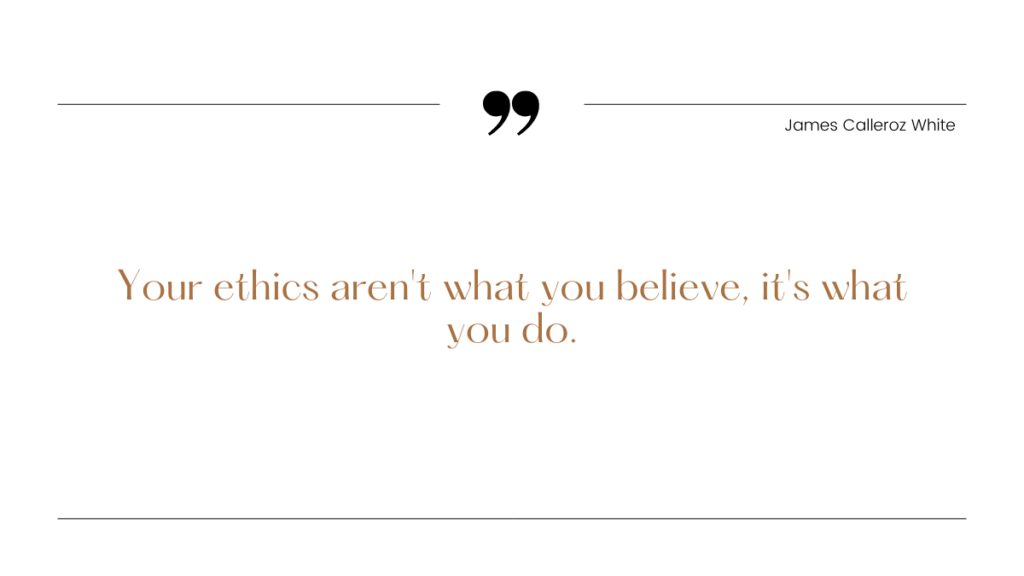
James: I think the first piece is, if you say you’re going to do it, do it. Your ethics aren’t what you believe, it’s what you do. And I think trust is not just what I say, it is what I do. I think I also build trust by supporting them. Sometimes even when they’re wrong, we can have those conversations after the fact.

You know how this works, right? We can say things like, ‘That can’t happen again.’ But in the moment, ‘Hey, I’m not going to let anybody come at you.’ My job is to protect as well. And I think that those are the moments that build trust. That is key. 

I think the biggest compliment that I can give my team, and I’ve said to them,  ‘You make me not worry.’ And I’m like, When I’m not worried about whether you are doing your job or whether the fence is painted or the grass is cut or the kids are… When I don’t have to worry about that, I actually have the bandwidth and the space to actually do my job. 

I’ve been a head for now 13 years, which is crazy to me and this was not the job that I ever aspired to be, but I have just a new profound respect for the job… just the ever-changing nature. I hope that ultimately, what is defining in terms of the work that I’ve done is just that I worked hard for the schools, the places, and the people.

James: COVID made me recognize really quickly, and I always known this, but really front and center, how precious life is, how vulnerable these spaces are that we curate. 

Liz: I think heads are still just now in 2025 realizing I’m tired. I need a change. I’m exhausted. I can’t do this anymore. What would good support for you have looked like or look like now?

James: It’s so hard to answer that because I don’t actually know, if I’m being honest. I know that there were times when I was really mad because no one ever asked me how I was doing. And I didn’t want them to ask me because I needed them to do something. I just wanted them to ask me because they were thinking it. And then I had people afterwards say things like, Oh, I really wanted to reach out. And they never did. And so what I would say is, Listen, if you are a parent, if you are a faculty member, if you are a board member, if you are thinking that somebody just needs you to ask them how they’re doing, just ask them. They may not need it. But I will tell you, the gesture goes a freaking long way.

And sometimes it is a hug….or a phone call. 

James: When I lived further from the schools that I worked in, I was a much better friend because I had time in the car to call people. And I would use that time in the car to call all my friends, high school friends, college friends, just people, colleagues, and whatnot. And so I realized that as I moved up the ranks to become a head, I actually started moving closer and closer to the schools I worked at…

Liz: So I’m never going to hear from you now that you live on campus.

James: No, that is so… Shush.

I lived on campus for six years. For me it was exhilarating to belong to an instant community but created a particular kind of exhaustion. Student crises had a way to seep through the walls with no physical boundary between who you are and what you do. I remember a young girl waking me from a dead sleep to ask me with tears in her eyes to rub her back as she fell back to sleep following the aftermath of a breakup from tumultuous teenage love. Callously, I told her if you lean up against the door jam just right and squirm a bit, it feels like a good back rub. As I shut the door and turned back toward my bedroom in the dark apartment, I knew I had changed. It was time to find a new home. I needed a space where I could simply be human—messy, uncertain, private, real. I needed a kitchen where I could burn dinner without it being student gossip, a front yard where I could water plants without it turning into a parent conversation, or lie in the sun without being shot with a bb bullet… a Saturday where you can exist without being prodded to attend an on-campus football game. But I’ll tell you for years I also missed that irreplaceable feeling of being woven so completely into the fabric of a place that your heartbeat matched its rhythm—the profound belonging that comes from being not just part of a community, but truly home within it and with the people who became my family.

Our homes and in turn our classrooms and offices are extensions of who we are as we curate those spaces.

Liz: Tell me about getting that whiteboard ready when you got here.

James: So you will laugh. When I got here, this office didn’t look anything like this. The wood paneling, older furniture, it made it look like a cigar lounge. I wanted it to be lighter. I wanted it to feel like people could come in here and be welcomed. And also, as a head of school, a lot of the conversations we have, they’re heated, right? So when you walk in this space, it automatically de-escalates. It brings people’s energy down almost immediately. And that’s on purpose. 

His office personifies James. It is colorful and full of joy. Every piece tells a story. From the Star Wars glass figurines that remind James we are not alone to the quotes that inspire him every morning.

James: One of the things that I’ve done pretty much every day since I started this is I come in and I find something on there every morning. And that speaks to me.

What’s speaking to you? 

Liz: Well, first of all, the You can’t pour from an empty cup speaks to me because I feel like that’s head of school stuff. 

James: What speaks to you right now might not speak to you tomorrow or last week.

Liz: I would be remiss if I didn’t ask, how does being a neurodivergent learner yourself impact the way you lead a school? 

James: I am dyslexic. I am probably a little OCD, and I am definitely ADHD. For me, I have to remind myself that I’m that because it’s normalized for me. I don’t know any different. And so what I’ve come to realize is that I have to be much more mindful of helping people know what I’m thinking because I don’t think linearly. People think about what’s coming down the hallway and my mind is, ‘What’s around the corner?’ I’m already looking around the corner. 

And so my team sometimes doesn’t see it the way I do. I’ve gotten to this place now where I will say to my team, ‘If you don’t see where I’m going, you just have to ask me. If you ask me, I can walk you through.’ 

It’s just how I think. So when I walk the halls, when I walk around, the thing that they notice really quickly about me is that I notice everything. I see everything. I hear everything. And I notice small things. I notice big things.

Liz: So you’ve made it a superpower.

James: It’s always been a superpower, right?

For many, many years, those of us who had this superpower, we were told that we had a deficiency. We weren’t told that we had a superpower. We weren’t encouraged to use it. We didn’t necessarily have people around us who knew how to help us use it. It’s like when Superman realized he’s Superman, it took him a while to figure out all the things. I think that there’s a lot to be said in terms of the work that we need to do in schools, that it’s not just work for those who are neurodivergent it

is great work for all kids. If it’s working in one group, we should at least ask ourselves the question, ‘Can it work in another one?’ And we don’t take time to do that.

Liz: And that goes right back to your, if you say you do it, do you do it? If you’re going to accept my child who you know has dyslexia, is he going to be supported?

James: And can you, right? I’ve been really clear with schools where I’ve been the head, saying, ‘Listen, what is the profile of a child that we know we can support? What is it?’ And be honest. Let’s be real. 

Listen, we are graduating neurodivergent kids every day, all day. We know that. So we clearly can serve some of them very, very well. And then there’s some that by virtue of the structure, by virtue of how we do things, we won’t. And I think the hardest thing for schools and teachers and educators sometimes to do is to say, ‘I can’t serve your child.’ But I will tell you, it is the thing in my mind that is the most respectful of a child and a family to just own the fact that we can’t do it. We can be honest.

Superman’s power also comes with his kryptonite – for James dyslexia was a superpower except for being asked to read aloud that was his kryptonite.

James: I hardly ever, meaning almost never, read anything out loud. So I don’t write speeches, Liz.

Liz: Right.

James: I don’t write. Because that means I have to read them. And if I have to read them, that means I have to look at that word, I have to process that word, I have to remember in my head how to say that word, and then I have to say it.

Liz:  And it stumbles and you’re not flowing.

James: And I realized this when I was asked once to read the names at graduation. And I butchered kids that I had known for years.

Liz: And people didn’t understand. 

James: They didn’t. And so after that, I never did it again.

Liz: So you got to take me to, you adopt your son, and then he has the exact same processing that you do. What was that like?

James: I think what it was like for me was that I’m glad he’s with us.

Liz: Yeah. I get it.

And without realizing it, I’m crying. I’m not crying for James or his son. I am crying for Ella. For the baby girl who was born a little earlier than expected with a certain guarantee she would someday have a learning difference. Thank God she did – it’s one of her many superpowers.

So why did I walk with James? He shares with me everything I set out to unpack as I started walking. I had to walk with 45 other people until I finally made the campus rounds with this school leader who understands the fatigue of the position. This teacher who understands dyslexia and how we could better serve all kinds of minds. “What we know is that the pace of some of our schools make kids feel like they’re not smart. My kid is hella smart, but the pace may be too much.” And this dad who understands how beautiful adoption is. 

James: Friday morning, January the 30th, 

James: I got a call from the adoption person. She’s like, ‘Hey, we just took mom to the hospital. She has elevated blood pressure. We’re going to deliver her today. And I was like, Are you *** kidding me? Like today? Like right now, today? She’s like, ‘How fast can you get here?” I said, “I’m getting in the car now. So I jump up, I grab sweats, get in the car.” 

Mistalene was the Dean of Undergraduate Education at Spaulding University at the time. She was running a retreat. I’m calling her frantically. No one’s answering. So I just take off. I’m flying to Cincinnati, right? She calls me as I’m pulling into the parking lot, and I said, ‘Listen, I’m in the parking lot. I’m about to go in the hospital.’ She’s like, ‘I’m on my way.’ So she takes off. I walk in the hospital. They take me straight to the room, put me in scrubs, and he’s delivered maybe 15 minutes after I get there.

Liz: Wow. I did not know that. 

I know how his story hits me as an adoptive mom. I don’t know how it impacts you. For James as he tells it, you can see the love for his wife and his son… and his two biological daughters waiting at home for their baby brother.

James: I have a great picture of her holding him for the first time. The joy is just unbelievable. It’s unbelievable. So that’s how Ismael came into this world, and he has been great. And so I’m so grateful and feel so blessed that whatever your belief … that he ended up in our house.

Liz: It was meant to be.

James: It was meant to be.

Do our children know how much we love them? Do they know the joy they bring to our lives? Do the children and adults in our schools know the depths of our conviction and support? I don’t know. Here is what I do know … so far… because I am and will always be a student of life… the more joyful, more calm, more authentic I am…when I am laughing, smiling and curating the spaces and experiences that elicit that, the better my corner of the world is.  As Luke Hladek said when we walked, “I’m not trying to take myself super seriously when I recognize that 90% of the most serious problems are not at my doorstep. You know what I mean? So let’s have some fun. If we have an opportunity to have some fun, let’s laugh. We’re teaching kids, we’re in an elementary school, which means we’re all basically a bunch of big kids.”

I wish I knew James when I first started my headship. It’s dumb luck sometimes the wisdom we get and when we recognize it, so let me share this from the wisdom I have gathered on the playground.

The playground teaches us everything we need to know about leadership, if we’re wise enough to learn. Watch a child navigate the monkey bars after falling off – they simply dust off their knees and try again, often with infectious laughter that transforms failure into fuel. Children see through pretense instantly and respond to genuine care over polished authority. Sometimes we need to sit in the dirt during a meltdown. Sometimes the best intervention is simply bearing witness to another’s struggle by asking, ‘How are you?’ The quiet child on the side might just need a moment alone or might be the one who thinks differently and identifies solutions invisible to others. Most profoundly, playgrounds teach us that leadership is not about having all the answers but about creating spaces where others feel safe to fail, learn, and try again – because in the end, we’re all just big kids learning to navigate an uncertain world together. James understands joy creates the connective tissue of community, which tells me authentic presence matters more than perfect performance. We must remember that laughter isn’t just the soundtrack of childhood – it’s the medicine that heals wounds, builds bridges, and reminds us that even in our darkest moments, joy can break through. And like James’ resonant laugh, it instantly transports us to that place where everything feels possible again.


Liz Hofreuter

Founder GEN-Ed

Not your typical researcher or consultant, Liz connects lived experience to transformative leadership. To uncomplicate leadership and education, every story matters and she is just getting started.
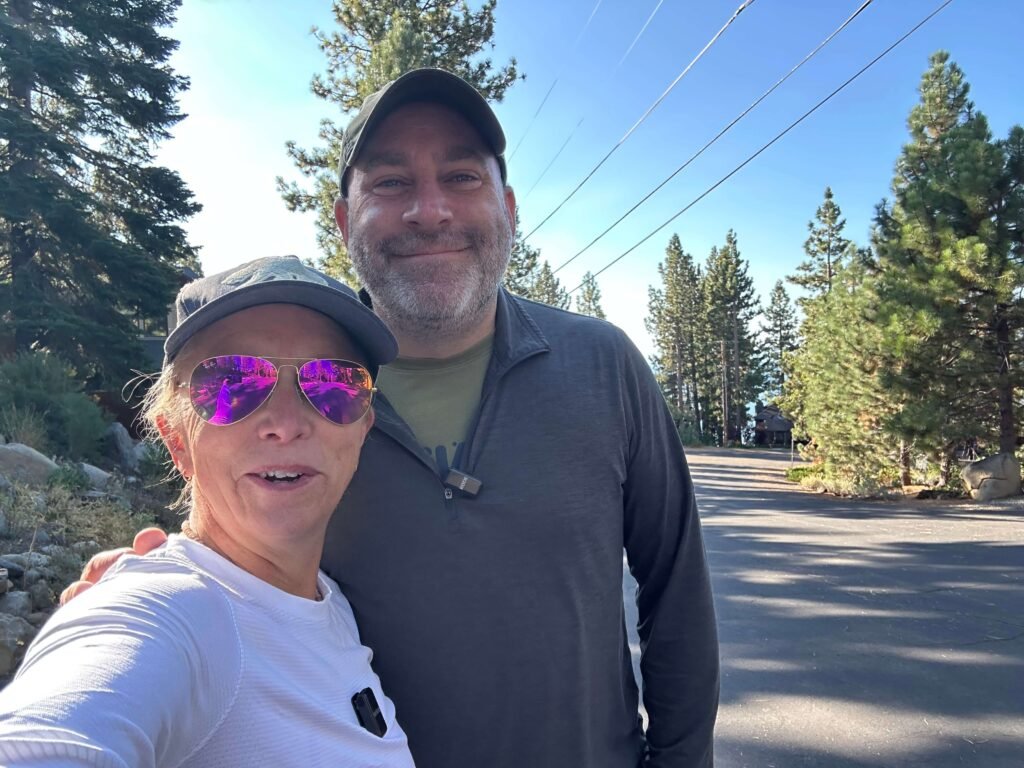
How are you?

Five years later, we still don’t understand the physical and emotional impact of the pandemic. I have barely scratched the surface of the educational impact. With every conversation on the topic, I learn something new. For example, when I first heard the term “Long COVID,” I assumed it meant feeling run down with lingering symptoms. That doesn’t even begin to explain it. 

Stacey Farlie has explained to me for much of the first year, she could barely get out of bed. She was a prisoner in her house except for quick trips to the grocery store. Today she is better. What does better mean? She deals with elevated temperature and flu-like symptoms from the routine task of taking medicine or supplements and massive post-exertional malaise (PEM). 

She went from spinning 4-5 times a week to barely being able to walk. Everything exacerbates this… food, heat, exertion, mental anguish…it’s a constant yet unexpected roller coaster in a life of unforeseen limitations that are strange and complicated. Each relapse brings with it unremitting depression, crying, fever, sore throats and breathing issues, congestion, hoarseness, internal vibrations. Not to mention an inability to stand up for too long. 

Stacey’s three-year journey through this invisible illness reveals not only the profound physical and emotional toll of Long COVID, but also the gaps in our medical system, the loneliness of suffering from a condition that others can’t see or understand, and the urgent need for all of us to expand our compassion for those fighting battles we cannot imagine. This is her story, told with her permission, because sometimes the most powerful medicine is simply being heard.

Stacey: It’s just a very hard thing to describe to people. They just think you’re tired.

It’s not like I need a nap. It’s like somebody has unplugged all my cells.

Check yourself. What is your initial impression when you hear the term, Long COVID? What presumptions bubble to the surface? I’ll admit I had no idea it had dropped my college roommate into a world where her own body would become unrecognizable to her, where the simple act of taking medicine could leave her bedridden, all within a medical system – traditional and alternative – that struggles to understand what is happening.

What I’ve learned, through Stacey’s recounting of her countless doctor visits, mysterious fevers, and hours of research deep-dives is that this isn’t a disease, it’s a post-viral syndrome, and it is devastating. In fact, research completed in the United Kingdom revealed something Stacey already felt in her bones: people with Long COVID may actually suffer more than those battling certain types of cancer. 

Stacey: They did a study of people, and they said that people with Long COVID actually suffer more than people with cancer, because when you have cancer, now this is probably not if you’re dying of cancer, but just having cancer – there’s a protocol, there’s support. You have days where you can feel really good. You know it’s probably going to be over, hopefully, for the most part. It’s a really bad period that you’re going through. They found that the people with Long COVID were actually suffering more because there isn’t any of that.

Not because cancer isn’t devastating—it absolutely is—but because cancer patients have something Stacey doesn’t: a clear diagnosis, established treatment protocols, a healthcare system and public opinion that takes their suffering seriously. This study published in BMJ Open, involving over 3,750 Long COVID patients across England, found that the impact on one’s daily life was worse than stroke survivors and comparable to people living with Parkinson’s disease. 

“Long COVID is an invisible condition,” explains Professor William Henley from the University of Exeter, one of the study’s authors. “Many people are left trying to manage significant changes to how they can function. Shockingly, our research has revealed that Long COVID can leave people with worse fatigue and quality of life than some cancers, yet the support and understanding is not at the same level.”

The invisibility he mentions Stacey has described as isolation. There are no established clear treatment pathways, support groups, nor a shared understanding of Long COVID. You often look fine from the outside, but you’re trapped in a body that is betraying you while the world expects you to function normally.

Stacey: Okay, so here we start crying.

Liz: I’m sorry.

Stacey: It’s just really hard. I mean, I think the hardest thing about Long COVID is how lonely it is.

In the beginning, like with any acute sickness, your friends rally around you. But once you’ve been sick for a while, especially with COVID being so politically loaded and people just wanting nothing to do with it. If I had said I had almost anything else, I think I would have gotten a completely different reaction. But It’s very isolating.

Stacey has had to become her own case manager, researcher, and advocate out of necessity. She has had to stand up for herself in the face of skepticism and dismissal from friends and physicians alike.

Stacey: And I have what you would call a busy brain. I’m always thinking. And so imagine when I first had this, I wanted to figure out what to do. I’m a problem solver, and I wanted to… I felt like the answer had to be out there somewhere if I just looked hard enough. I don’t know. I do still think there is an answer, and I do think there are ways to get better. And sometimes it’s just time. It’s been three years now. I am much better than I was that first year that I’m describing to you.

Liz: Better isn’t the answer. I don’t want you to feel better. I want you to feel good.

So I was wrong. Long COVID isn’t just about being tired. Stacey can’t push through or think more positively to navigate her way through this disease…and it isn’t a disease. This is a complex, multi-system illness that has fundamentally altered Stacey’s body and her life. It’s about waking up every day not knowing what might cause her next downfall – other than the very medicine prescribed to help.

Liz: You’ve got to be tired of silver bullets that don’t work out.

Stacey: Well, the bigger thing is I can’t take anything.

And by that she means medicine or supplements without getting a fever and mini relapse. 

Stacey: So until someone figures out how to turn that mechanism off… It took me a year to connect the dots and see it wasn’t until I got off all the medicine that my fever started to go down a little and then eventually go away. Now, when I take anything, I immediately get a fever, and I feel like I have the flu. Anything anything, like aspirin, which should quell the fever, but it doesn’t.

Covid triggered a systematic collapse that she hasn’t recovered from over three years later. Again, check yourself. Are you thinking about an underlying condition and coming to the conclusion – ok then that couldn’t happen to me. At one point a Long COVID specialist wanted her to take a strong immunosuppressant.

Stacey: I was so sick. I kept protesting taking the medicine because I’m like, I don’t react well. This is before I knew why, but I was like, I don’t react well to this. This is a really strong medicine. It’s what they give you when you’ve had a transplant to keep you from rejecting the organ, it has a black box warning, can cause cancer.

I’m like, Are you kidding me? I don’t do well with little things. And he was like, Well, what are you going to do? Just sit here crying? You need to take steps. You need to do something. He’s said, I know better than you that this is what you need to do.

And because I was in such a vulnerable place, I was like, Okay, I’ll try. So I went home. Really, I was trying it just to prove him wrong. And I immediately took it… within an hour I had a 104 fever. I was on it for a few days, and then I just took myself off of it. That launched me into three months in bed, basically. And it wasn’t really until I got off of all the medication that I slowly, slowly, slowly started to be able to get out of bed.

I didn’t know what to do because at that point, I was like, I’m done with Western medicine. All they have

Liz: …is what’s on the flowchart. 

Stacey: in their bag of tricks is medication.

COVID is an unknown that landed us all in a massive science experiment. While researchers work through hypotheses and debate treatment protocols, real people continue to suffer—and if it’s not happening in our own homes, we remain blissfully unaware of their reality. Stacey has given me permission to tell this story for awareness, knowing that this account might not change her outcome, but it could possibly shift one person’s understanding or ease the isolation for someone else walking this difficult path.

A new study has developed a blood test to diagnose Long Covid. 

Stacey: And I don’t think they know enough about it yet. So, that study, I thought, was very interesting because  it’s the first step. Then they’re going to develop a blood test eventually. I mean, again, kind of silly, because I know I have Long COVID, but at the same time, they’re now going to start working on antivirals…

Liz: And the medical world needs the blood test that says, yes, here’s the diagnosis to do the next thing, so at least you’re another step out of the flowchart.

Stacey: Western medicine, the way they operate is you have to do a study, then you have to get it passed through all this bureaucracy, and then eventually you can give that medication for that illness.

Medicine that Stacey cannot take, but she tried time and again as instructed by doctors and naturopaths alike.

Stacey: I did because I’m a good girl, and I listen …most of the time. But I’m also a rebel. If I don’t see it going well, I’m out. 

Liz: This is trauma for you. This is not just medical because in trauma, something hasn’t happened for two years, but when it happens, it feels like it happened yesterday. That has to be what these reactions feel like to you.

Stacey: It is. I take it back with the loneliness is not the worst part. The worst part is the setbacks. I can be going along and I’m pretty good and I’m functional for a month, and then I try something…. And to be back in that place is so difficult.

Liz: Yeah. And you got to beat yourself up. I can’t even imagine.

Stacey: Yeah. And I just feel like it’s never going to get better. 

I think that one of my biggest epiphanies of this whole experience has been about masking. And I think we all do this to some extent. I’m a bit of a perfectionist, and I always have that mask on .. everything’s great, and I’m doing this, and I’m achieving that. And it’s carried on into the sickness, where I’m doing what other people want. I’m pretending like I’m fine because I can’t deal with their reaction. It’s just not worth it.

Liz: And that comes from the good girl syndrome.

Stacey: Yes, absolutely.

There’s another layer to this struggle. As someone raised to be a “good girl”—to be accommodating, to not make a fuss, to put others’ needs before her own—advocating for herself in a medical system that already struggles to take women’s pain seriously has been its own form of torture if you ask me.  Given that women make up 71% of Long COVID clinic patients, I am certain there are many females trying to break free from the “good girl” trap—learning that your suffering matters, you are not a burden, you deserve care, saying “no” isn’t selfish. You don’t have to put on a mask of a brave face for the world. Ironic to be talking about masking – putting on a brave face – in relation to the pandemic that required masking and gave it a completely different meaning.

Liz: The other thing this plays into is that other thing we have being perfectionist, overachiever, overthinker, good girls, is ‘I’m not doing enough.’ And I’m sure you feel that way. And as your friend, I feel that way. I’m not doing enough. 

Stacey: That’s very hard because Craig (Stacey’s husband) constantly wants me to do nothing because it does appear like I’m better doing nothing, but then I’m also not healing. It’s just a band-aid. I think. But that’s how I feel. He can’t see that or feel that. But I have this constant need to try things. 

I get that. Our social media feeds are saturated with products that promise to improve our lives – be healthier, lose weight, have more strength, stamina, serenity… These endless advertisements prey on our insecurities and offer a stream of “solutions” that suggest our current selves are somehow inadequate. Of course, we all fall prey to one thing or another.

Liz: Gosh, my mom, I asked her one day, “Mom, you’ve been in medicine. How long? What is the thing? I want one thing I should do every day that is going to make me better because I can’t keep following the long list that just keeps getting longer of what I’m supposed to do.” She laughed at me and she said, eat an apple and go for a walk

We were in the pool at her apartment complex, and there was another man who happened to be standing nearby. And I saw him months later at a yoga class, and he looked at me and said, ‘Still eating my apple every day.” And I looked at him and I said, ‘Are you kidding?’ And he says, ‘I heard your mom. I walk every day and I eat an apple every day.’ I said, ‘How are you feeling? He goes, I don’t know how I’m feeling, but I feel like if your mom told me to do it,  I’m doing it.’ 

I don’t know. I do think we can run ourselves ragged as a full population. So I can’t even imagine how it would be for Stacey.

There is no magic bullet – and of course I wasn’t suggesting an apple could cure Stacey’s ills. I told her as much, but I couldn’t help but chuckle when she texted me later in the day, “…I just had an apple.”  It’s not about the apple. It’s my mom. As a physician, she listened… to a fault. You knew she cared. She also had an uncanny sense to hear symptoms and make recommendations that worked. I think of her every time I cut an apple. Before I take my first bite, I feel better. I doubt an apple will have the same curative effect for Stacey, but I do wish mom were here to talk to Stacey …to offer her rare brand of support.

Liz: What would positive support have looked like? Can you identify that?

Stacey: Yeah, it’s really not hard. It’s just checking in. It’s checking in and being curious, wanting to find out, well, what are you feeling? Just being heard is support. And just saying, oh, my God, that must be really hard. 

Liz: When somebody says, How are you? They want you to say better. They’re really not looking for any other answer. And I don’t know how to change the question because now in my life, when I say, How are you? I want the truth. ‘I’m as shitty today as I was yesterday.’ That’s a good answer. But I don’t know how to change the question because ‘how are you’ in this society is as throw away as the wave I just offered to a woman on this walk. It was just a courtesy.

Stacey: You asked what I need from other people. I am somebody who likes to work through my problems by talking. That’s how I think. The more I talk through it, I have epiphanies when I talk.

Liz: That’s what this whole walking project is. 

Stacey: Exactly. So what I’ve learned by this is that other people are the opposite. They don’t want to talk about problems, that’s not what they want to do. And so that’s really been the hardest thing about Long COVID is being shut down. I do want to talk about it. I do want people to ask, ‘Well, explain to me, What are you doing? What do you think? And why? Do you have any ideas why you can’t take any medicine?’ It helps me to work through it. Sometimes I put pieces together that I would have never had before if I hadn’t talked through it. 

Not everyone wants to talk through it. Not everyone processes that way. We also have to leave room for our differences.

Stacey: I’ve realized friends serve different purposes at different times.

Liz: Nobody can be everything for us.

Stacey: Absolutely.

Liz: And it’s okay.

Stacey: And you can come back to them at a different point when you need them for other things, or you can be there for them.

Show up. Text. Call. Ask. So many of these walks have offered these same reminders. Why do we forget life is precious? We do not know what lies around the corner.

Stacey: We take each other for granted.

Liz : Oh, my God. I’m taking the fact that I’m walking for granted. I can’t tell you how many times in this call I’ve thought, I got to stop bitching. I feel good for the most part. I can walk.

Stacey sat for our “walk” – a more than acceptable exemption in this case. I wish her illness wasn’t so unknown. I wish she could count on more strength. For how much I hate medical flowcharts, I wish there were protocols to follow that promised some relief.

Liz: We don’t know what to do with Long COVID, and we want it to just fit neatly into a box, and it doesn’t. And that’s what it is for the friend who doesn’t have it. But for you, you literally have no choice but to respond to what your body is forcing you to do.

Stacey: Yes. And it’s just a very hard thing to describe to people. They just think you’re tired.

We need a new word. The actual medical term for long COVID/ME-CFS fatigue is post-exertional malaise. That’s probably not it, but “tired” is too commonplace. When someone says “I’m tired,” people immediately think of their own experience of tiredness and respond with advice like “get more sleep” or “have some coffee.” But Long COVID fatigue is more like having the flu while hungover after running a marathon – it’s a completely different physiological state… but through the haze of that, Stacey can still find positives.

Stacey: It’s the essay writer in me…you have to have a conflict, and then come out the other side…

And she has the fortitude to see the positive growth she has experienced.

Stacey: I’ve become a lot more emotionally self-reliant, which is hard for me, because I talked to you about how I like to talk through my issues, but I’ve had to reach deep and keep reminding myself, ‘It’ll be a little bit better tomorrow, I’m just having a bad moment,’ …kind of talk myself through it.

She is also learning patience and making herself a priority when much of our lives as wives, mothers has been about everyone else.

Stacey: that’s another thing I’ve had a lot of trouble with, is… 

Liz: what’s that? 

Stacey: Putting limits.

Liz: I don’t know, I think… I think you could teach me a ton about how to use the word no.  I mean, my mom used to say all the time, it’s a full sentence.

Stacey: Yes, and I still have my problems with that.

Liz: I have never once felt let down because you took care of yourself, even when you weren’t coming to reunions.  I was disappointed I wouldn’t get to see you, but there was a part of me that was so effin’ proud of you for putting yourself first, because that’s just not typical, especially for women our age.

What if we rested when we need to? What if we prioritized our health and our future selves over a scheduled trip, event or meeting? What if we knew ourselves well enough to say no much more often than we do. And while we are talking about what if… what if a researcher heard this story and asked, how can I help? What can I learn? Stacey Farlie is not a statistic. She is one of my dearest friends and simply listening to her is not enough, but there is little else I can do… well… I could write her story down and share it.

Stacey allowed me to share her story not because it will cure her illness or change the medical system, but because she knows that many others suffer invisibly and they do not need to feel isolated. The act of truly seeing someone, of asking with genuine curiosity about their experience are profound gifts we could all offer much more freely.


Liz Hofreuter

Founder GEN-Ed

Not your typical researcher or consultant, Liz connects lived experience to transformative leadership. To uncomplicate leadership and education, every story matters and she is just getting started.