

There is a moment that sneaks up on you that is unexpected and unwelcome. It is the moment the first service personnel calls you ma’am. You realize you present as more mature. You convince yourself it is a sign of respect, but you know it is a slippery slope to senior status. Senior what? In my world that means top of the food chain, extra privileges, a beginning of a new life lying in wait just around the corner. Senior Citizen? Well, there’s something damn jarring about that. Society, it seems, has collectively decided that I have hit the age that marks the beginning of my decline. As if I was handed a script suggesting my vibrant chapters should now gracefully give way to a quieter, more contained existence. Bullshit. I am reclaiming senior status with all its positives from high school vernacular for myself and my contemporaries. We are going to cut the lunch line, decorate our parking spots, and embrace a new chapter of living all with a much slower metabolism. Who says there should be an expiration date for ambition, for reinvention? My most interesting stories are still unwritten.
Carolyn: Nobody really prepares us for this phase in life. Nobody really talks about it. I mean, I think they talk about it more now than ever before, but there’s a long way to go. And you have to really be your own advocate in this journey at our phase.
Monica: There’s two big components you guys just broke out. Number one, women aren’t really seen in health care and are often dismissed. Particularly after we pass the age of “productivity,” which is the Western model, to be productive, we can feel put out to pasture. Part of that is, we’re going back to a patriarchal order that does not witness the different ages that women have. We’re way more start and stop with our hormonal rhythms than men are. Andropause is long and slow and gentle. Menopause is abrupt and shocking. We get hot and angry and dry.
Liz: All the things I felt so far today.
Monica: In indigenous cultures, there are rites of passage for teenage girls starting their menstrual cycle. There’s a rite of passage for entering, exiting the motherhood stage and entering the wise elder, the crone stage.
Liz: The crone stage.
Monica: The crone stage, yeah. Which doesn’t sound attractive, but it is the embodiment of grandmother wisdom. The grandmother is revered in the tribe and is like a secret wisdom holder. But in the West, we don’t have a place to elevate. There’s nothing that elevates us in this stage. As we’re experiencing this transition, we have a loss of identity. We feel like chopped liver because we don’t have a story that takes us into our wisdom stage, which is what this is.
Carolyn: Well, it’s our wisdom stage, but we’re also a culture which is going, I think, in a really horrifying direction as far as what beauty looks like. And with all the cosmetic surgery and people and women trying to fight aging in a way that I find very uncomfortable instead of women embracing their wisdom and their age, they’re fighting it in a way that re-defines what beauty is.
I embrace my aging reflection in the mirror. Indeed as I walk with my contemporaries, Monica Williams and Carolyn Greenfield, I see only their passion and spirit, appreciating their style. I am inspired by the less travelled paths they have chosen and at no point am I wondering what beauty products they use. We don’t feel like we fit inside the box that once contained our folded, compliant selves. Carolyn turned a creative hobby into a successful jewelry business. She is the artist behind almost every piece of jewelry I wear.
Liz: I only wear your jewelry, with the exception of a gift and the ring I designed. And every time someone comments on what they call in my neighborhood, ‘the Liz necklace,’ there’s a moment when you and I are connected. It’s empowering that you chose to do this and that you’ve made so much out of it.
Carolyn: Well, thank you. That’s very flattering. I like to make things with my hands, and I like to be creative. And although it is not something that anyone “needs,” what gives me great joy is to see people wearing things that I made with confidence and it looks different from one person to the next. I can be in a room of crazy, dynamic women, and they’re all wearing things that I’ve made differently than each other. And nobody knows, except for me, that it came from Carden Avenue. It gives me pleasure just seeing you wear it with confidence.
Liz: But I think you’re doing more than working with your hands. I think you’re curating a place of joy and calm. I don’t know. There are times I just want to be in your jewelry studio.
Calm was also a destination for Monica as she chose a path out of chaos that walked her right out of the emergency room sliding doors following the pandemic.
Monica: I was a full-time emergency physician during COVID, and I did not contract COVID until October of 2022. And it didn’t put me in the hospital, but it put me in bed for two weeks. And I haven’t had an illness as an adult that took so long to recover from. I was going through menopause at the same time, so a double hit. The joints on my right-hand started to swell up in the second week of my recovery. After I was fully recovered, those joints of my hand would swell up in the middle of a night shift… after a glass of red wine… or after too much stress. I got very clear there was a line that had been drawn in the sand. My body gave me a clear signal that this level of stress is a pathologic state, and it was turning on an acute arthritis, which is another pathologic state. And genetically, we see that one disease state turns on other disease states that are latent. And so I just thought, I need to obey this because this could be a clear sign from my body telling me, ‘You have two pathways here.’ I actually quit full-time emergency medicine practice and spent the next year healing.
Carolyn: What did that year look like?
Monica: Well, I retrained in genomic-based health. I started seeing patients who were the 15% of people who fall outside of the textbook that are generally dismissed by doctors, those tend to be women, tend to be medically complicated, may not have a classic box or category that their lab work identifies them as having “X.” So they feel very unseen, and they’re very sick. And these were the people I attracted as patients because genetically, we could look at you and say, “This is the blueprint. These are the cards you’ve dealt. And these things are trying to wake up. They just haven’t reached laboratory significance yet. But we can work on them and bring them back down, cool them off.” Because that was my own experience in my own health.
Liz: So the arthritis, you cooled off?
Monica: Yep. So whatever genetic pathways were turning that on, when I came out of my state of distress, it was self-induced and career-induced and COVID-induced. It was just the convergence of all of these different stressors. And my blood pressure was out of control, my kidney function was starting to get abnormal. So my ship was sinking, and I got very clear, “Well, I’m not ready to fully decline. I have three children who are dependent on me only, so I need to change my life if I’m going to not be disabled.”
Liz: You’re talking about a medical IEP. In education, we’re talking about an IEP for everyone, including teachers and administrators because we all learn differently. That’s basically what we’re saying. Let’s stop talking about us as late ’50s women because it’s Carolyn, it’s Liz, it’s Monica.
Monica: Exactly. That’s where traditional medicine is no longer going to apply to us because we have algorithms for your blood pressure. We’ll start with this medication, we’ll move to this one, we’ll add in a third. But those are based on population-based studies, and none of us is a statistic.
If we looked at our genetic profile, we may or may not fit that Bell Curve. If I’m treating you according to what’s under the thick part of the Bell Curve, and you’re one standard deviation out, well, you’re going to feel like medicine has failed you because it has. That’s the future of medicine, which will make it personalized… construct something that’s good for all people and it’s not leaving anyone out.
Liz: I love the feeling of hope in what you just said.
I can’t help but think that the fact that you chose to follow a passion and design jewelry, and Monica chose to step off the treadmill and not be a full-time ER doc. And I walked away from the next, and next, and next in the education ladder, provides some role model for things that can be different from the way we were taught to consume and achieve…
Carolyn: I think it’s so important to mirror or to demonstrate your work ethic, regardless of what it is. It’s super important that you’re doing something that you love. I do think that our generation of kids values that more than any other generation that’s come before us.
Liz: Yeah, I love that you give yourself grace there that we grew up differently.
Carolyn: Well, it’s what we’re learning from our kids. And when you make that shift, you have as much to learn as they do.
Monica: Crone Wisdom 101.
Always willing to learn but always aware we are modeling and teaching our daughters.
Liz: There was a moment, New Year’s Day a year ago… when I was headed into the last semester of being a Head of school and thought at that moment I was going to be the CEO of a software startup. We were having our philosophical “what’s ahead in the new year conversation” and I was overwhelmed to say, “Girls, I don’t know what will come next, and I may fail, but I want to do this because I want you to know it’s okay to risk, to fail, and to learn.” And my God, if I didn’t fail large.
Monica: I would give you a standing ovation for that talk.
Liz: Thank you. They both just gave me the daughter nod.
Carolyn: It’s the obligatory daughter “I know” nod.
Monica: But you know what? That probably unnerved them a little bit since you’re their stabilizing force. But that will give them confidence and bravery and unseen moments in their lives.
Liz: I’ll take that. True or not, I’ll just take that.
Carolyn: No, it’s true. You’re putting yourself in a very vulnerable situation.
Monica likes to say we are individuals, not a population. I like that. I don’t want my failures or my age to be someone else’s cautionary tale or a problem to be managed. I want to be an individual. I want to write my next chapter as an adventure of learning, of unbridled joy all while being grounded and more balanced. I am after all a human being …not a human doing.
Monica: My main sense of loss has been around energy because I was way more energetic when I was younger, but I also abused that. I thought my body could do anything. So now I’m coming to terms with the fact that I’m energetically limited, but I’m trying to find the gift in that, and I’ve interpreted it as there’s less energy for doing, so there’s more space for being. And that really should be what the last phase of life should be about, in my opinion.
Carolyn: Well, that’s what I was going to say. I feel like there’s been a shift for me in that your life doesn’t have to be so task-oriented, but it’s all about, how do you want to spend your time? And what do you do with that time? And that goes to your whole idea of being, right? What is it that fuels you? Because it might not be the same thing it was 20 years ago.
I don’t know about the two of you, but I’m just increasingly aware all the time about how you’re so invincible for a period of time in your life, at least you think you are, right? And then there’s a shift, and I’m not sure when that is, but you all of a sudden, maybe it’s when we become moms, or maybe it’s… I mean, who knows what the shift is, and I’m sure it’s different for everyone. But your viewpoints change because you just realize how fragile life can be.
Monica: We just visited a 75-year-old friend who works with homeless boys in Kenya and raises money for an orphanage there for them. She’s like, I must curate my remaining time and devote my active energy to what matters most, even if I find these other things interesting. So what’s the best use of the action principle that I still have remaining? And she’s an elder, wise, crone woman. I could take that from her. I could see the wisdom from which she was practicing. I found all of that inspiring.
We talk about “managing” time as if it were something we could control, when really what we’re doing is making choices about where we place our attention. There’s something almost sacred about deciding to be fully present with the people who matter most—putting down the phone during dinner, lingering a moment longer in conversation, choosing the walk with an old friend and a new friend over the to-do list with which you arrived.
Liz: I keep saying when I’m writing these walks, that these were the right people. And I don’t really know why some of them were involved, like even this walk, it wasn’t planned. And yet we’re standing in the midst of a conversation and I knew it had to be part of the series.
Monica: Yeah, the right people. You take the opportunities when they present themselves to reconnect with the people that do make you feel good.
I used to guide parents to think about the adults who were in their children’s windshield. When they look up and around every day, who do they see? Who is serving as a role model. For their most formative years, Grace and Ella had the right people in their windshields. They are still there. I never once thought about my wind shield until I started on this journey of walks. I’ll be honest I have not always had the right people in my windshield, so I’m grounding myself to connect with people who make me feel inspired, calm, happy. These two women fit that bill. I knew I had to walk with them. For me. There were hours of conversation I didn’t record. I wish I did. You would be inspired. But maybe it was enough that we had those discussions. That we inspired each other.
There are rare souls who make us feel more like ourselves when we’re with them. They are the right people for this later chapter of my life. They bring hope. They are present. They fill my soul.
Carolyn: it’s in your heart.
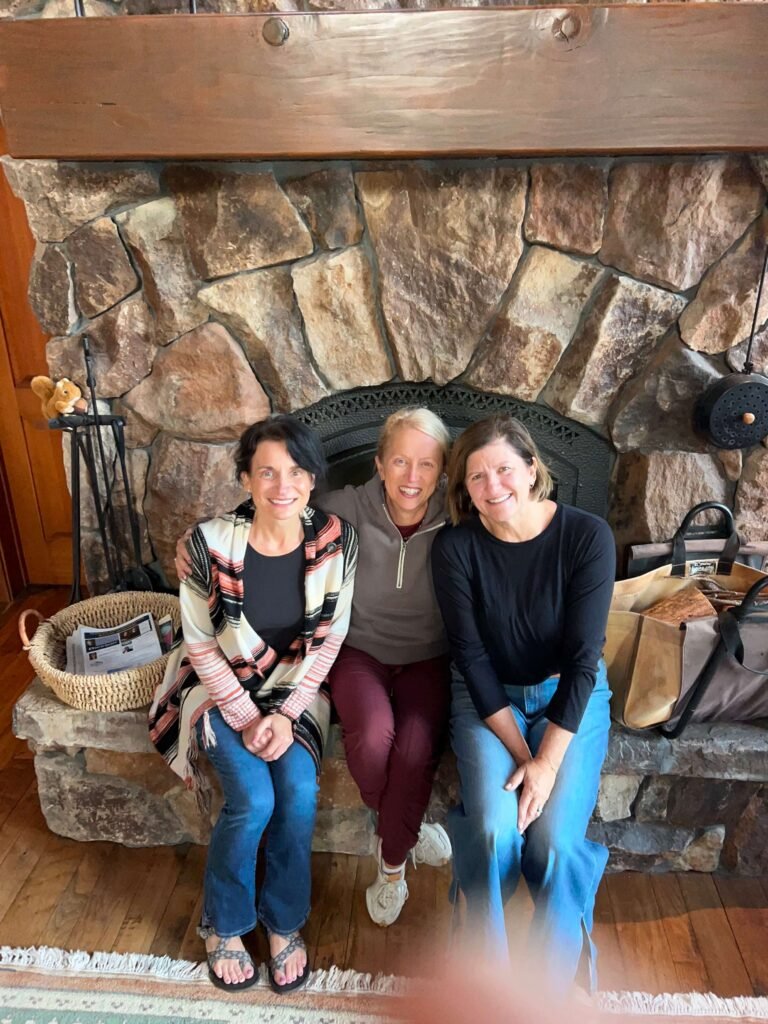
They see in me what I am becoming: not a woman diminished by age, but one amplified by wisdom and seasoned by laughter. I am at the beginning of the most beautiful chapter that opens the moment you stop apologizing and start celebrating the profound grace of a life fully lived as imperfect as it is. Yes ma’am, I am stepping into my crone, and she is glorious.
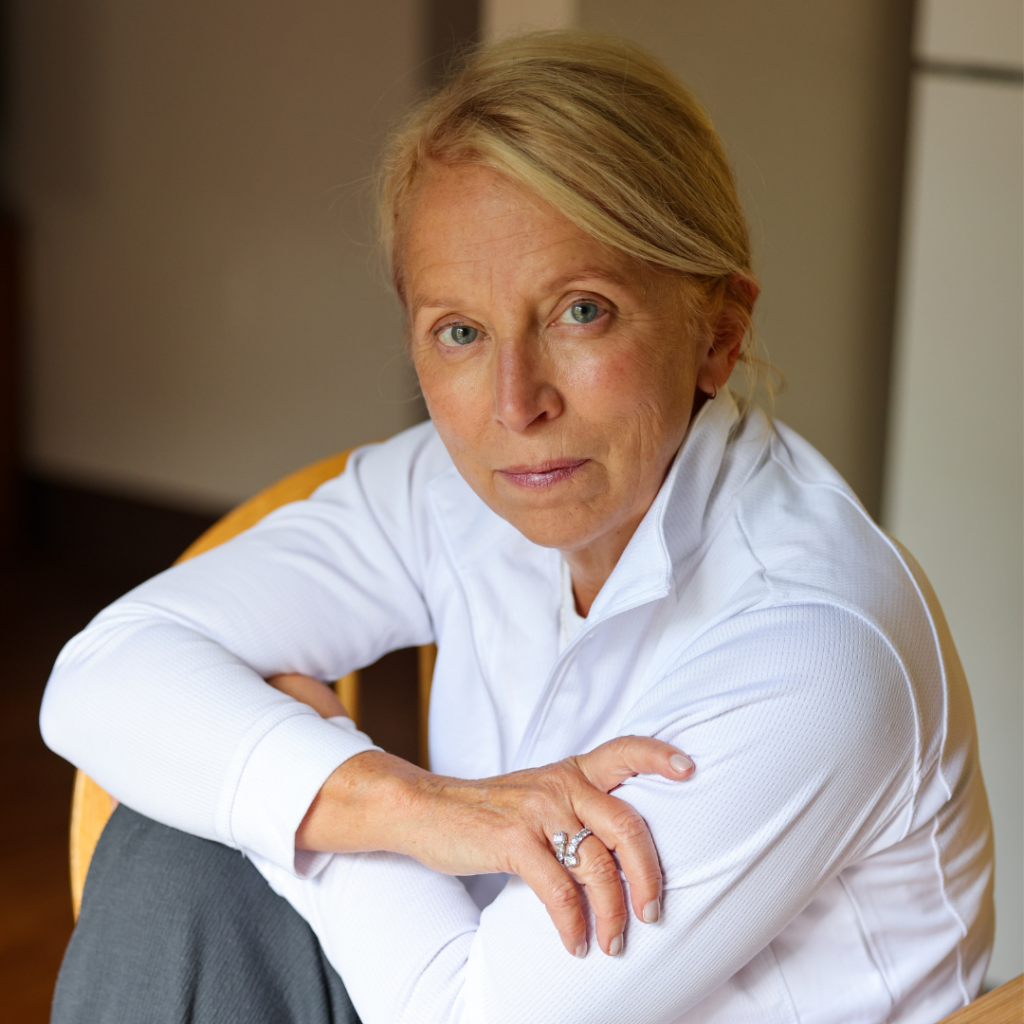
Liz Hofreuter
Founder GEN-Ed
Not your typical researcher or consultant, Liz connects lived experience to transformative leadership. To uncomplicate leadership and education, every story matters and she is just getting started.


