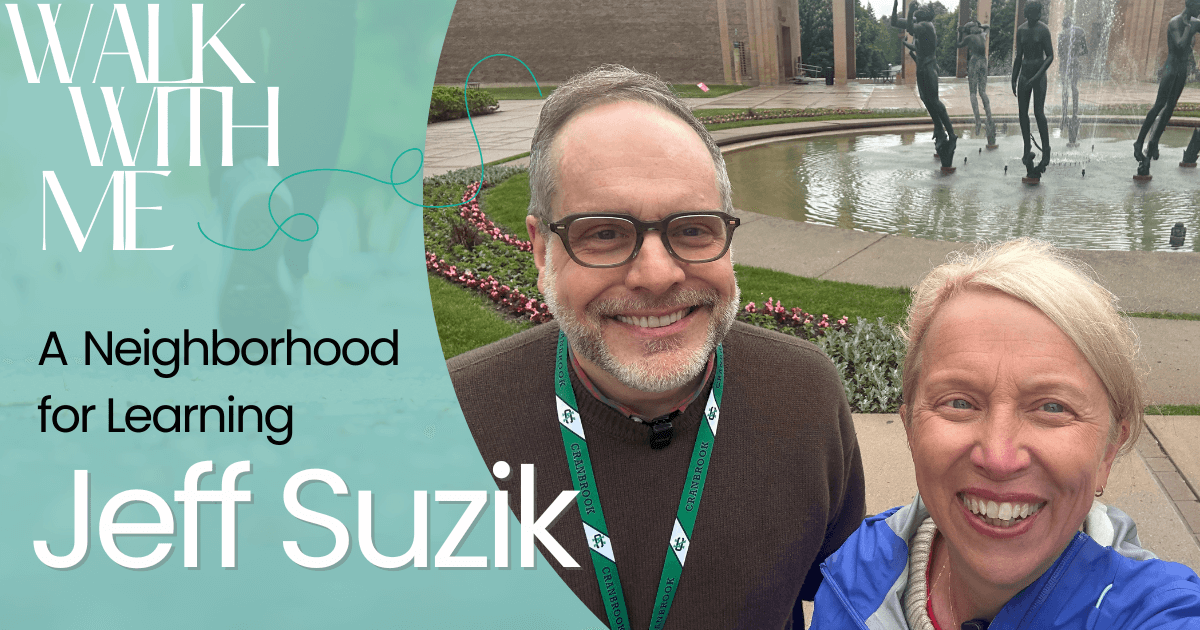
A Neighborhood for Learning

I didn’t set out to have Mister Rogers be such a backbone of so many of my walks, but that was shortsighted of me. Of course these walks were invoking our loving neighbor who laced up his tennis shoes and donned his cardigan. It was after all a series of walks through my extended neighborhood – the people in my life who had taught me something… who are still teaching me something. It became a chance to give back to some of those people in the spirit of Mister Rogers, who understood that children – and adults – flourish when they feel genuinely seen and heard.

Jeff: When I first moved to Pittsburgh in 1994 as a grad student at Carnegie Mellon, he was, of course, still alive, and he was still making his show. He retired, I think, in about 2000, maybe 2001. I was by then working at Shady Side Academy, and I was invited by a student to his graduation party. His parents were both producers at WQED, the station that made Mister Rogers’ Neighborhood. And in fact, his mother, like many of the people featured on Mister Rogers’ Neighborhood, was just someone who worked there, and was asked, “Will you play a part?” So she was the important, but little seen, Mrs. McFeely, So I go to this graduation party and I see Fred Rogers standing there. 

Liz: In a cardigan? 

Jeff: No, in a sport coat. 

I had grown up worshiping that show and I was feeling heart palpitations. Like, “Oh my God, oh my God, oh my God, He’s here.” I thought, I’m not going to be that guy. I’m not going to go up to him. I’m not going to say, I love you so much. I’m going to give him his space. And then the boy’s mother, Mrs. McFeely, brought him over and said, “Fred, I need to introduce you to Jeff Suzik. He’s Michael’s favorite teacher.” And he said, “Isn’t that nice?” And then she, with intent, moved away. And I got to have a 20 – 25 minute conversation with him by myself.
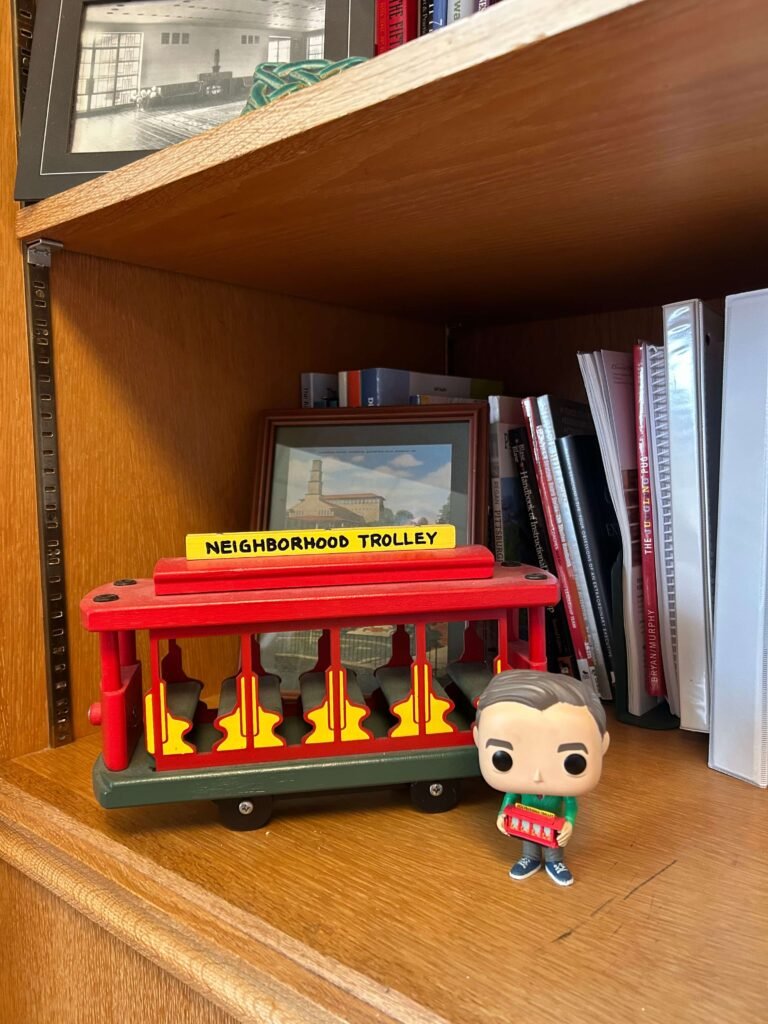
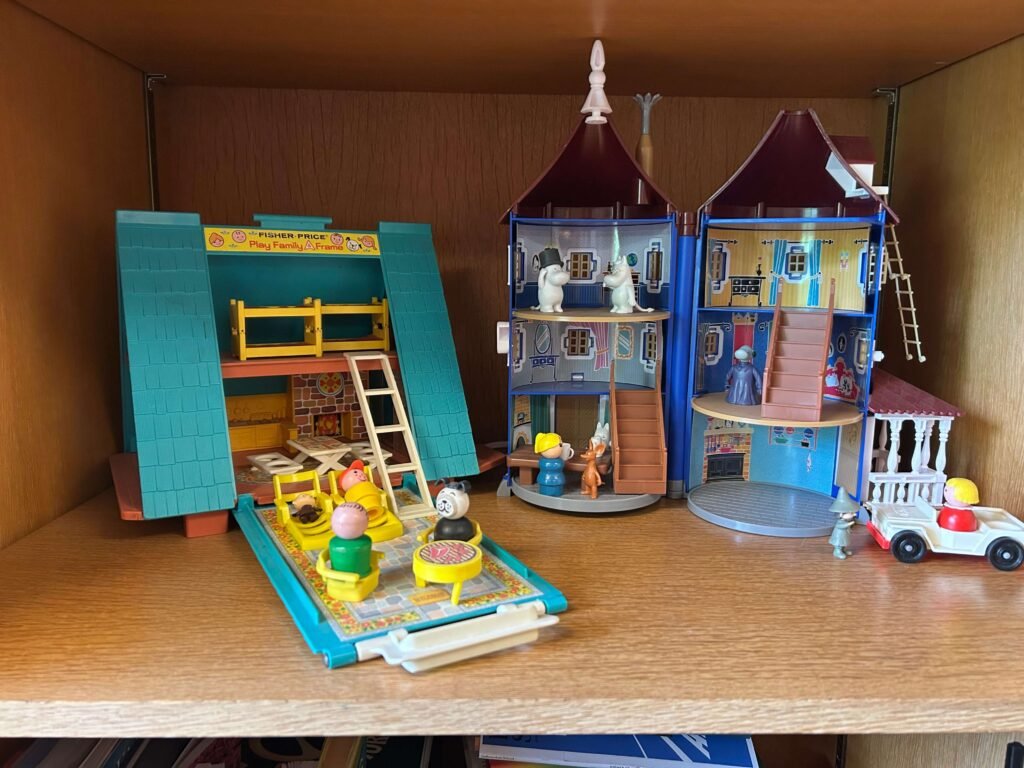
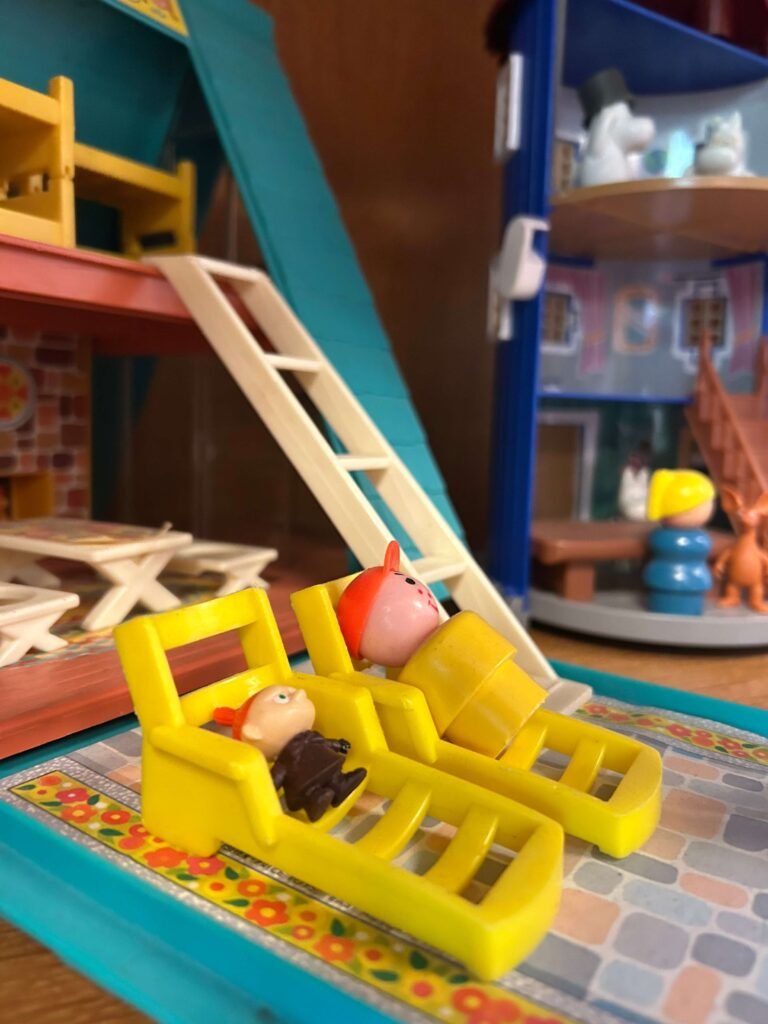
A dream come true. A hero in his presence. A moment preserved not just in his memory but in the toys that grace his bookshelves in the office of Dr. Jeff Suzik, Director of Schools for the Cranbrook Educational Community.
Liz: What do you remember?

Jeff: That he was exactly the person who we saw on TV. He was the most authentically that. It wasn’t an act. He wasn’t talking down to children or being saccharine or anything else. That’s who he was. And it was just a wonderful, wide-ranging conversation about children and their needs, what they deserve from us, what developmentally they should expect, how to partner with parents. 

And then I said, just as part of the conversation, “So are you enjoying retirement?” Remember, this was like 2001, so a long time ago. And he  said, “Oh, yes, I am. But I would really not categorize myself, Jeff, as being retired. So I’m working on a lot of projects.” I wouldn’t have known this, but he was then on the cusp of early development of Daniel Tiger. And he said, “The most recent thing I’ve done is I just launched my website. And it’s www.misterrogers.org. And I do hope that you’ll visit me in this new neighborhood.” 

Liz: Oh, I love that. 

Jeff: And then I learned later when I returned to Pittsburgh to lead Falk, that Falk had been the school that he had chosen for his son.

Falk Laboratory School. The place that had drawn Jeff back to Pittsburgh to be its Director in 2014. How I wish we had a recording of that dialogue of two men who honor childhood as a distinct stage of life…and who share a vision for a better future created by the very children in whom they were investing their lives’ work: Mister Rogers through educational television and Dr. Suzik through independent education in some atypical settings. You see, Cranbrook comprises schools, plural, and an art museum, an institute of science and a graduate art academy all sharing resources on a 319 acre campus. Indeed, in his website neighborhood, Jeff offers visitors “an enthusiastic welcome to Cranbrook Schools, where we believe that a childhood and adolescence filled with wonder, discovery, and curiosity is the greatest and most enduring gift a person can receive in their lifetime.” Mister Rogers would like that.

Liz: What do you think Mister Rogers would make of Cranbrook?

Jeff: I think that he would…That’s a great question. I think that he would recognize the elementary school’s inherently child-centered way of educating, I think he would appreciate its long-standing, fundamental and foundational commitment to “specials” classes (art, music, movement, technology, drama – things like that) and to children being given a lot of hands-on opportunities to learn.  Because while the upper levels of Cranbrook are pretty traditional pedagogically, and that’s something I’m eager and committed to working on, the elementary school has always been more expansive and innovative in its practices.

Of course many, many elementary schools are like this, because they can be. But the elementary here was headed from its beginning, and then for 39 years, by a woman who was plucked out of the lab school culture of Greater Chicago in 1922. Her mark on this place is indelible. And so I think he would like all of that. And I think he would like the other major thing that I like here, which is the fact that this whole campus and the resources here, the other institutions that we are a part of, create this opportunity for learning for children and partnership that is just unparalleled. The potential here has been tapped in some ways, and in other ways, it hasn’t. And that was really why I came.

Jeff: The closest comparative models, I think, are schools that are part of universities like Falk. And so that prepared me well for being here.

Picture an independent school that operates almost like a living laboratory for education – it’s where theory meets practice in the most dynamic way possible – that is a university-affiliated lab school. I often compare it to a teaching hospital – but for education – where future teachers learn their craft in a real classroom setting with actual students, not just theoretical scenarios, and experiment with new educational materials, curriculum designs and pedagogical methods. In working with local colleges and universities, Wheeling Country Day School had been an informal lab. It allows me to understand what draws Jeff to such profound potential. There’s this incredible multiplier effect happening on your campus. Every innovative technique you develop, every breakthrough moment, every creative way you make learning come alive – it doesn’t just impact the children in your classrooms, it ripples out in ways you will never fully appreciate through the college students and guests that grace your campus as well.  

Jeff: I came to Cranbrook because I could see so many tremendous, open opportunities for innovation and growth. I had so loved being at the lab school, and I loved the opportunity there to collaborate with other units of the University. So we’d be working on NSF grants with the School of Engineering that involved showing a commitment to translating the research into activities for the K-12 space. So we would get written into those and then they would do it. And those were fabulous. Or just working with School of Ed colleagues on new pedagogies and practices.

Liz: For K-12 and Higher Ed to consider because you’re where the rubber hits the road. 

Jeff: Correct.

Cranbrook is different, wonderfully so. While there is no university affiliation, Cranbrook boasts a history museum, a planetarium, an observatory, a contemporary art museum, architecturally significant historic homes, outdoor sculptures and one of the oldest Japanese gardens in the US, with fountains, lakes, trails, and more. Indeed, it is an

Jeff: …amalgam of school spaces and nonschool spaces, but all of them are educative spaces, and all of them are, with some form of intent, built to elicit reaction.

This might be the only place in the world that I would choose to work, except for Falk. And so when approached about it as a possibility, even though I wasn’t looking for a job, I explored it, and there were aspects of it that were just so enticing. And I thought, the things I am engaging in here at the University of Pittsburgh could be done on steroids here, and with more ready partners in some ways, or rather with some more obvious partners, like an art museum, an institute of science that has a planetarium, and natural history specimens and a T-Rex and whatever else not.

What if the walls of a classroom could expand to embrace a larger community? This is the vision we had at  Wheeling Country Day School which Jim Denova captured when he described it as “a constellation of learning spaces.” No longer confined to its original two-acre campus in Wheeling’s Woodsdale neighborhood, the school bloomed across the city—taking root on the branch campus of West Virginia Northern Community College and flourishing within the green spaces of a municipal park managed by the Wheeling Park Commission.

This expansion wasn’t about real estate; it was about reimagining where authentic learning happens. The seeds of this thinking were planted years earlier during a tour of the Children’s Museum of Pittsburgh with its Executive Director, Jane Werner. As a line of preschoolers wandered past us, I remarked on what seemed like a perfectly timed field trip. Jane’s response stopped me in my tracks: “They go to school here.” What?!? How had I not given my daughters such a rare opportunity? An idea was born. 

Place influences culture. Context matters. Place-based learning doesn’t just expose children to new people and ideas—it dissolves the artificial boundaries between school and life, transforming every corner of a community into a potential classroom. When learning spills into museums, parks, colleges, and downtown spaces, students discover that education isn’t something that happens in isolation, but something they actively participate in as members of a learning community. Their larger neighborhood becomes their school. Just as Mister Rogers suggested.

Cranbrook has all of this available within the 319 acres that it calls home, but such access sometimes becomes a logistical dilemma.

Liz: The students actually shuttle between the campuses?

Jeff: They do, yeah, the Upper Schoolers, that is. There’s 15 minutes of passing time between their classes, which is a lot. It cuts into the day a lot. So we’re looking at the daily schedule now to create longer blocks of instruction, which I would like anyway, but it will also minimize those disruptions.

Liz: Isn’t it nice when logistics are the Trojan horse to get something programmatic?

Jeff: That’s right.  It can prove challenging to get people to think critically and differently about the “boring” logistics when they are so deeply devoted, oftentimes quite rightly, to the perceived way that things have “always” been done. And always done well. This has been true, in some way or another, everywhere I’ve been, at every school where I’ve worked.

Liz: Is that a fear of change?

Jeff: Yes, I think it is. We humans seem, more often than not, to prefer continuity over change. It’s safe and it’s comforting. All of us love the rituals and the traditions that make our lives meaningful. But tradition can sometimes be a tricky concept to navigate. I have found for some it can mean “back off.” This is a tradition. So please look elsewhere in your quest to evolve things or contemporize them. We all run the risk of declaring rudimentary things, say, like daily schedules, to be traditions. And so for a long time now I’ve been on an educative journey to remind the people with whom I have worked that some things are just not sacred enough to be considered traditions; they’re practices. And practices should be continually interrogated and reinterpreted for contemporary use, while true traditions are to be celebrated and jealously guarded.

Liz: Practice in and of itself is a word that is a journey. 

Jeff: Correct. 

Liz: You’re getting better at something.

Jeff: Yes. And it’s unfinished, right? Because it’s a practice. And so people stare at me quizzically sometimes when I say this. And then they might go right back to like: oh, no, but having lunch at noon is a tradition. No, it’s not. It’s just a practice. But having mid-year exams is a tradition. Again no, it’s just  practice. And step by step we’re getting somewhere with all of that.

The uniqueness of this place, the unicorn nature of it, is a significant part of its incredible charm, but it’s not helpful in every circumstance or situation. We sometimes can’t seem to identify any benchmarks because no one is quite like us. Why would we look to see what other people and places are doing, for instance, with admissions? Or with advancement? We do our own thing. Because there’s clearly no local peer, right?

Liz: Right.

Jeff: Then when people think about it, there’s just no peer anywhere so all the more reason for us  to interrogate our practice.

Liz: Michael Fullen says it takes 5-7 years for a change in education. It’s true.

Jeff: It is.

Liz: Which scares me because so many of our heads are 5-7 year heads. It is very interesting. 

Jeff: So true. And I think that one of the things that’s inevitable in those transitions, well, maybe not inevitable, but often part of them, is when whatever committee, board, group is creating the plan for finding a new head, whatever that happens to be, they end up prioritizing things that are the opposite of the things that the person brought to the table because they’re so focused on finding “fresh.” So if the last person was a very business-minded person, now we need a kid person. And if they were a kid person, now we need somebody with business and admissions and advancement acumen. Really, though, all of us have to be all of it. I think that that’s a tricky transition for institutions. I think sometimes it’s the thing that leads to these unlaunched tenures. 

Liz: In other words, there is a problem of governance in our industry?

Jeff: I suppose there is, yes. And there’s the problem of the rapidity of change and the challenges that schools have faced, I would say since the financial meltdown of 2008, and the reworking that came with it of what people thought about their discretionary income, that the stakes are now so high for so many of our schools. I mean, this is something you learn through accreditation, right? When you go on teams and the school says, well, our hope is that we’re going to increase enrollment next year by 25%. That’s how we’re going to deal with our budget deficit. But hope isn’t a strategy. You can’t hope for something. But I think that boards sometimes do that. When I took on my first headship in Minnesota years ago now, the board in my initial contract tried to write into it that I would have a bonus only if I did X, Y, and Z. And I said, “No. I want you to give me that bonus if I spend five successful years here and you haven’t fired me. Then you should give me the bonus. I don’t know now that I can do these things. I don’t know this market. I don’t even know if they’re rational asks.”

Jeff might be talking about a governance concern, but he’s manifesting a bigger issue about the context necessary to make decisions, especially in the company of strangers. And make no mistake—despite shared mission statements and common purpose, board members and heads often remain strangers to one another in the ways that matter most for decision-making.

Malcolm Gladwell’s exploration in Talking to Strangers reveals just how poorly we actually understand people we don’t know well, even when we think we do. We fall victim to what he calls the “transparency illusion” – the dangerous assumption that we can easily read others’ intentions, motivations, and character. Without asking good questions and being explicit, we assume meaning and intent.  As another walker told me, “I might be thinking of a doberman while you conjure a chihuahua – very different animals although we are both thinking of dogs.”

Gladwell’s concept of “coupling” – how behavior is inextricably linked to context – becomes particularly relevant here. A goal, achievable in another city or even in a different school across the same town, might be impossible based on context. Place matters. Keeping Gladwell’s theories in mind, how are boards and heads who are just getting to know each other best able to navigate decisions?

The industry warns that we don’t want a board of parents or friends—that creates different problems of proximity and blind spots. But if effective governance requires strangers to make complex decisions together about institutions they care deeply about, how do boards and heads create the conditions for understanding each other well enough to disagree productively and decide wisely?

 In my history, a friend becoming board chair 

Liz: …was the best thing that ever happened to Country Day. 

Jeff: Oh, I bet. 

Liz: He was able to call me on things, but he also was able to hold the board back to say, “No, we’re going to let her try this thing.”

Jeff: Well, and look what happened. You tried some pretty impactful and out-of-the-box things….

You sold a progressive, expansive way of thinking about children and school to people who would not normally be predisposed to like it, but in ways that made it meaningful to them, because education should be meaningful to everybody

For me, everybody is the key element in that last sentence. I knew an independent school could pilot new theories and incubate fresh ideas, but I wanted it to serve more students directly than just those who walked through our doors.

Take Cranbrook’s HUB (Horizons Upward Bound) program, which serves the greater Detroit community. Through a 6-week summer residential component and Saturday academic series, this program prepares students with limited opportunities from the Detroit metropolitan area to succeed in post-secondary education. The program doesn’t just help those students – it enriches the entire school and transforms faculty lives too.

WCDS created something similar with the Edge program. We leveraged technology to transform our on-campus tutoring center into a virtual reading solution for afterschool programs like Boys & Girls Clubs – at no cost to the families served. That program reached far more people than just the children being tutored directly.

Liz: I was thinking earlier when you were talking about HUB, that that’s your Edge for Boys & Girls Clubs. I really think independent education needs that thing that is for public purpose.

Jeff: 100%. And I think a lot of us have thought that for a long time because it was something that I think I remember Pat Bassett popularizing eons ago. But I really think that that’s valuable. 

We agree, it actually helps all of us with trying to change the perception of our schools as just, oh, fancy rich enclaves. When that’s often simply not what they are.

Jeff: Because one of the things that drew me to Cranbrook along with the uniqueness of the universe and the collaborating units, was that Cranbrook as a whole, not just the schools, is a major cultural force – or can be – in this region. And as this region reimagines itself, which is really what is happening right now, we should be a main partner in that. We should be helping the greater region to achieve that goal because we can be a place that is a draw for people, that is an example of what life can be like if you relocate to Greater Detroit. Not just if your kids go to school here, but all these things that you can do here. This is a publicly-facing place. 

I love this idea of a school as a leader in a community. In my mind, the heart of a neighborhood is the education of its children—the very future of each community. This isn’t just educational rhetoric; it’s the lived philosophy that Fred Rogers understood intuitively and shared freely.

When Mister Rogers invited us into his neighborhood each day, he wasn’t just creating children’s television—he was modeling what happens when a community organizes itself around the care and development of its youngest members. His neighborhood worked because everyone had a role in nurturing children: King Friday, Mr. and Mrs. McFeely, Lady Aberlin, and many more. The neighborhood thrived because children’s growth and learning weren’t relegated to one building or one set of adults, but was a shared responsibility that connected everyone.

Schools have the unique opportunity—perhaps the obligation—to be the Mister Rogers of their communities, the convening force that reminds neighborhoods of the purpose of their existence. When a school sees itself as community leader rather than community service provider, it transforms from an institution where children must attend into a living demonstration of how learning happens everywhere, all the time.

Our schools are perhaps the only institutions with both the reach and the missions to ask the essential Mister Rogers question of their neighborhoods: How can we love these children well together? 

If we could get that sorted out, so much else would fall away. I got the sense as I walked the Cranbrook campus that Jeff Suzik was in the right place, asking the right questions to find such an answer.
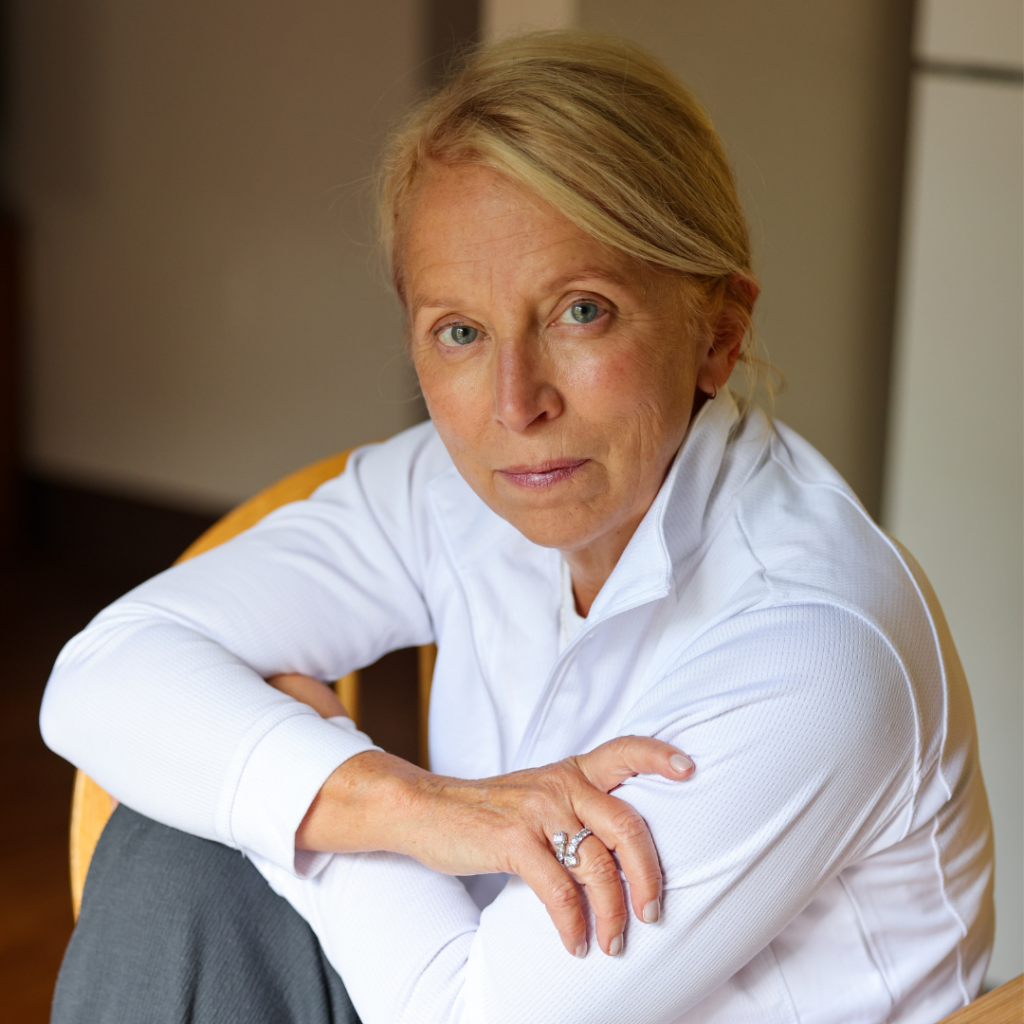

Liz Hofreuter

Founder GEN-Ed

Not your typical researcher or consultant, Liz connects lived experience to transformative leadership. To uncomplicate leadership and education, every story matters and she is just getting started.

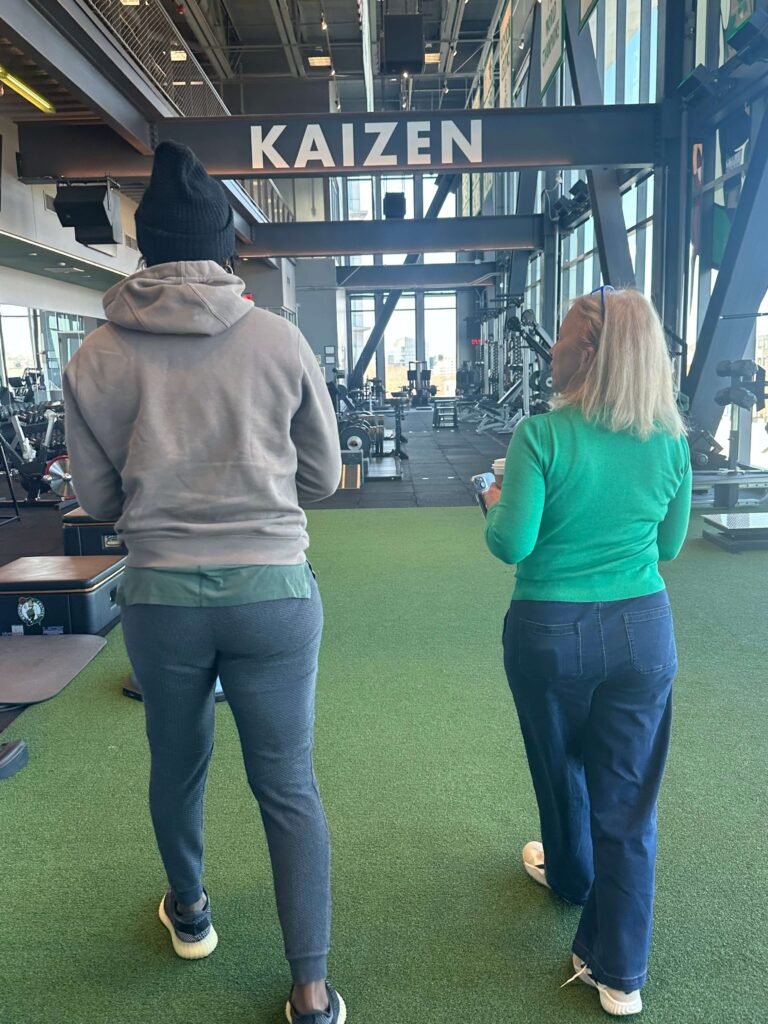
Kaizen

Palmer: And then the process gets easier and easier as you do it. And then finally, you get more comfortable doing it.

You get more comfortable. You reach the next level. You move forward stronger. Things change …good change. I do not live in constant fear that something is going to happen to my daughters. I have learned to let them live their lives…mostly. I very rarely cry myself to sleep in grief as I once did. My heavy emotions …and the humor I use to disguise them… are tempered.  I cannot point to any single moment when things started to get lighter… but they did.

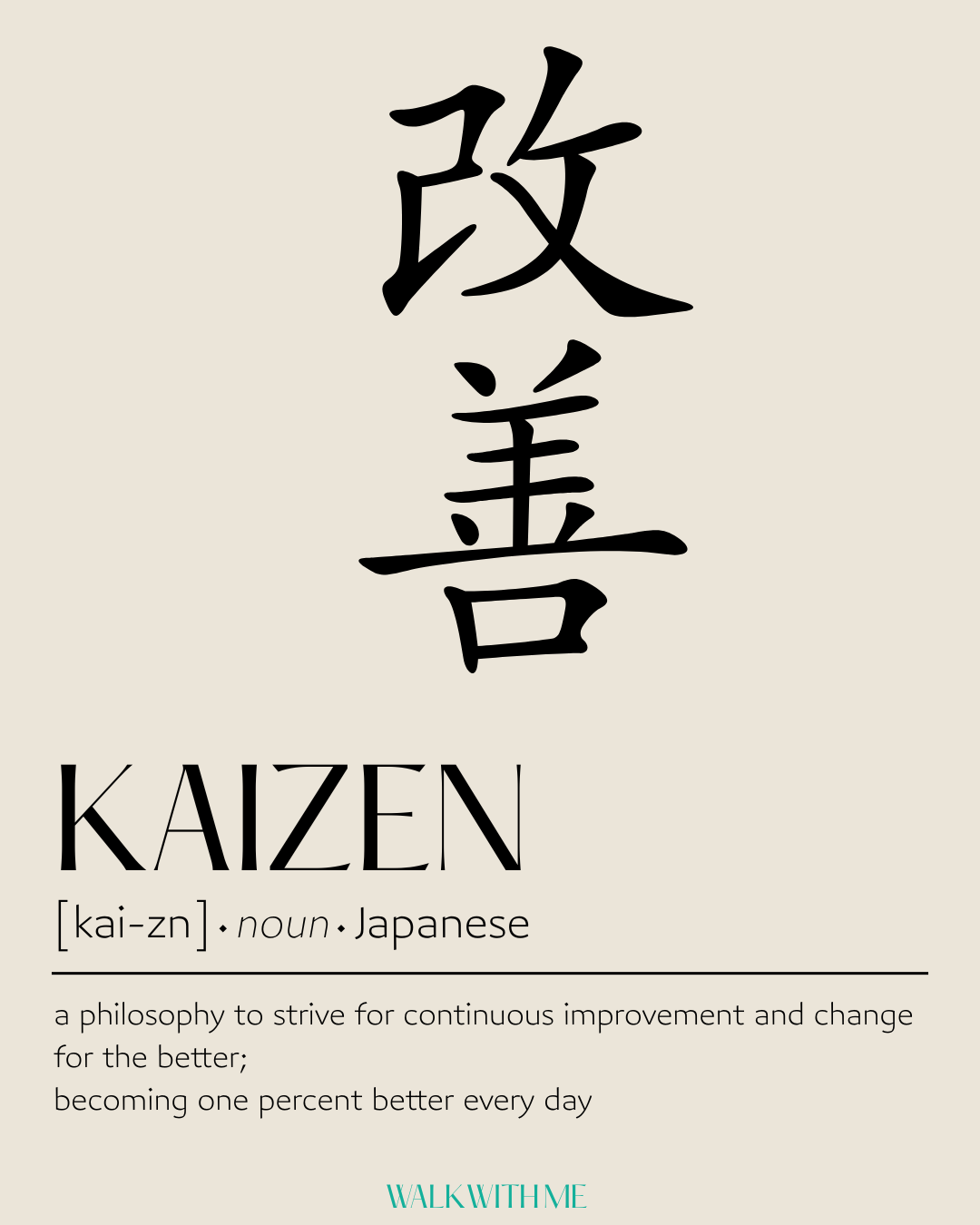
That’s Kaizen.

Translated literally to good change. One percent better everyday. It’s not a lightning strike. It’s a steady but light rainfall. 

The beauty lies in both its gentleness and its accessibility. All of us can improve by one percent. We can make one small adjustment. We can take one more step. While the improvement may be barely noticeable day to day, stay the course. When I look back over months of conversations, my own unfolding is undeniable. When I consider each walk’s transcription another layer is revealed. Kaizen has been in the very fiber of these walks.  

It directly showed up in the seventh walk with Rose Helm as we discussed supporting teachers and students.

Rose: How are we going to support students right across this spectrum of learning, which we’re saying has always been there and it’s the right thing to do …if we aren’t supporting teachers to be able to do that?

As these walks have proven to do, we circled around to an answer: Incremental improvement. Small, good change. Kaizen.

Rose: So what is that Japanese theory? I think it’s Kaizen, where it’s the idea of… What’s the next step you can take? They do this with people who are starting a weight loss journey or intimidated by an exercise regime. What is one thing you can do? Can you stand up a little bit more today? For five more minutes…or whatever.

Nineteen walks later, Ashley Battle toured me through the Boston Celtics Auerbach practice facility. There, painted boldly across a steel beam overhead: Kaizen.

Brad Stevens had brought this philosophy to the team during his coaching tenure as a fundamental shift in how they approached their game. As Nicole Yang of the Boston Globe captured it:  “When implemented in sports, kaizen de-emphasizes the game’s outcome. Instead, it centers the process. Stevens regularly encouraged the Celtics to stay “growth-oriented,” with a focus on striving for daily improvement. The right process, defined by consistency and incremental progress, will eventually lead to the right results, he preached,” 

Walking beneath that beam, I knew I would write this blog. 

We may not be able to pinpoint the exact moment when everything shifted—but it will shift.  One more rep today than yesterday. One more mindful step. One more genuine question. Then you’ll look back after a month… a year…or even twenty-one years, and see the quiet, persistent magic of Kaizen …yes, some days will feel like setbacks and you may very well lose your footing in that quicksand, but you are still making progress… good change. 

That’s Kaizen.


Liz Hofreuter

Founder GEN-Ed

Not your typical researcher or consultant, Liz connects lived experience to transformative leadership. To uncomplicate leadership and education, every story matters and she is just getting started.
Still Born

This is the very blog for which I am grateful that we decided to have an audio companion. If you are reading this, your mind is thinking about a stillborn.  That is not how I think about it. Nicolas Hofreuter Landini may have died, but he was still born.

He would be 21. I don’t have to calculate that in my head. I always know. He is Grace’s twin brother.

If your heart drops when I say that, please don’t feel sorry for me, for their dad or for Grace. It is hard to explain, but somehow your sympathy makes it worse. I cannot speak to the pain of losing a child, but I know the pain of losing a baby. 

I hope you never do. 

This walk is written in support of those who suffer a similar death… the parents, the siblings, the extended family… or anyone who is trying to understand the grief of losing a baby.  

Mark: I think the biggest thing is a lot of people can’t walk in your shoes.

Liz: Thank God.

For reasons I still cannot yet articulate, I only feel truly comfortable telling the story with someone else who has experienced the same loss. This is a collective story. Five other lives are inseparably woven into it.  I spoke with each person individually, yet their voices harmonized to reveal a separate but shared narrative waiting to be told. Walk with me as Amanda and Chris, Jessica and Jon, Mark and I try to pull back the layers of what we experienced —hoping our journey might light the way for someone else walking a similarly dim path. What follows is the unravelling of the threads of our shared experience, hoping that in the telling, we might offer a lifeline to someone who needs it.

Jessica: I always keep track of how old he is and what he’d be doing. In fact, he’d be out of college now. I don’t think that ever goes away. I think the pain of what I went through will always be present. It’s not like I can forget that pain.

I never felt so alone as I did then either. I remember I would try to tell Jon, and he’d listen. He was there. But even telling him, I realized how completely alone I am. You know what I mean? Even if someone’s there. I think that was the first time I really realized that no one can protect you from anything, really.

Amanda: It just made me realize that as much as I am in control of things, I’m really not. For me, I always say, Carson’s death took my faith from being pretty passive to active because this is where the rubber meets the road. And it was knowing God’s there. And how can I trust him through this really terrible thing that just happened to me? Because now I’m scared.

Liz: Scared of what?

Amanda: Just the fact that people died. I mean, my child died.

Pain, fear, anger, loneliness… These are just some of the emotions that still play in our hearts as mothers who have lost. Nathan would be 23. Nicolas would be 21. Carson would be 8.  I don’t know what a healthy pregnancy or birth is like. My only experience was the twins: my fragile preemie rushed through the doors to the NICU and then the dimming of lights for the hollow, clinical birthing of Nicolas. I’ve been told that in healthy births, oxytocin floods the brain with such fierce love that some women forget the pain of childbirth entirely. Their bodies, wise with forgetting, make room for joy. But my body remembers everything.

Liz: Everybody talks about the amnesia of childbirth, not when it’s still birth. 

Jessica: Not so for me, I honestly don’t find that true anyway because I remember. I remember what I was feeling. I remember my worries. Like with Mary, there weren’t worries. I remember I’ll be like, oh, God, I hope I don’t pee. You know me, that stuff. I wanted this little romantic setting or whatever, a playlist and stuff, where after Nathan, it was like, I could care less. I don’t care if you have to go in there and knock me out, just take the baby. You know what I mean?

Jessica: That’s one of the hardest things for me is to keep my mouth shut when people say stuff like that because people are like, “Oh, I want this and that, and then the other.” And I’m like, “You don’t even –-beep – know what you want. 

Liz: You want a healthy pregnancy and a healthy birth.

Jessica: You think that’s what you want. That is not what you want. What you want is a healthy baby. 

I mentioned anger, didn’t I? You can hear that anger that exists just underneath all of the other emotions. We don’t talk much about the anger stage except with other mothers, but it is a normal stage of grief and shows up for mothers who have lost.

Liz: I went through a pretty crazy period of you deserved this.

Jessica: Yeah.

Liz: We were driving up for one of our appointments and there was a car accident, and we arrived pretty soon after the accident before they had stopped traffic, and we didn’t stop and get out. That was reason one. And then just feeling not good enough, not whatever, all the other things that go through your mind. Did you ever have any of that?

Jessica: Oh, yeah. I thought it. I still to this day think it was my fault. I ate a lot of candy the night before, and so I thought it was the sugar.

So add self-blame, guilt, and jealousy to the list of lesser discussed emotional landmines we still tiptoe through.

Liz: I don’t think anybody talks about their twins, that there’s not this weird, wistful reaction inside of me that quickly goes through… You’re lucky. Thank God for you. I’m a little jealous.

Mark: I’m jealous of twins for sure.

Neither of us like using the word, jealous, but words are difficult to choose when you discuss such grief. Articulating the raw honesty and complexity that still echoes in our hearts keeps us silent. That is not the answer. Turns out the word “jealousy” often implies fear of losing something you have, so maybe our lingering fears choose it subconsciously.

The actress, Julia Roberts, was pregnant with twins at the same time I was. Hazel and Phinneaus. Why do I know this? Because they survived. I’m not proud to say I harbor some rare form of anguished envy, because I am also so grateful that she never 

Liz: …went in for a regular checkup, and there was only one heartbeat. 

Mark: they couldn’t find the two heartbeats.

Liz: A nurse very, very kindly said, Hadn’t you been counting kicks? And it was enough to make me question, did I cause this? 

Jessica: Well, I remember the night before that he was moving so much, like weirdly moving so much. Then, I never felt him move again. You know what I mean? But the weirdest thing was I had a dream that night … What I remember of the dream is that I was talking to God, or Jesus, I don’t know. They were pouring liquid out of a container, and I was just crying. I said, “No.” They said, “Not this time” or something like that. I woke up and I just knew he was dead, but I went into work, and I literally got all the billing done. I got the payroll done for that week. I got everything done by 10:00 then I went to the hospital. 

Liz: You knew. 

Jessica: I knew, but I wasn’t… Then you know how you second-guess yourself? Oh, yeah. Everything’s fine. You’re just ridiculous.

Amanda: Okay, so I woke up on St. Patrick’s Day, and in hindsight, when I say this, it’s not an exaggeration. The day was dim. There was just a darkness over it before I even knew he had died. I thought, This is weird. I never wake up at 7: 30 comfortably in my bed without feeling kicks in my ribs and all that stuff. I went downstairs, I drank some water. I tried to get him moving. I took a warm bath because it always got him moving. That’s when the panic set in, and that’s when I just started praying, “God, what? It can’t be happening, not to me. It happens. I know that, but not this late in pregnancy, not to me.” I mean, as silly as this sounds, I’m a good person. This is what is going on in reality. I had called my doctor and they said, Come right in.

I knew on the way there, it was raining, and I just felt it. I knew, but I didn’t want to believe. Even when they confirmed and said, his heart stopped, I wasn’t ready to believe that he had actually died. The machine was wrong, and there’s still hope, and this isn’t happening.

Once your fears are confirmed, the world rushes at you, but you are not really living in it. 

Jonathan: It’s like you’re on a ride and you can’t get off from there on. I remember asking, what was the option? I remember saying “Okay, you can just do a C section. Just knock her out.” “No, we can’t, oh, no, she has to give birth.” That’s when I thought, “This is punishment. What do you mean?”

Amanda: There’s so many decisions that you have to make, and it happens in the blink of an eye. One minute you’re waking up, and the next minute you’re like, “Am I going to go be induced, or do I want to wait till labor starts naturally? Are we going to have a funeral or memorial? Are we going to do nothing? Is this real? Are we going to cremate him or bury him?”

Mark: It was all a rush. They rushed us in there to begin with. I was worried about you. I was obviously worried about Grace because we knew we had already lost Nicolas. I didn’t want to lose it all.

The world hits fast-forward while we are floating somewhere near the ceiling, observing this as if it is somebody else’ life falling apart in real time. They rush in with protocols and procedures, but using gentle voices and hushed tones. The questions come like bullets. Do you want to be induced? Would you prefer to wait for natural labor? Will you hold the baby? Do you want photographs? Funeral or memorial service? Burial or cremation? Each question felt impossible and urgent all at once. Being carried along by a current with no power to resist. Making decisions that felt scripted by someone else while we had retreated somewhere deep and unreachable. The world rushed in with its demands and timelines and necessary cruelties. And mother and father move through it like ghosts, going through the motions of the living while feeling fundamentally separate from life itself.

Liz: If I could do one thing, based on my regrets, it would be to help a family say things like, “It doesn’t matter, you have time. Take some time. You don’t have to decide that today.” I wish somebody had just said, “Take a breath.” Really, the only decision either one of us had to make was, “Are we going to deliver today or later?” And nothing else had to be decided as quickly as we were told. 

And then there was telling our families. How do you pass on such grief? How do you find words for something that has no words? For me, hearing myself say the words out loud cut the grief even deeper…and I had to do it over and over again.

Jonathan: I remember making the calls, and I remember calling Marianna and Nanette. They must have been together somewhere. They just dropped everything. The next thing I know, I remember them coming down the hall. It was the middle of the night.

Liz: It’s interesting because I remember making those calls. And part of you feels like.

Your whole world is shattering and people are saying the most stupid shit on the other end of the phone.

Amanda: I feel when we go through these things, people don’t know what to say. The filter goes away. And it happens with people that we love very much. It happens with people that we don’t know at all. I always say when people are going through hard things, it’s easier to sit in the silence because at least I would know you’re here with me instead of saying something wrong or, no offense, but stupid. That is hurtful. That just brings so much more internal tension to me as the person who is grieving their child.

Jonathan: It’s awful. And you just don’t. And you don’t even want that. Right? I mean, you want somebody, like I said, I reached out to a couple of my sisters because you just want somebody there. 

And when they get there, the door of your room will have a card to mark that yours is a room of grief on the obstetrics floor.

Liz: I think about that placard that was outside the hospital room.

Mark: With the little drop of water on the leaf.

This subtle image of a fallen leaf posted outside a hospital room door signals that something heartbreaking has happened to the people inside. When I saw that card outside Amanda’s door so many years later, I was stopped in my tracks and somehow transported to Ruby Hospital in 2004. 

Amanda: At the end of the day, nobody really knows how to do this. Nobody really knows how to lose a child, how to grieve, how to be there for each other. I think we all just try our best. We’re going to fail. We’re going to mess up. But I feel like sending that grace and forgiveness to people.

Trying to comfort others when grief is incomprehensible to you is another level of pain. Carrying their grief was a weight none of us could bear. I wish I had been able to articulate that then.  I offered grace to those around me, but left none for myself. For me the load only became a little lighter three weeks later when I received a letter and a book in the mail. Jessica had written to me. Its raw emotion gave me comfort. Allow me to share a small excerpt.

“ I know about the pain you are going through. When Nathan died at 36 weeks it was a complete shock to me… I hope you have a great network of friends and family to lean on. At times they were very helpful to me but sometimes I didn’t want to talk to people who had no idea what I’d been through and couldn’t fully understand my pain.” 

Jessica: When Nathan died, several people reached out and… and it was totally different talking to someone who’s been through it. So I reached out to you.

I knew then it was a grace I would need to pay forward. Unfortunately, I had the chance years later when my friend Darryl Crews called to tell me his son and daughter-in-law had lost their baby.

Liz: I think when I showed up with you, that was what I really wanted, I wanted to say to Darryl, she needs space and love, and somebody make sure you’re taking care of Chris. I mean, that was something I know I said to Darryl and Judy.

Amanda: I remember when you showed up and said that. It hit me – I’m only living my experience, he’s having a whole other experience. He’s trying to make my experience of birthing a child that’s not going to cry be easier than what it was. I’m going to cry thinking about it because it was this selflessness that was coming out in him to try to comfort and console me. I’m like, “You don’t have to be strong for me.” Then we cried together. I don’t know. If you didn’t say that, I don’t know necessarily that I ever would have had that because I was so absorbed in the idea, I have to birth this child.

Liz: When I went to see Amanda Crews when their baby died, the most important thing to me was that people take care of Chris. We were in the midst of getting divorced. And I think I assumed if you didn’t take really good care of the relationship of the parents, what happened to us could happen to anybody.

Mark: I guess I understand that.

I don’t know how to articulate the pain a father feels, but I did live the effects of it on Mark, Nicolas’ dad. Chris tried to help me understand.

Liz: Talk to me about being the father and how different that is from my process of being the mother.

Chris: So if you think about it, as the mother, you felt that child, right? It was part of you. We didn’t feel that. I mean, we felt the kicks every once in a while. So I feel like it’s completely different. 

I don’t know if this is valid or not, but I felt like I had been through a lot of loss in my life already. And so I felt, Oh, I’m old hat at this. I just need to be there for Amanda, whatever she needs. You knew my dad, right? So everything gets bottled in. Oh, I’m good. There were people that came up and said, and you might have been one of them, actually. Everyone’s asking Amanda how she is, but how are you? But the line was always, oh, “I’m fine. It’s whatever Amanda needs.”

Chris worries eight years later whether his feelings were valid or not. What devastating truth lives in that statement. When others unintentionally push us to “get through it” and “move on,” do we begin to question whether our emotions have any right to exist? And what happens when no one even recognizes your grief as grief at all?

This is exactly why I worry for the fathers.

Liz: So I actually worry about the husband because at least people think about the mother. I shouldn’t say husband, I should say father. But I never heard anyone say, how’s Mark doing?

Jessica: Yeah, no. And that was hard for Jon. Jon always said he’d come home from work and all day long, every single person he knew avoided talking about it with him. That’s how men deal, right? He’d come home at night after I’ve been dealing with it all day and reading and writing in a journal and all that stuff. And then we’d go out and have a glass of wine or whatever. You know what I mean? But that was the only time he had to talk about it. It was with me. Probably one of his sisters or whatever, probably. And if there was another couple there with us at dinner, he couldn’t talk about it, but I still could. You know what I mean? And it was like, everyone just let me talk. So that was hard for him.

Liz: Those societal norms are very difficult in this state.

Jonathan: This guy said, “Oh, yeah, I heard what happened to your wife. That’s hard on the women.” Yeah, it is.

Liz: That had to kill you.

Jonathan: Well, what do you say? 

Liz: It invalidates everything you feel, you know.

Jonathan: Yeah, well, yes, it does, but I didn’t exactly take it that way. It really kind of just made me pause to think what it meant because I was going through all these emotions of loss, but I did not carry that child. So I felt guilty. I felt terrible for my wife. I still feel terrible for my wife. I’m still angry that she had to go through that. You know, as husband and protector that was one big emotion. 

What an impossible contradiction—his own heart was shattered, but the father feels compelled to be the strong one. He was grieving the loss of his child just as deeply, yet somehow he also had to become the shield between mother and the world’s demands. Feeling the need to protect his family while his own pain went largely unacknowledged. The world expected him to be the provider and protector even when he was drowning too, creating an unintentional separation within our shared grief that still feels almost unbearable.

Liz: Isn’t that the role of a husband and father?

Chris: That’s how I see it, for sure.

Liz: But was that true? Did it kick you in the butt later?

Chris: It definitely kicked me in the butt later. But I don’t know, it still kicks me in the butt, to be honest.

Even after we delivered him and got to hold him for a little bit, there were still those decisions that we had to make. Like, how long are we allowed to hold him? What are we supposed to do? 

Mark: The first thing I think about is that nobody can prepare you to hold a lifeless child. That’s the most vivid memory that I have, is when he was brought to us to hold him in that dark room. And it wasn’t for long, but it seemed like it was a long time.

Jonathan: But there’s also the fact that I never held him when he was alive, so can I feel the same loss? You know, it’s almost like you have to give yourself a break. 

Liz: That’s what I think I’m starting to understand is that you have the loss, but you still feel like an outsider.

Jonathan: Absolutely.

Liz: If we got a call right now that someone else we knew was going through this. What advice would you give to the father?

Chris: So it’s funny you ask that because I work in a building with a lot of people, and I’ve had a few that have gone through the same thing or similar. And I don’t know if it’s the right advice or not, but it’s always been. And I say, You need to be there for your wife. Whatever she needs, you got to be there for her. You can worry about yourself later, which I don’t know if that’s the right advice or not. That’s what I did.

Liz: Did you worry about yourself later?

Chris: No.

Liz: But Amanda was there for you, too?

Chris: One hundred percent. For sure.

Liz: So what advice would you say to a female employee or colleague as far as taking care of the father of the baby? 

Chris: Oh. That’s a good question. I guess just talk about it, really. Might be hard at first, but the more you talk about it, the more you can heal.

Talk about it. There is no statute of limitations. Bring it up today. It does wonders for me to hear his name on someone else’s lips. Their stories matter. They say a picture is worth a thousand words, so thank goodness all three of our families have pictures of our sons. We highly recommend it. 

Jessica: When Nathan died, I wanted to acknowledge him. We had a big service and everything else. You know what I mean? And I had pictures and everything else. And everyone was like, you can’t put those up. It makes people uncomfortable or whatever. And I never did. And I get it. But I was not about hiding it. 

There we are… carrying other people’s emotions. Putting their discomfort before our own grief or healing.

Amanda: After Carson died before his memorial, a friend said, “Just be prepared. This is not for you. This is for you to comfort however many people show up and to make them feel good. It’s in the moments after today that you will need it.”

We need you to understand it is in lots of moments after that day that we need your grace – and space for our grace for ourselves. 

Amanda: I mean, there’s a dream before, but it’s a dream that died. Because you make all these plans. Like, what are they going to be like? They’re going to be cute, and they’re going to smile, and they’re going to probably cry. I’m going to have sleepless nights, but then none of that comes true. We had the car seat in our back seat of our Honda CRV for weeks leading up to this. We were prepared. The nursery was done. The car seat was installed. When we drove home from the hospital, we drove home with an empty car seat in the back seat to an empty nursery. Walking home into our house for the first time was not what I had dreamed of. It was my worst nightmare.

Mark: I don’t think people recognize the grief that we had with Nicolas quite as much because we had Grace.

Liz: Agreed. Do you remember all the people who sent us a pink card and a blue card? A pink, Welcome to the World, Baby Girl, and a blue, Sorry for your loss.

Liz: When Nicholas died, the difference for me was that it was twins, and I had Grace, and all the attention had to be on this child in the NICU. And my mom tried to get me to trust the nurses. “She’s in the best place she can be. I will stay around.” And I just couldn’t leave. I had already lost one child. I wasn’t going to lose two. 

I threw myself into the joy instead of the grief, and I dealt with the grief in little pockets. It’s almost like having rooms, and you go into the grief room for 10 or 20 minutes and let yourself experience whatever that is. And then you have to come out because the baby needs to be fed. And feeding Grace was an all day job because you fed her. …You had to wake her to feed her because she was so young. And then I’d have to pump after feeding her because I had to express all the milk. So then it was double the time, even though it was just one baby.

Every feeding for 11 months was a physical reminder that my son had died. I sat alone in a beautiful yellow chair and pumped the milk that was meant for him … almost every feeding I cried or I prayed. This infant loss leaves wounds so profound that don’t come up in typical conversation.  If you want advice on how to support a friend or loved one, show up and hold space for the stories.  This infant loss doesn’t leave us.

Liz: Do you think you dealt with your grief?

Mark: I think I still grieve. I don’t think the grief is ever over. The grieving is never over losing a child. Because a piece of you is lost. You lose some of your future. 

Jonathan: I reminisce about what he would have become? Where would he be now? What would he be doing? What would our relationship be like? You think about things like that, you know, and then you go back to living your life, but you don’t. 

Liz: I think we live with a fear that some parents don’t know. I think there’s collateral beauty to the way we learn to cherish the miracle of pregnancy and life, but I think we have tasted the fear of losing a child and have fear in a different way too.

Jonathan: Oh, yeah.

This fear was palpable as it played out two years ago on a day as beautiful as I can ever remember.

Liz: We went to Italy two summers ago with Rick and his boys. He has four boys. I have two girls. We rented a boat. We were out on the Amalfi Coast, and we were stopping. And the captain said to me, “The kids want a cliff jump.” And I said, “Absolutely not.”

I was suddenly 19 years younger and feeling the pungent fear of loss… the pain was imminent and the anger followed close behind it.

Liz: Those kids swam very far from the boat to where the cliff was. And they had made a deal with me that they would do a short jump first to make sure they were okay. And I was so angry. I was so angry with everyone because I was the only one in that water that had ever… I mean, you said it. I was a mom who had lost. And you want me to sit here in this water and watch my kids? And they climbed to the highest cliff. And the boys jumped, and I could see how scared my girls were, and then they jumped. And when everybody was back in the water, Rick said to me, “See, they’re okay.” and I said, “It’s not okay.”

I wasn’t mad at anyone on the boat that day. I certainly wasn’t mad at my daughters. I was angry – just angry as a stage of grief that still jabs a left hook whenever it wants. What wasn’t ok? Me. I wasn’t ok…not in that moment all those years later. 

Amanda: Especially being a mom who’s lost. It’s really hard to let go. And that’s where I’m at right now. Where is the line of, Hey, I’m being a helicopter parent, or I’m letting them be too independent, or I know they need me still, but that’s something I’m working on. I don’t know if I’ll ever be fully able to let go. And let them just leave the nest.

Liz: I’m so glad you articulated it that way because, yes, you’re having to let go, and you don’t have a choice. But it’s different.

Amanda: Because you can protect only so much within your limits. But when they go and they jump or they do whatever they’re going to do, it’s like, I just want to keep you safe for a longer because I don’t know that I can bear the loss of another child. I don’t think I could do it.

Liz: Most people don’t think they could do what you’ve already done.

Jonathan: You just don’t know where the path leads. So it’s hard to, what, 23 years later … just the path that it throws you down. 

Mark: I would agree with that. You don’t know what your path would have been, though, if you would not have lost a child. 

Jonathan: We hit this obstacle now we’re going to pivot, and we’re going to go this direction. And then, you know, and then you have a child that has autism, and you pivot, and you go, and you just keep going. 

Liz: That’s that 30,000 foot thing.

Jonathan: Yeah, but you. Yeah, but then I was looking down and the world was spinning out of control. And now I may be looking down and be like, you know, okay, yeah, we had that and it was unfortunate when we went through it. And it changed us. I think it changed the way maybe, I hope maybe we’re more compassionate as human beings and maybe we’re just a little more like we let a little more run off the shoulder. We just don’t sweat the small stuff.

This isn’t about finding meaning in tragedy or believing everything happens for a reason. It’s about discovering that when you’ve lost completely, the smallest offerings of light become sacred. My capacity for gratitude has been forged in the fire of loss, and while I would trade it all to have my son back, I can’t deny that grief has taught me to receive joy with both hands wide open.

Liz: I think a lot about the fact that I didn’t get the opportunity to raise my son. I am almost embarrassed to say, I think to myself “Well, your grief isn’t as bad as someone whose child lived and then died.” None of it is relative. It’s still grief. It’s still pain.

Dr. Myerberg: Did you deal with it at the time?

Liz: Of course not. No. That’s part of what this sabbatical project is.

Amanda: I am working on getting Carson’s story out there on paper through a book, and the words that keep coming to me is… If only for one. And we said that at his service, If this is only for one person, in our case, it was to come to know Jesus, then it would be worth it. But it has to be worth it, right? But if it’s only for one person that you’re showing up and doing whatever it is that you’re doing, I think there’s so much beauty in that because that’s how we make a change through each other. It’s a connection.

Liz: The bottom line was the only number that matters is one. If one heart is changed. I love it. If only for one.

Amanda: I tell a lot of people who I talk to now because I talk to a lot of women who go through this. I tell them what you told me when I was in labor and you came to the hospital and you were by my bedside and you said, “This feels like an island, but you’re not on an island. You’re on this peninsula.” Jessica reached out to me after we lost Carson in a letter. It’s just like what we were talking about, if only for one, we go through these really terrible things, but then there’s beauty that comes from it because other people are going through the same thing. Maybe not the exact situation, but we have the power in our voices and in our testimonies and stories to encourage one another to keep going.

Liz: I’m sorry you lost your son. 

Mark: I’m sorry you lost your son.

Unfortunately, somewhere, someone is sitting in a darkened hospital room with a card on their door, feeling more alone than they ever thought possible. Someone is driving home with an empty car seat. Someone is pumping milk that will never be needed. If you are the one who needed to know that the anger is normal, that fathers grieve differently but just as deeply, that there is no timeline for healing, that you can speak their name out loud, that you are not broken beyond repair—then every tear we’ve shed in telling these stories has been worth it. 

If our words reach just one heart in that darkness, the brief lives of Nathan, Nicolas and Carson created ripples that reach far beyond what we would hope. They were still born and their stories matter.


Liz Hofreuter

Founder GEN-Ed

Not your typical researcher or consultant, Liz connects lived experience to transformative leadership. To uncomplicate leadership and education, every story matters and she is just getting started.
In Our Nation’s Service… for our babies

On August 9, 1963, in a small room at Boston Children’s Hospital, a father stood helpless as his newborn son struggled for breath. Patrick Bouvier Kennedy, born five weeks early, would live only 39 hours. Those moments between first cry and last breath break your heart. The President’s grief was private, but the questions his son’s death raised were not. Why couldn’t medicine save a baby born to unlimited resources and the finest doctors? In the wake of that heartbreak, researchers who had been quietly working on the mysteries of premature lungs suddenly found themselves with funding, urgency, and a nation’s attention. Although Patrick’s life was cut short, the death of the Kennedy baby sparked a revolution in neonatal care. The science of keeping premature babies alive was about to change forever, born not from textbooks or lab experiments, but from the raw, universal heartbreak of parents who refuse to accept that some babies are simply too small to save.

On February 17, 2004, Grace Hofreuter Landini, born eight weeks early, survived. Until I walked with Dr. David Myerberg, I didn’t know about the Kennedy baby. I didn’t know the impetus for neonatology. I just knew I wanted to walk with this man who knew the name of every baby and parent he saved for over a decade. It is on his shoulders that Grace’s doctor stood to save my little girl.

Dr. Myerberg: The Kennedy baby was the point. Do you know about the Kennedy baby? 

Liz: I don’t. 

Dr. Myerberg: Okay. So John F. Kennedy and Jackie had a baby who was 35, 36 weeks gestation. So your baby was much smaller than that. And this, of course, was in the early ’60s, I believe. He was in the White House. They had this baby, and the baby died. Died of hyaline membrane disease. And I’m sure that the politics of it just exploded at that point. God, it was the President’s baby, and the baby should have survived. And we got to start doing some research on this. It just took off. Politics matter. I don’t think any of the people whose babies were saved over the next 50, 60, 70 years, realize how that happened.

But it happened. And I believe that there were some pretty good units already, and good research in Europe and in Australia, so US was able to take from the rest of the world. But man, it happened. And it happened primarily because of that. Now, I’m sure, go back and read the history of this, that there were people who were talking about this for a long time before the Kennedy baby.

Liz: But it didn’t get the momentum. The story wasn’t told. 

Here’s what’s remarkable: it wasn’t just the tragedy itself that sparked a revolution in neonatal medicine—it was the power of a story that the whole world could understand. Respiratory distress syndrome, as it is now known, wasn’t an obscure medical condition affecting nameless premature babies; it was the thing that took Patrick Kennedy from his parents’ arms. Scientists who had been working in relative obscurity found themselves with government backing and public attention. The story gave the research a face, a name, a family that millions knew and grieved with. There’s something profound about how narrative can accomplish what statistics never could. Stories transform us and demand our attention and action.

Every story matters… especially the stories I heard from Dr. David Myerberg as we walked through the trails at Cooper’s Rock outside of Morgantown, West Virginia. He made this his home after medical school because…

Dr. Myerberg: They were just starting a neonatal unit, and it was like, okay, build something. You’ve had all this incredible training. Build something. And so that’s why I came here.

Liz: When you say they were just starting it, how far along were they? How responsible were you for the building of the neonatal unit?

Dr. Myerberg: It wasn’t just the building, but it was the spreading of neonatology doctrine over the rest of the state. They had built a unit, which was eight beds, and they were doing it. But they were doing it with one person who had done her residency there and with the support of the rest of the staff, so they didn’t have enough people to really run a neonatal unit. And so I came in as the second.

It was fun. It was great. I swear, The first 10 years or so that I was there, I remembered almost every baby.

Liz: Oh, my goodness.

Dr. Myerberg: And all the parents. It was wonderful.

Liz: And are all the children in a neonatal unit at serious risk?

Dr. Myerberg: Yeah, they wouldn’t be in the neonatal unit unless they were. They’d be in a normal nursery. At one point, I had a kid who came into the NICU brain dead. And we had to tell the parents that that was the case, and there was nothing more we could do. And so the baby died. And this baby was a SIDS case.

SIDS – Sudden Infant Death Syndrome. If you have been pregnant, you know exactly what that is. It is the reason Grace and Ella slept on their backs on a sheeted mattress with no bears, bumpers or blankets. The list of don’ts goes on. The warnings come at you from everywhere once you know to listen for them. Your hospital discharge nurse reviews safe sleep practices before you leave with your newborn. Your pediatrician reinforces them at every well-child visit. Even the tags on baby products remind you of the rules. It’s not fear-mongering—it’s evidence-based prevention delivered with the kind of repetition that ensures you’ll never forget, even at 3 AM when you’re so tired you can barely remember your own name. The safe sleep guidelines aren’t a guarantee against heartbreak; they’re simply the best tools we have to tip the odds. 

Or so I thought. In West Virginia, we have another tool: The Birth Score.

Dr. Myerberg: I began to understand what these parents go through and how important it is for doctors who do neonatology to understand SIDS. Not just understand it, but maybe do something to prevent it. So In the late ’80s, I got a federal grant for this, and started a program that was called the SIDS Prevention Project.

He learned

Dr. Myerberg: …sometimes these babies have apnea, and it’s unknown to the parents.

Liz: At birth, they have apnea?

Dr. Myerberg: Well, no, they have apnea when they go home. And it’s unknown to the parents. Sometimes the parents notice it, but sometimes they just notice it when the baby’s dead. There was some literature at that point that led people to believe that if you monitored these babies, you found out who they were first. Based on certain criteria, you monitored these babies, and you could keep them from dying.

Liz: Wow.

How did I not know this? I knew “Back to Sleep” but there was more.

Dr. Myerberg: That was part of the SIDS Prevention Project. The other part of the SIDS Prevention Project came from England. There was a guy named Robert Carpenter, who was basically a statistician and a pathologist there, who did some studies that showed that these SIDS kids didn’t grow properly before they died and that they had problems. This was where the pathologist came in, he went back and he met with the families. They said, “So I need to know, were there things going on?” Well, yeah, there was this. They weren’t growing well. They weren’t eating well. 

Liz: Failure to thrive? 

Dr. Myerberg: Yeah, failure to thrive. Occasionally, they would say, Yeah, baby had some spells where I thought the baby stopped breathing, but then it started, so I didn’t do anything. And so they put together a program with their visiting nurse group, and they increased the number of visits that the nurses made. And they developed what they called the birth score. 

The birth score was this thing that they developed in Sheffield, England and what it did was treat the top 15 % of the kids with birth scores that were that high, and gave them special treatment with the visiting nurses. 

Liz: So just those babies the most at risk.

Dr. Myerberg: Risk scoring has been around for a while, but this was the first time they ever did that. I read about that and I thought, we could put together a program in West Virginia where we not only taught the doctors how to recognize the ones that needed to be monitored. And at the same time, we could convince the public health service in West Virginia to do more visits on the kids who were more at risk. 

What it showed was over a relatively brief period, the number of SIDS cases in West Virginia dropped precipitously.

Liz: Wow.

After their remarkable work with the SIDS Prevention Project Federal grant, Dr. Myerberg was asked by the American Academy of Pediatrics to join two other researchers to evaluate the world literature on whether the Academy should recommend “back sleeping” to prevent SIDS. The results of this were published in 1992, which is considered a seminal publication that supported the “Back to Sleep” initiative adopted by the AAP.  He was asked to travel around the US to speak about this research 1.  Turns out… my walking companion is at the heart of all I had known about “Back to Sleep.”

Dr. Myerberg: And that then was followed up a few years later, I was gone by the time they did this… I wanted to do this, but I was in law school at the time… but they went to the legislature and they had this program, the birth score, passed by the legislature to continue. And my bet is that your little twin got a birth score. 

My little twin. Grace of my heart. Born

Liz: At 32 weeks, I didn’t know anything was wrong. I went in for a regular checkup, and there was only one heartbeat. 

Dr. Myerberg: How was the little girl?

Liz: She, God love her, fought like crazy. I got very upset any time any of the doctors from the NICU would talk to me because they would talk to me about she’s really a miracle baby, be part of our miracle network. And I’d get mad because to me, that meant there was still a chance I could lose her. 

Dr. Myerberg: And How big was she? 

Liz: She was three pounds, six ounces.

Patrick Kennedy was four pounds 10 1/2 ounces.

Dr. Myerberg: Okay, so 29, 30 weeks. Three pounds, six ounces.

Liz: She was 32 weeks by the time she was born.

and the babies next to us were one-pound babies, and they had cocaine in their system. 

Dr. Myerberg: Oh, boy. That’s something else, how much of them are, how many of them are affected by drug addiction.

Liz: Would that be what you saw the most of?

Dr. Myerberg: No, I didn’t. 

Liz: You didn’t? 

Dr. Myerberg: Because see, I was out of there by ’92, ’93. I went to law school.

Law school. That is the second time he referred to the pivot in his life. After championing neonatology for over a decade, Dr. Myerberg went back to law school. Like many mid-career pivots, there was a confluence of reasons he made that decision. Some of them echo mine.

Dr. Myerberg: I don’t think that I was appreciated because… And I don’t know. That’s ground-breaking. Maybe egotistical, but I felt like it was the work that should have been recognized by the department. I was an associate professor. I left as an associate professor. And it just seemed to me like getting promoted to professor was the next step. Never happened.

Liz: So any story of pivoting in your career, there’s not just a single catalyst. 

Dr. Myerberg: No. 

Liz: There’s a couple of things happening.

Dr. Myerberg: Oh, yeah. Oh, no question about it. I told you that I remembered all the babies. From about ’88 to ’90, I didn’t remember any of them. I didn’t remember the parents or anything. It was just like slogging through to get it done. 

Liz: Believe me, I can feel that moment of not knowing the baby’s names anymore because that’s partially why I left my headship.

Dr. Myerberg: I was wondering.

Liz: It’s very similar. There was an email asking if it was okay if a boy was tutored at a specific time on two different days. It was mid-school day. I said, “That almost seems impossible. How’s the family going to get him here? Is he homeschooled?” The email came back, “Liz, he’s a second-grader at Country Day.” I don’t know what the tone was. It was an email. But what my mind heard was, “Liz, come on. You don’t know this kid. You should know this kid.” And that was the first rock out of the dam that I said, this school and every child here deserves a head that is focused to know them all. 

Dr. Myerberg: So that was one side of it. From the beginning of my medical practice, I became very interested in medical ethics. I became a part of what was known as the Ethics Group at WVU in Morgantown. I had some knowledge of the medical side. I had some knowledge of the ethical side but there was always this little thing that kept creeping in. It was the law. And I look at it as a three-legged stool, and I didn’t know anything about that leg. 

I finished up the research that I had done on Sudden Infant Death Syndrome…and I needed something else. And I thought, I’ve always really wanted to understand this legal stuff as part of the three legged stool.

And so Dr. Myerberg traded his stethoscope for legal briefs. A lawyer with medical expertise brings real clinical experience to the courtroom, thus he adeptly defended hospitals, doctors and nurses through Jackson Kelly PLLC for the next twenty years.

Liz: You weren’t turning your back on medicine. You were adding to your body of understanding. 

Dr. Myerberg: Right.

It turns out Dr. Myerberg and I share a common history: we were both Sociology majors at Princeton. It was there in the hollowed office of Dr. Marvin Bressler that I learned to say, “I don’t know” and then take the admission as a catalyst to learn something new.

There’s something beautifully brave about the three words “I don’t know” that we’ve somehow trained ourselves to fear. We sit in meetings, classrooms, and conversations, nodding with what we hope looks like understanding while our minds scramble to catch up with concepts that sailed right past us. The moment you say aloud “I don’t know,” you create space for real learning to happen. You give the other person permission to slow down, to explain differently, to meet you where you actually are instead of where you’re pretending to be. That honest admission transforms you from a passive nodder into an active participant in your learning. It signals curiosity over pride, growth over appearances. And perhaps most importantly, it models for everyone around you—especially children—that not knowing isn’t a failure, it’s simply the starting point for discovery. The courage to say “I don’t know” is actually the courage to say “I’m ready to learn,” – added proof that vulnerability is in service to understanding. 

Dr. Myerberg is more than his professions… I love adding the plural to that word. He is a father and a husband.

Liz: And where in the story do you meet your wife?

Dr. Myerberg: So I met my wife at the time that I was putting together this SIDS Prevention Project.

Liz: Before the sabbatical?

Dr. Myerberg: Right. A few years before the sabbatical. Actually, I met her because of an ethics consult. 

Liz: Oh, really? 

Dr. Myerberg: She was an obstetrics nurse in Cumberland, which is about an hour away from Morgantown. And they had a baby who had what’s known as anencephaly. And I don’t know I don’t know whether you’ve ever heard of that. 

Liz: I’ve not. 

Dr. Myerberg: It’s about as bad as it gets. The head just doesn’t grow. The brain doesn’t grow, so the head doesn’t grow. Some of them can breathe on their own. But many of them have serious problems and die within the first week or two of life. And there’s a debate as to what you should do with such a baby while it’s in the utero and also when it’s born. And they had a problem in their unit. She was a head nurse of the OB unit, and they were having a problem between the nurses and the doctors. And the doctors basically said, “Look, we’re just not going to give anything to this baby. The baby’s going to die.” And the nurses were saying, “Well, the baby’s hungry.” so they needed a mediator… so I went up there and I met Cynthia.

I had met her before this, but I didn’t really focus in on her and talk to her a lot because… And she remembers this. I told you about neonatology not having enough staff. Well, we had to to go out on transports. And I got a call that there was a transport. I don’t remember what year this was. It might have been ’82, ’83, something like that. I got a call at home, there was a transport of twins from Cumberland to Morgantown. And they weren’t terribly sick, but they were too small for them to take care of.

I think we took an ambulance up there and got the twins. And when I went to go to the ambulance to leave from Morgantown, I just put on anything that I could find. And it happened to be one of these what are the Jean things called that have the…

Liz: Oh, the overalls?

Dr. Myerberg: It was an overall. I just put on these overalls. And I had a big beard at the time. And so I went out there and she said… She told me this later. They were standing in the background while we were getting the babies ready. And she said to one of the nurses, “Do you think we ought to let him take these babies?” She didn’t know me from Adam. I introduced myself. I said, “I’m a newborn intensive care doctor, and we go on all these transports.” And she nodded her head, and she turned to this nurse.

Liz: Oh, that is too funny.

Dr. Myerberg: Here I was looking like I came out of the holla.

The West Virginia holler. If you know, you know.

After such a rich life, Dr. Myerberg is very grounded.

Dr. Myerberg: I wake up in the morning and I say six words. I want to be reminded of them every day. So the first word is gratitude. And gratitude comes from just being grateful that I’ve lived a charmed life. And more than that. Gratitude for my wife and gratitude for my kids and so forth and so on. And the second word is compassion. And that’s been very important in my life. When I drive by a dead deer on the road. I go, oh, shit. You know? I don’t know what other people do. 

Liz: So I picked up the habit in my divorce of writing down three things I was grateful for as soon as I woke up in the morning. And it’s amazing when I looked back how many times I wrote ceiling fan. I wouldn’t let myself constantly write my daughters. It just didn’t It seemed like I was being creative enough. And so I would write ceiling fan every once in a while.

I am, afterall, a woman in her late 50’s. A ceiling fan can be the difference between a good night’s sleep and a bad day. Again, if you know, you know.

Dr. Myerberg: The third one is love. And I’ve had wonderful love in my life, from my parents and grandparents and friends and wives. But then following that is patience. Because you may get love, but you don’t keep love. You don’t keep any of those things without patience. And so we’ve got gratitude, compassion, love, patience. And then the the fifth one is self-respect. I don’t think that I can have self-respect without following that credo from Princeton. 

He is referring to “Princeton in the nation’s service.”

Dr. Myerberg: I don’t think I can. I wouldn’t. I wouldn’t have that. But it’s even more than that. I mean, there’s all sorts of stuff that I do where I say, Wait a second. Have a little self-respect here.

Liz: So it encompasses treating yourself kindly?

Dr. Myerberg: Yeah, treat yourself kindly. But at the same time, you can’t have self-respect unless you treat others kindly. You just can’t.

Liz: And the sixth?

Dr. Myerberg: Humility. And that is one that I see so many examples, especially today, of people who have no humility whatsoever. They just want to slash and burn. You got to have humility. When you have humility, you can see other people and what they need. I mean, it goes along with compassion. It goes along with love. I just say it every day. I thought a few years ago maybe I ought to change up the words.

Liz: Change the order or change the actual words?

Dr. Myerberg: No, just change them up. Just find some other words. And I thought, no, these are fine.

Liz: It would be hard to take one away. I could see adding something, but I can’t imagine replacing something. Humility to me is what changed everything or what made me a good teacher all along. But what changed me as an educational leader was realizing how we have to humble ourselves to learn something and when you ask children to learn something, you forget that they, too, have to humble themselves, especially at a time in middle school where they’re just figuring out the bravado, that façade they have to have in order to make it in the world socially. And then you’re asking them in front of those same peers that they’re trying to navigate around landmines, you’re asking them to publicly show, “I don’t know how to do this.” And what compassion was necessary for a teacher to have in order for those children to really be able to learn and not just complete work, but actually learn it. And that was a game changer for me.

I walked with Dr. Myerberg because his son, Jonah, told me to. Jonah had been a student of mine decades ago. We caught up at the Boston Celtics game when I walked with Ashley Battle. He bought me a beer and a burger before tip off. He asked about Grace. He suggested I reach out to his dad who had been instrumental in the neonatal unit, so I did. Honestly, I did it as much as a thank you for the conversation and the burger originally. Now I owe Jonah an even greater thank you. Walking with his dad was yet another game changer for me. It has pivoted a plan for how these walks should show up in the greater universe. It has reminded me that our lives touch so many other lives – our reach is unknowingly exponential.

It also reminded me that a young life lost can spark hope for many others. In 1963, 10,000 babies died like JFK’s son. Today those babies would have a 95% chance of survival. In looking up that data, I read the following:

“In the days surrounding tiny Patrick’s death, [the President] was seen weeping on three occasions; alone, after the boy’s death; when telling his bedridden wife about the ordeal; and at the funeral, so “overwhelmed with grief,” Cardinal Cushing recalled, “that he literally put his arm around the casket as though he was carrying it out.” 

That story needs to be told. John F. Kennedy was not an emotional man. His tears speak to the devastation of the loss of an infant. The story was lost in our collective history because 15 weeks after the death of his baby, President Kennedy was assassinated.

Dr. David Myerberg picked up that story and did his part to rewrite the narrative for countless babies in West Virginia… in the nation’s service. I feel called by the humility and compassion of this man to further that cause for children. I could not be more grateful to him.

  1. Kattwinkel J, Brooks J, Myerberg DZ: Positioning and SIDS: AAP Task Force on Infant Positioning and SIDS, (1992), Pediatrics 89,6,1120—1126. ↩︎

Liz Hofreuter

Founder GEN-Ed

Not your typical researcher or consultant, Liz connects lived experience to transformative leadership. To uncomplicate leadership and education, every story matters and she is just getting started.

Take Me Home Country Roads

They say, “Never forget where you came from.” For me, West Virginia is responsible for the very best of me – my humility, my empathy, my pragmatism and maybe my self-reproach. 

It was 1989 when Marvin Bressler, my advisor, said to me, “Well, you’ve done it.” I thought we were embarking on a congratulatory conversation about my defending my senior thesis. We were not. He continued, “You will forever live with one foot firmly planted in the world that shaped you in West Virginia and one foot stretching as far as it can to plant itself in the world at large. What you will make of that challenge is up to you.” 

Before I had any idea of the depth of his insight, I could feel the tension he predicted in my future.  The die was cast – create meaning, serve others, and let the weight of where you are from be your compass.  Don’t get me wrong. When I travel, I yearn for those country roads to take me home. I also wonder if it’s time to stretch beyond. At 58, I sometimes ask, have I stayed home too long?

Sarah

I don’t have any feelings of regret for being back here. I think probably because I’m here, I was able to achieve things more quickly than I would have been if I was someplace else. And there’s just a lot of work to do here. There’s a lot of work. And so I enjoy doing the work.

Liz

One of my college roommates told me 10 years ago “You could do what you’re doing anywhere, but nowhere needs you as much as where you are.” And I like that.

Sarah

Yeah, it’s fair. It’s true.

Liz

What do you mean?

Sarah

Well, there just aren’t that many people that stay. So many people move out, particularly the people with big ideas.

Liz

What was your big idea?

Sarah

For here? Oh, I have lots of them. Free community college –  that passed. We got dual enrollment passed. So for the first time, students in West Virginia can take college classes for free when they’re still in high school. Right now, we’re redesigning financial aid. We have 15 different financial aid programs for students, which means they have 15 different applications and 15 different sets of rules that they have to follow. It doesn’t make any sense. So we’re just going to flatten it and we’re trying to figure out how to do that – how to get kids access to post-secondary education. We just got written up in an article for increasing our FAFSA completion numbers pretty dramatically… that’s all the work that the folks in my office are doing to try to get kids to really think about what comes next for them. And we do a lot of that.

This is the voice of Dr. Sarah Tucker, Chancellor of the WV Higher Education Policy Commission. This is also the adult voice of one of my favorite students from my early career as an English teacher at The Linsly School. She and her best friend, Chrissy Hoag, were a touchstone of creative and critical thinking even when they were juniors in high school. Today we are fortunate that Sarah is channeling that same intellectual curiosity and innovative spirit into transforming higher education policy and serving the students in West Virginia.

Liz

But finance is only one hurdle. When I went to the WV Higher Ed Summit sponsored by you, I was shocked to hear transportation was such a hurdle in West Virginia.

Sarah

Transportation is a big issue. Food insecurity is a big issue. We’ve been able to get food banks at each of the institutions, so that’s helpful. But it’s more than just food. It’s the things that you need in your everyday life. I’m always amazed when I go to a food bank and I hear that they need things like feminine hygiene products. There’s a lot of unmet need for our students that we have to try to meet. 

Liz

That’s fascinating. Here you are, Chancellor of Higher Ed, and you have to think as much about food insecurity as you do education.

Sarah

Every year, there’s a bill that goes up, sponsored by students. It’s happened for the past four or five years about food insecurity. Fails every year.

At that summit I had the opportunity to sit with a high school guidance counselor from southern West Virginia who explained that finances and transportation had a third deterrent affecting matriculation in post secondary education: families.

Liz

Truly the obstacle was grandparents and parents who didn’t want students to leave them. They needed them for basic care, which continues the generational poverty. 

Sarah

And we had that a lot during COVID. Kids were able to work different types of jobs than they were before. A lot of kids ended up making money for their family that sustained the family. A lot of kids dropped out of college for that very reason.

But that’s why I was so vocal last year when we had the FAFSA debacle at the federal level. I lost my mind because we had been doing so much work to get kids in school.

If you’re living with your grandparents, but your grandparents haven’t taken legal custody of you, or you don’t know where your parents are…you’re out of luck. And that’s really hard. It’s a really hard thing to face. I was meeting with students several years ago, and six kids came up to me. They were waiting in line to talk to me at the end. I’ll never forget it. And they were like, “Can we talk to you about Promise?” And I said, “Sure. What’s up?” Every one of them was living in some situation other than with their parents. All six of them qualified for the Promise [scholarship which provides free tuition]. None of them could get it because they didn’t fill out their FAFSA. And I said, “I’m going to fix this.” And they said, “What do you mean?” I replied, “I’m going to fix it. Let me go back and talk to my staff. I’ll figure it out.” And I went back and asked my staff, and they were like, “Oh, yeah, this happens all the time.” … “Not anymore.”

It was close to the legislative session, and I went and explained to them what was going on, so they passed a law that lets us waive that parental requirement under certain circumstances. And so we were able to waive it for those kids and any others like them so they can get the Promise. It’s crazy what happens with financial aid.

Liz

It’s also crazy that you have been doing this so well and for so many years that you have the power that you have in order to do what you just did, to go to lawmakers, be able to tell them a story on behalf of six kids, even though it’s representative of more, and get something done quickly.

Sarah

There’s a lot of trust there that’s taken a long time to build up. It wasn’t there immediately, but I tell the truth and do what I say I’m going to do. And if you do that enough times, they trust you. You can get things done faster. 

Liz

So what are the characteristics that have made you a good leader for education in West Virginia?

Sarah

Oh, gosh. I don’t know.

Liz

Clearly trust.

Sarah

Trust is a big one. I have a really good team of people. I have really, really smart people, and they’re really dedicated to this mission, and they will always figure out a way to make it work. And that’s huge because lots of people hold the belief about state government that you have a bunch of bureaucrats who just say, No, no, no, no, no, And that’s the opposite of the way my office works. They do everything they can to say yes and try to figure out how to make things happen for our students. I always talk about “we” because I can’t do it without them. We also don’t take a situation for granted, right? If something is a problem, we don’t just go, “Oh, that’s a problem. Yep, that’s a problem.” We make it not a problem anymore. We fix the problem. And I’m with a big crew of people who are fixers, and that’s really nice. It’s really nice to have people with that mentality. Try to make things better. 

There is no doubt that a leader is stronger with a supportive team. Indeed, the whole is greater than the sum of the parts. And yet, at the end of the day, even with a strong team surrounding her, Sarah must take to the podium alone as the female face of Higher Education in West Virginia. She is one of the few women who have attained her level of authority in our state or in the industry.

Liz

So I’ve paid a lot of attention to the idea that one or two women in a room are still treated with some token mentality that it takes three for a tipping point. 

Sarah: That’s interesting.

Liz: Have you experienced that at all?

Sarah

I have certainly experienced my fair share of misogyny, but for the most part, when I’m in a room, I’m taken seriously. It was not always like that. And there are times when that is not the case. But for the most part, now, if I say something, they know I mean it.

Liz

Which circles back to trust. You weren’t taken seriously partially because you were new?

Sarah

Partially because I was new, partially because I was young. I remember telling my boss at the time, I would go in to testify in front of the legislature, and they would call me “Honey” and they would call my male counterparts, who did not have PhDs, “Doctor,” but I had mine. I was like, “This isn’t cool. I’m not okay with this.” That doesn’t happen anymore. But it did for a while.

Liz

Now it’s Dr. Tucker.

Sarah

Yes.

Liz

Isn’t that amazing? I come from a generation where the women older than I had to work very, very hard to even shove their foot in the door to make sure there was some access. And my generation thought we had arrived because we got a woman in the room. But what I’m paying attention to is a single or two women in the room really wasn’t the change. So we still have a responsibility to the next generation not to go quietly into the good night, but to use our voices and be loud and pull that third and fourth woman into the room. And it’s hard.

Sarah

It is hard. It’s interesting because there’s an organization for my position. They’re called SHEEO’S, State Higher Education Executive Officers.

Liz

God, if everything in education doesn’t have a…

Sarah

An acronym …you’re right they all do. I think there might be five of us.

Five women. One just retired, so I’m not sure where that leaves us, but we have an affinity group every time we meet. And it’s just so startling how few women there are. We have this big lunch, and we can all sit around one single folding table.

Liz

Wait, tell me you get a folding table because you’re women?

Sarah

Well, a nice round folding table. A banquet table. But it’s crazy to me. And we talk about how to get more women into these roles.

Liz

Do you ever walk into one of those rooms and wonder why you’re there?

Sarah

I used to. I really don’t anymore. But I absolutely get nervous. I have very specific ways that I hold a lectern before I talk so that I don’t shake. But I don’t get worried about imposter syndrome anymore. I used to. God, it was awful. I used to have horrible imposter syndrome.

Liz

Even with an Ivy League undergrad and a doctorate… a PhD after your name?

Sarah

Yeah, I was always convinced I was going to be found out. Always. I don’t know when it switched, to be honest.

Liz

Me too.

Sarah

You feel the same way?

Liz

My whole life, I did. I’ll be honest with you, Sarah, it switched. I left a job where people trusted me and I did well, and it came back. 

Sarah: Oh, no. 

Liz: Yeah. And it has taken a lot of this year to put it down again. The best thing I can say is I don’t walk into a room afraid anymore. But when I started these walks, just these walks, for example, I was afraid to walk with the first head of school that wasn’t a friend. Who am I to be asking questions?  Ashley Battle called them reps. I think the reps are what slowly puts the imposter syndrome baggage down. The times somebody says, Who do you think you are? Or You made this bed, so lie in it. It no longer hurts. No effect. It’s just, okay, that’s just your opinion. That’s not who I am. 

There are negative voices in our heads that amplify the imposter syndrome. There are also times when you hear the words come out of someone else’s mouth, “You deserved what you got”… “You’re not who I thought you were”… with practice you can hear them without allowing them to land on your spirit. You can remember them with a more positive intonation. I did get what I deserved because I worked hard to learn from the lessons in this life. I am not who you thought I was because your thoughts about me have no impact on who I truly am. With those kinds of reps, the imposter facade falls away. 

Liz But I can’t tell you that it’s gone for good.

Sarah

That’s scary. I want it to be gone for good.

Liz

So in a lot of these early walks, there was a clear theme of imposter syndrome, and then Luke noticed it dropped away. I wonder if it’s because it dropped away for me. 

Sarah: I bet it is. 

Liz: I wasn’t hearing it the same way.

It’s easy to lose sight of what truly sustains us. I’ve watched too many people, myself included, get trapped in the exhausting cycle of trying to overcome imposter syndrome at work, staying late to prove we belong, checking emails during family dinners, and missing bedtime because we’re convinced we need to do more to be enough. The cruel irony? All that extra time spent trying to feel competent or more deserving leaves us feeling like we’re failing everywhere—mediocre at the office and absent at home.  Whether it’s choosing to stay home for your kid’s soccer game instead of attending that networking event, or simply putting your phone down during dinner to really listen, these small acts of prioritization create the foundation for life itself… and from what I’ve learned create the safety net that catches you when life gets messy. 

Sarah

The other thing that served me well is my family.

I mean, people thought it was crazy when I had Oliver. They were like, how can you be with a toddler? And the thing is, when I come home, he needs all my attention. And so I can put [work] away. I can’t always. I mean, during the legislative session I spend every night on the phone. But for the most part, I have to put it away, and I have to pay attention to him, and play soccer, or baseball, or listen to, I don’t know, 18,000 different versions of Pokémon cards.

Liz

But it sounds like you have a really good balance. I like that you said Oliver demands you, so you put it away. I assume it wasn’t like that before Oliver. 

Sarah

No, it was 24 hours a day. It can’t be now. And that’s nice I’ve been super proud of him this year. This spring said that he wanted to pick his own extracurriculars. So he picked musical theater and baseball. And I knew he would be okay with musical theater, but I was convinced that he would hate baseball because he doesn’t like having all the pressure on him. And I thought being up at bat would be too much. Damned if he hasn’t hit the ball every single time he’s gone up to bat. Every time. Every time.

Sarah relishes the details in her family’s life. She learned that lesson before she ever had a family of her own.

He’s got a busy little passport. And he loves seeing new cultures and telling us how they’re different from what he knows and what he experiences. Very upset in Italy, but they don’t have playgrounds. No playgrounds in the whole country.

Liz

Only a child could see that.

Sarah

Yes. He asked me if we could write a letter to the President and ask the President to send them playgrounds.

Liz

And the only answer to that is yes. Yes, of course. I love that even with the job that you have and the responsibilities that are so great, I can only imagine that when Ollie wants to sit down and compare cultures, you sit right down at the table with him with the same level of attention that you would give the governor if he called.

Sarah

I’d probably give him more attention. I mean, the truth is, my mom died when she was 52. I’m almost there. Right?

Liz

Right. So you think that piece of your own history has made you better able to attend to your family.

Sarah

I know it has.

Liz

Can you say more about that?

Sarah

I am very protective of them, and I’m very protective of my time with them. I will not let things interfere with it, just because who knows? And so I make sure that we always go to bed saying, I love you. It’s cliché, but it’s not. And that we take time. I pick him up every day from school or try to.

Liz

That’s a gift.

Sarah

Just try to be there. And part of being in West Virginia is that it’s easier to do that here. I think people may understand it a little bit better than if I were in DC.

Liz

“It” being the balance?

Sarah

Yes. And the importance of family. I think people really understand how important family is in this state and honor it when you say, “I’ve got to do this thing.” One of my points of pride is that I have had multiple men say to me at some point, “You know I’m okay saying that I can’t do this because I got to go to my kids’ thing because you do it.”

Liz

The speaker at [Virginia Tech’s] commencement was in charge of car racing for Toyota, and he’s talking to a room full of engineers. So he’s the coolest dude in the room, right? But he mentions, I missed a lot of birthdays. I haven’t been back for a reunion. You could hear the note of regret. And then he said, “Trophy’s rust.” I thought to myself, but can these 23-year-olds really hear that message? Because I remember Jim Squibb telling me, I don’t need you to direct the school play. And my thinking, I can do it all. And I wasn’t ready yet to understand that I was off balance. That’s the best way to put it. So I no longer say “I have to work.” I say “I have to write.” So when Ella comes home from school, I now say I have to write because for so many years, my kids heard me say I have to work as if that was more important than them.

Sarah

Yeah.

Liz

As if work was an acceptable “out.” And I’m so sorry I ever used that language. I did learn it fairly. I did learn it from my dad, but I’m so sorry that I used it.

Sarah

I get upset sometimes. I’ll find myself if I’ve picked Oliver up from school, and I get a phone call in the car, and he doesn’t get to finish telling me about his day. Once I get off the phone, I kick myself for like, Come on, really? That person could have waited. He just wanted to tell you about his day.

She gets it as if she has already been a parent for an entire lifetime.

Liz

So with your mom dying when you guys were so young and being the older sister, did you have to do any parenting? Or did you do any parenting? I’m not saying anyone made you. 

Sarah

Yeah, I did parenting. I did parenting with my dad at the time. I think we all did, right? I mean, it was so shocking. I mean, it shouldn’t have been. It was cancer. It’s not like it snuck up on us. But it just changed everything.

Liz

Everything.

Sarah

Everything.

Liz

Do you talk to her?

Sarah

Sometimes. At the beach.

Liz

Was that your place with her? 

Sarah: Yeah. Look, you got me crying, Liz. 

Liz: I’m sorry. I don’t know, Sarah. I miss my mom every day. I can’t imagine if I had to start missing her at …

Sarah

24.

I cannot even imagine. I miss my mom everyday. Every. Day. It overwhelms me sometimes. I want to talk to my mom again. Walk with her and ask, “What should I do? Am I getting it all wrong?” She would probably just ask a question back, “Who is to say?” And then add, “And why does their opinion matter in your life?” Like it or not we grew up with definitions of good mom, good woman, good girl. I am still trying to put that down.

Liz

There’s a big piece of the definition of good girl that is being successful.

Sarah

That’s tied up with money.

Liz

That’s tied up with financial success, job title. And I’m really trying to put it away. And you asked me a question that I don’t even think you know how it landed. We were chit-chatting about what I was going to do, and you said, “Do you even want that job?” And I hear your voice every time I get ready for a job interview. And the truth is, I have applied for a few jobs that no, that’s not what’s right for me. But it’s the title, it’s the compensation, 

And if I’m being honest…

Liz: It’s the response, “Oh, of course she left Country Day. Look at what she’s doing now.” And, wow, none of that is the reason to do something with your life.

And why would what someone else thought matter anyway?

Sarah

I just can’t imagine spending as much time as you have to spend with your work, spending it doing something that I don’t believe in or that I don’t care about. And it’s time away from Oliver. To me, at this point, it’s all relative to Oliver. Is it worth me not being with him? Is it worth me not hearing him giggle? Is it worth me not getting to go to the beach with him? Is it worth not sitting on the front porch? If it is, then I do it. If it’s not, then I don’t. 

And I struggle with that sometimes, Liz, because at some point, there’s going to be a next step. And what is going to excite me enough to make me be okay with being away from him?

Liz

It’s interesting. I’ve been thinking a lot about there’s a July 1 coming for all of us that live fiscal years. There’s a July 1 coming with some year attached to it that you are no longer responsible for Higher Ed in West Virginia. And what will that transition be like for you? Because I love the years that I dedicated to the work that I did. But on July 1, there was someone else, and it just ended. We talk so much about the way we launch people into careers and so little about the landing, so little about what it’s like to stop doing the thing that you poured yourself into.

Sarah

I think that’s a lot of why my dad lives with us, right? He was like, What am I supposed to do?

Liz

Yeah.

Sarah

But it’s a really fair point. I have spent a lot of time setting up my office so that when I’m gone, and again, I’m not planning on leaving anytime soon, but so that when I’m gone, they’re okay. Because that wasn’t done before.

Liz

But the truth is, you don’t know that.

Sarah

I don’t know that, but I’ve gotten us involved in enough things with enough different groups of people, enough different organizations, that the relationships are there, not just for me. They’re not Sarah Tucker’s relationships. And it’s important to me that the office functions, whether I’m there tomorrow or I get hit by a bus tomorrow.

Liz

Shit, that’s exactly what I used to say all the time. 

Sometimes putting family first requires us to make the hard choices. When we decide to step off the path we have been following—relinquish a position … sell the house … file for divorce … we get to decide what path comes next. For us. Not what comes next on that old path, not what others expect, not what looks good on paper. The beauty of these pivotal moments is that they hand us back our agency…and remind us of our limits. 

The path forward might be uncertain, might require starting over, might mean disappointing people who liked the old version of your life. But when you make a choice for your family’s wellbeing and your own authentic purpose and joy —you’re coming home to yourself.

Sarah

But I haven’t thought a lot about what’s next for me. 

Liz

Well, when you’re ready, I’ll be there.

Yep, I’ll be there to welcome her home.


Liz Hofreuter

Founder GEN-Ed

Not your typical researcher or consultant, Liz connects lived experience to transformative leadership. To uncomplicate leadership and education, every story matters and she is just getting started.

It’s Simple

As I round the final bend toward 50 walks, I am beginning to process all that I have learned. A strong inner voice urges me to keep it simple. We make things much too complicated. Starting to reflect on the insights I’ve learned, I am seeing that I knew most of them all along, but I had to get a little lost to truly see their wisdom. That’s the thing about learning – it’s not a checklist. No one and done. We learn some lessons over and over. And the best you can do is keep learning, keep growing and keep asking good questions. Embrace it all – the good, the bad and the ugly. 

If you’re lucky enough, you have someone in your corner to simplify it when you can’t. I’ve developed quite a network. Where I find myself in the last three years… navigating a start up, understanding SaaS, unpacking leadership and now interviewing for the next chapter… I have turned to someone I have known almost my entire life for advice, Ed Lando. Our fathers were friends, so my dad trusted Ed. When I would ask to go somewhere, my dad would reply, “Is Ed going?” Whether it was true or not, I’d say yes, just so I could secure permission to go. I also knew if Ed were going to be there, it would be a good time. Ed lives every moment to the fullest. Better yet, he is present with you in every moment he is in. 

Ed: We have so much going on in our lives between kids and siblings and family and friends and all these things. You get pulled in so many different directions, which means you have a busy life, which is great. But to lose one’s way, I mean, it’s common. It happens. It doesn’t happen all the time to everybody. But if someone says, I’ve never lost my way ever, whatever that means, it’s like, “Come on. Come on. So you broke the DNA strand?” I mean, it’s life… that happens. It’s natural. And so I think the key is when you realize it,  fix it. If you want to fix it, fix it. I mean, again, keep it simple. Things aren’t complex. Life can get complex if you allow it. But what’s the simple solution? If it’s a relationship, work on the relationship. If it’s unworkable, then fix that. 

Liz: I really appreciate that you added, “If it’s unworkable, fix that.” Not meaning to stay married or stay in the job, but okay, the time came…now we’ve got to pivot. I appreciate that because my inner voice, which sounds a lot like my dad, is to stay with it, fix it. His generation stayed with the same job forever. And jumping jobs was only because you were elevating up on the corporate ladder or the medical ladder or whatever. Never because there was just something else you wanted to do. That is not the way our world is anymore. But I can still hear him disappointed that I gave up on something because that’s the way he would have seen it.

Ed: So I’m not sure that’s the way it was. Again, you can only steer someone’s perceptions and thoughts so much. But I know you forever, you’re not a quitter. 

Ed is right. It’s all about perception. What one person calls quitting, another calls pivoting. But ultimately, it comes down to knowing yourself—listening to your instincts and recognizing when both your head and heart are saying it’s time to move on, then having the courage to act on it. During those pivotal transitions, Ed becomes an invaluable ally. He’s built his career around seizing opportunities and connecting people with exactly the right resources to help them capitalize on their next chapter.

Ed: Really for me, I’ve always felt that one of the biggest benefits of being a headhunter or a recruiter leader is how much I’ve learned over the years about how business is run, how people manage teams, the difference between what are great leaders and average leaders. I ask them about what makes them great leaders or what they learn from other great leaders. And I’ve always said, my style, good, bad, or different, it’s been built based on all the smart people and all the talented people I’ve talked to and interviewed through my life. So it’s been a real advantage.

Liz: I love that. I love that you see all these people you’ve interviewed as people who gave something to you. So you brought it up. What is the difference between a good leader and a great leader? Or an average leader? 

Ed: Yeah, I always tend to try to keep things really simple. So I’ve come to realize that in my opinion, it really comes down to two things: sincerity and trust. 

The trust factor is that the team trusts that you have the knowledge to lead them. You know your craft, you’ve got the experience, you’ve had the education, whatever it is. But the sincerity part is they can believe what you say.  

As for sincerity…

Ed: So one of the things that I learned to build into my feedback was, if someone wasn’t performing, one of my first questions really became, Is everything okay at home? I don’t want to get into your personal life, but is everything okay at home? And they say everything’s been great, then it’s like, Okay, well, you failed at this. I mean, if something was not going well at home, I understand how that would come into your professional life. But if everything’s okay at home, then the expectations are A, B, and C, and you’re missing B. So how can I help you get back on track because the company needs you to hit B, or whatever that is. But that, again, people want to know you care about them. I mean, you can’t fake it.

Ed includes sincerity. I have been using the word, authenticity, but I think we are using them interchangeably. I think my walks have collectively painted a picture of authentic leadership as deeply human, courageously vulnerable, and fundamentally about creating a culture where both leaders and those they serve can show up as their genuine selves while working toward shared goals and purposes. Authentic leadership isn’t a solo journey. The team around you matters in that culture. I always referred to it as getting the right people on the bus. 

Walk with Me - Liz Hofreuter and Ed Lando

Ed: I worked for a CEO that used to say this all the time, “Software is software. It’s really all about the people and having the right people who want to be a part of the team who want to do great things.” Culture trumps strategy all day long. And I’ve been fortunate enough to be a part of companies that had great culture. And I’ve watched as leaders turned on that company, how fast the culture went downhill. For me, if I’m interviewing, that’s what I’m looking for… Can I trust the person? Do they know what I’m hiring them to do? Are they skilled for that? And do I want to be around them? Are they good people?

Liz: Well, I think a third one is that you’re in a constant state of learning. I mean, to me, that’s a good leader as well.

Ed: Well, so first of all, that’s a huge thing for me. Every team I’ve either been on or helped build or whatever, should always be in a constant state of learning. So that’s just a life thing for me. What’s the old saying, “When you’re green, you’re growing, when you’re ripe, you’re not.” So it’s one of those things. If you’re done learning, what’s your life about that? 

If there is a third pillar, I would say you can always tell the successful leader because the successful leader gets people to work harder than they’ve ever worked in their life and love every second of it. I don’t hire people who don’t want to be great, who aren’t passionate. To me, I’ve always been around high growth entities, And to have a high-growth entity, you’ve got to have everybody all rowing together and love rowing…or at least the result of rowing.

Liz: Spoken from somebody who sat in the back of the boat, when the boat is rowing together, there is a transcendence that lifts the boat, and it feels like you’re not working anymore.

Ed: Yeah. How many times we’ve heard people say, If you love what you do, you will never work a day in your life.

Don’t get me started on rowing… or actually just wait until I really talk about rowing and the impact it had on my life. I was the Princeton varsity coxswain for three years. I know rowing. When eight rowers and a coxswain come together, there’s this moment of transcendence that happens – but only when everyone stops trying to prove they’re the strongest and starts pulling with their genuine effort, flaws and all. You’re sitting backwards, unable to see where you’re headed, completely trusting the person calling the cadence and your teammates most of whom you can’t see. There’s nowhere to hide your authentic effort; every catch of the oar, every weak pull, every moment you’re not fully present ripples through the entire boat. But when you find that sweet spot – when the collective rhythm tops individual glory – something magical happens. The boat begins to sing through the water, moving with a power that’s exponentially greater than the sum of its parts. That’s authentic leadership in action: creating the conditions where people can show up genuinely, trust completely, and move together toward something they couldn’t possibly achieve alone.

Ed: Leaders have to lead, but it’s also the leader’s job to develop the team and the people on the team that want to be developed to a higher level.

So the leader doesn’t do everything. That’s not the job of the leader. You have to empower. You can never have too many high-quality people, because in the end, people do run to the speed of the leader. So if the leader is a high-performing, great communicator, that’s how fast that team is going to run. I don’t care if you have all first-round draft picks. If your leader does not run fast and hard like the company needs them to, they will inherently slow down the team. So they will run to the speed of the leader and the quality of the leader.

Liz: And you’ll lose some people because of that speed.

Ed: Absolutely. It’s always the best ones you lose first because they want to run faster and harder, and they’re not getting that fulfillment. So it’s always the ones who are the average performers who don’t quit because it’s easy. They’re average performers. Nobody’s on their case because they have an ineffective leader. And the ones who are high performers see it. They don’t want to be on a team like that. 

Good teams have a good culture. Rarely can a team be successful on the water (or the field… or the court) if there is turmoil in the locker room.

Liz: One of the things that’s been driving me nuts, in this past year especially, is the defensiveness that people have. You say something honest, you ask an honest question, and they’re immediate response is to be defensive. How do you counter that?

Ed: I just ask, why are you being defensive? I wasn’t attacking you personally. I didn’t say you were a bad person. I’m just saying, you didn’t do this. Don’t get defensive. Let’s talk through it so this doesn’t happen again because you’re not happy about it. That’s why you’re defensive. It’s not helping the company. So let’s work together to solve it. So there’s a piece of sincerity that comes with directness. I’m pretty direct just because I want to solve the problem. I want to help that person solve the problem. 

Liz: You also told me no matter the conflict you have with somebody, you can put that aside and go have a beer with them at the end of the day.

Ed: If the culture is built the right way. The way you know you have the right culture is when that conflict happens. In the end, leaders have to lead. So the best way to come to a decision or an agreement is with a whole group agreeing, but that doesn’t always happen. So you have two or three different points of view, and there can only be one answer. That’s where the leader has to step in and say, “I’ve heard all of you. You may not like the decision, but this is the decision. This is the path forward for the company.” If you have the right culture and you build that, when you’ve hired that way, you’ve reinforced it… everybody is locked and loaded. So you may not agree with the decision. That ship has sailed. Execute to the best of your ability to make sure that decision is the best decision, because in the end, the paths are important, but it’s really the execution along the way that matters.

Liz: Lock in, baby.

Let me recap our conversation so far. I’ll set aside the rowing analogy for now and save that for another walk—let’s return to the bus. Picture a leader who’s always learning, someone who decides to take on a real challenge. She steps onto that empty bus because she wants to make a difference in her corner of the world. She invites, cajoles, and inspires the right people to join her, then builds a positive culture in those rows of seats. She does this by consistently following through on her commitments, by being authentic in both her vulnerability and empathy, and by offering the right balance of trust and accountability. That strong culture can weather the inevitable conflicts—like when seatmates in the third row start butting heads. But here’s what we haven’t discussed yet: everybody needs to know where they’re going. Before anyone steps on that bus, there needs to be a clear destination —that bright, unmistakable headsign that tells everyone exactly where this journey is taking us.

Walk with me - Ed Lando talking into a microphone

Ed: One thing I’ll absolutely say is, I don’t care how skilled and how good one is. If they’re not a good communicator, it’s hard to be a leader, an effective leader, because it is, going back to what I said earlier, it is about the presentation.

Liz: Trust, genuine, learning, communicator.

Ed: Being able to articulate. I mean, if you have all the thoughts, but you’re an ineffective communicator, you’re brash, You don’t use the words correctly. Whatever that is, your inability to communicate your skills, thoughts, and what you’re trying to motivate people to do are irrelevant because they just don’t pick it up.

If they don’t hear you the same way you intend for the words to be meant, that’s where you get offline. And I forget who said it, but a little bit of variance in the beginning becomes a huge variance down the road because you’re going in different paths.

Liz: And the thing you have to communicate the best is the vision for where we’re all going, where that boat’s headed.

Simon Sinek argues that it’s not enough for a leader to know their Why—they must be able to paint that vision so vividly that others can see it, feel it, and want to be part of it. When they do, you can feel it in the room. Meetings have a different energy. Conflicts get resolved differently because everyone’s arguing from the same foundational beliefs about what matters. When a leader successfully creates a shared vision, the effects ripple through every aspect of the organization. Hiring becomes easier because you’re attracting people who are already aligned with your purpose. Customer relationships deepen because your team’s authentic belief in the mission shows up in every interaction. Innovation accelerates because people aren’t just following instructions—they’re solving problems in service of something they care about. Your culture Sinek would argue becomes a “Circle of Safety” – where people feel safe to trust each other, to take risks, and to admit when they don’t know something.

Arrogance destroys that circle.

Liz: What do you do about that, arrogance?

Ed: I tell people this all the time. I have no problem with egos. The difference between ego and arrogance… Ego is I’m good, and I know I’m good, and I am good. Arrogance is I’m smart, you’re stupid, just do what I tell you.

Liz: Well, isn’t part of ego, I’m good, I know I’m good, and I know I can be better?

Ed: Absolutely. But my point is, arrogance is the exact opposite. People tend to interchange the word. They’re actually two different words. People tend to use them incorrectly.

Liz: How do you interview for arrogance? 

Ed: Let him talk. Ask an open-ended question. Hey, tell me about a team you built and who’s the best person? Why were they good? How did you help them become better? I mean, it’s an attitude. You can usually pick up arrogance in people pretty quick. Hiring is more of an art than a science. 

Look, my mom once gave us a book of sayings, and one of the sayings is, “Never try to teach a pig to dance. All that happens is you get muddy and you frustrate the pig.” And I use that all the time because it’s true. You don’t take a thoroughbred and have them plow fields. That’s not what the thoroughbred does. So you have to make sure… and this is the essence of hiring … or when you’re being hired, and you’re taking a job to make sure you want to work in that culture, and the problems they have are what you’re passionate about solving.

Liz: You really are talking about how a good leader has to have a balance between head and heart. 

Ed: People want to work for people who care.

Liz: Yeah. And it’s amazing how many people are in jobs where they feel like they’re not working for somebody who cares, and they stay.

Ed: The other thing that most people who understand sales will tell you, the biggest competitor in the world, I don’t care what you’re selling, is apathy. It’s to not make the change. 

Liz: Devil I know versus the devil I don’t.

Ed: It’s too much work to change. It’s inertia.

Liz: It’s inertia.

Ed: So in other words, you’re so used to going this way. For you to go this way takes a lot of effort. It’s a change of path.

Liz: But you would think changing jobs would be a priority. I know so many people in so many industries who are miserable, and they’ve just decided to stick it out.

Ed: It’s a lot of work changing jobs. I mean, number one, you’ve got to get your resume together. You have to find time. You got to hide it from your current boss. And then you got to go into a new culture. You got to meet people and there’s a lot that goes into it, psychologically, to really make that change. One of the things I’ve always felt… is everything works out in the end. Just make a decision. It’s going to work out in the end, mainly because you’re going to make it work out in the end.

What’s that saying? “Everything will be okay in the end. If it’s not okay, it’s not the end.” My dad paraphrased it differently. He would say “This too shall pass.” Four simple words that carried both hope and persistence. Without knowing any of this, a friend gave me a hand-painted magnet with those exact words. It now lives on my refrigerator, a daily reminder that feels like my dad is still speaking to me —telling me that challenges aren’t roadblocks, they’re simply part of the journey.

But Ed Lando takes it a step further, adding something my dad’s patient wisdom didn’t quite capture: agency. The power to act. While “this too shall pass” asks us to endure, Ed reminds us we don’t have to be passive passengers. If something isn’t serving us, we can change it. We have the courage to shape our own path through it all. 

I have had an image of Ed in my mind throughout the process of writing this. As he approaches me, he is smiling…always smiling. Yes, he is present as I said at the outset, but he won’t allow me to wallow in reflection. Ed urges me to take positive action with a succinct cadence to his words and simple responses. For example, I texted him recently, “This situation is toxic.” He texted back, “You’ll fix it.” The simplicity is powerful and brings agency to the forefront.

His advice reaches far beyond business or hiring or even leadership. Be genuine. Build trust.  It’s that simple. 


Liz Hofreuter

Founder GEN-Ed

Not your typical researcher or consultant, Liz connects lived experience to transformative leadership. To uncomplicate leadership and education, every story matters and she is just getting started.