“Ready All.”
All eight flexed at the catch, blades squared and almost buried by water. The slide compressed, knees bent, bodies coiled. Eyes locked on the shoulder of the teammate in front of you – save the stroke whose eyes are locked with the coxswain.
“Row.”
Eight oarswomen simultaneously lock onto their riggers as legs explode against footboards—legs, back, then arms. The shell, initially dead in the water, lurches forward. At the finish of the first stroke, blades feather cleanly emerging from the spring water in unison, hands dropping away as bodies slide forward for the second stroke. A process that will be painfully repeated for six minutes without recovery.
As the coxswain, I feel the boat respond —that initial jerk gives way to flight as the hull begins to run between strokes, the bow cutting through the water as momentum builds stroke by stroke. When the oars catch precisely as one, the boat lifts and seems to fly on top of the water. It is transcendent to experience the propulsion of such collective power. To increase hull speed, the race plan calls for a power ten at the 500 meter mark of this 2000 meter race. As if not already giving everything they have trained for since September, the rowers are asked to dig deeper for ten strokes.
“Power ten in two. One. Two.”
And we lift out of the water as if beginning again.
To sustain the effort, knowing full well the competition can hear my voice, I look across the lanes and begin naming the seats in the opponent’s boat.
“I’m even with the seven seat and climbing.”
“I’m walking through their engine room.”
The collective power moves us through the seats of other boats like climbing rungs on a ladder.
“Yes,” I scream with a guttural echo that now makes my dog cower.
Then, I nod, cock up the left eyebrow and smile slyly at the stroke, who is doing her best to control the stroke rate as the power surges at her back. I turn my neck just enough to ascertain I no longer sit across from a rower, but am almost equal to the bow of the closest competitor.
“Bow ball!”
We have taken the lead by a boat length. Thoroughbreds a full length across the finish line at the derby. “Bow ball” connotes our race plan, our collective effort is working.
Jane: When I look back at it, just the willingness to be disciplined, so disciplined, especially at that age, and then achieve really great things and surprising things, I can always lean back on that. Because life does, as we just said, life does life, and there are challenging times. I remember that because we rowed and because we committed to something so completely, and we achieved great things, anything is possible.
Liz: And there has to be trust. When I think about the fact that you, as a rower, can’t even see where you’re going, it blows my mind. We don’t ask many athletes to perform backwards.
Jane: Backwards, tied in, like literally injured if you stop. You can be thrown from the boat.
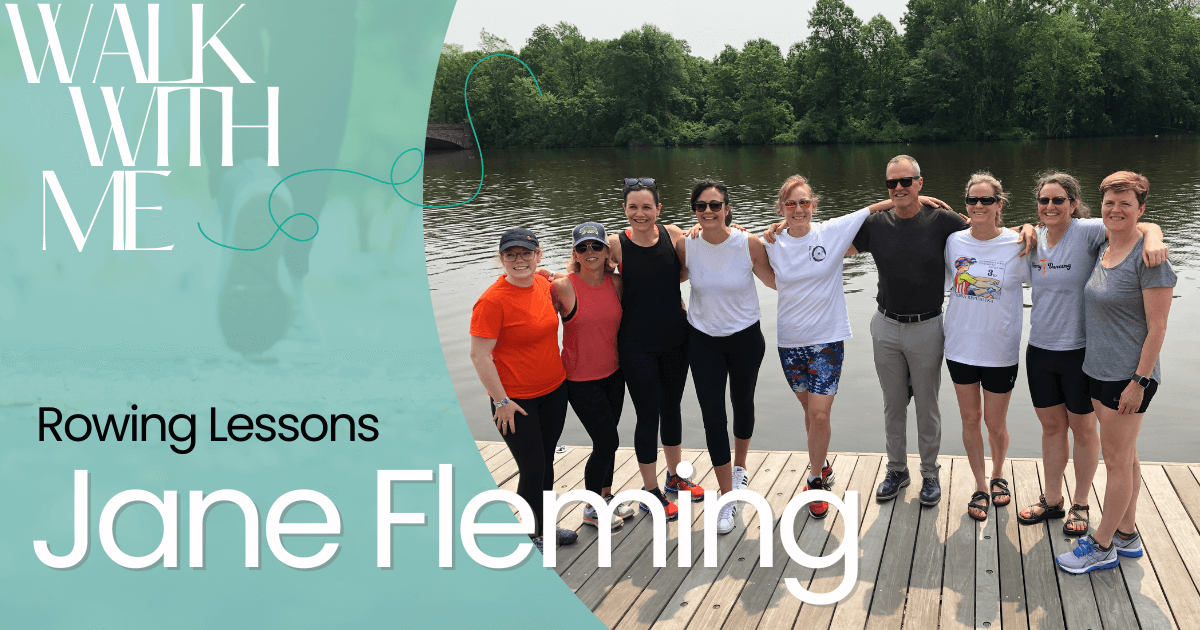
Jane Fleming was the third seat in that boat I was coxing. While we were only teammates for four years, we lived a lifetime in that boathouse and on the water of Lake Carnegie.
In 1904, Princeton University President Woodrow Wilson was courting steel magnate and philanthropist Andrew Carnegie for a major donation to support academic programs—specifically hoping for funding of a law school. His tour of Old Nassau took a turn when Carnegie announced, “I know exactly what Princeton needs, and I intend to give it to her.” Carnegie told the surprised Wilson, “It is a lake.” The cooperative effort of Rowing, Carnegie hoped, would provide a better model for global relations. I tend to think he was correct, but of course I am biased. That lake attracted a different type of person.
Jane: It was in us. I know you enough to know that you like to win, and you like the challenge of trying to figure out how to win. And I think I’m the same way. My competitive edge has softened as I’ve gotten older, but I think that I like to be excellent, and I like to push myself into new experiences. I think that rowing, of all things, was always a new experience because you were never physically or mentally the same every day, and yet you were being asked to achieve at the same level every day.
Liz: And add to that the weather. We rowed in some conditions that there shouldn’t have been a race.
Jane: Absolutely.
Liz: Including the one when we won the national championship.
Jane: Yeah, I’m convinced it’s because we were allowed to eat.
Liz: But you know what? That’s selling ourselves short. That’s not right.
Jane: Talk about that experience. That was a choice. We did not need to row that race. A bunch of us got together because we all wanted to challenge ourselves. For me, at 6 foot, dropping to weight was no easy task. But I think there was just something so fun about trying to achieve a national championship. I must say it’s one of the greatest bragging rights ever.
Liz: I couldn’t agree more.
Jane: Achievement is wonderful for everything we’re talking about. It’s the work put in. It’s about mission accomplished, working as part of a team to do something. But then you get it, and it’s great, and it goes into a bragging somewhere in the past. But really in and of itself, it isn’t a thing.
Liz: There was agency, there was confidence, there was collective risk-taking, and then a dedication of time because we were done.
Jane: It’s time and choice, and choice at a time when all of our peers were wrapping up and celebrating and partying and doing all the things that college kids do, we decided to go left when everybody was going right.

Our small crew made a different choice—while everyone else was sleeping off another night of beer pong, we were up at dawn, lacing feet into a shell, chasing something that made no sense to anyone else. There’s something intoxicating about being part of this small band of the obsessed, this little group that’s willing to sacrifice reunions for something bigger, something that most people will never understand until the day we crossed that finish line first. A crazy left turn away from ordinary paid off and ruminates in your mind as you face every choice thereafter.
Jane: But I think life is choices, right? I think our life is a result of the collective choices we’ve made, good or bad. I think that the willingness to, when they’re bad choices, to remedy is the stuff that makes a satisfying life, at least.
At 37 or something, I said to myself, I’m good with making mistakes. I just don’t want to make the same mistakes.
Liz: I love that. Fail forward.
Jane: Fail forward because making the same mistakes over and over again at some point, I think it does crush the spirit.
Liz: Right. I had a lot of good friends say, You can’t change what happened. So go back and decide how you chose the people you did that with. So you make good choices of who you’re going to go right with when everybody else is going left. So that you don’t follow the wrong people or have the wrong people follow you. I’ve always thought about making choices and wanting a team.
Jane: So interesting you talk about that because my business partner and I talk about that all the time, that success is 99% picking the right people. Because the other thing I was thinking about how rowing resonated for me is that it was a really wonderful lesson in being part of something rather than the something. And I think that I have a big ego. I think we all do. And my whole life has been about eviscerating that and realizing that all I can do is be part of a team. Another wise woman always says, I just want to be another bozo on the bus.

That brings me to the most salient memory I have of crew. It’s not the adrenaline rush of walking through Radcliffe to their bow ball. It’s not the exhausted collapse looking up into the sky after crossing the finish line first. It’s not being pulled from the icy waters of the Connecticut River after beating Dartmouth. It’s hearing Curtis Jordan’s voice emanating from the megaphone, “Pull the boats together.”
Liz: The other piece that I think is humbling in a way that I don’t know any other sport has is when you pull the boats together and switch a single person and head race again.
As coxswains we ease our shells alongside each other in the middle of the lake, oars lifted on the near side and stabilizing against the water on the other. Rowers reach for the oar of the corresponding seat and pull the two shells together as one.
“Hands on.”
Oarswomen reach across and hold the gunnel of the other boat. And then we collectively wait to hear what pair is unlacing and trading seats in a feat of balance and grace while your heart beats out of your chest across the fragile shells. Your eight had just won a head-to-head race. If he switches you, just you, will it change the outcome?
Jane: Always. Because I was never the strongest, and I was never the lightest. So it was one of those positions where I was a combo player. So I got switched a lot so that Curtis could figure out what the combination of human beings would work the best. I loved those. I loved that. I did. There was something about the truth of it that I really appreciated. I really appreciated that there was a purity in it. We’re going to switch one person and we’re going to see. Because I also realized that even though it was me being switched, it wasn’t just my job. All I could do is do my best and hope I work well with the teammates that I was rowing with.
I was coxing the JV boat. Our captain was coxing the Varsity eight. We had just lost a head race by a seat. Someone was about to be tested. Some change was coming. The anticipation hung in the air. Curtis instructed, “Switch the coxswains.” All 18 heads lifted, 36 eyes turned toward his launch in amazement. The coxswains?
Liz: I can tell you, I was switched. I did a head race, which was not typical, and that’s how I landed in the varsity boat. Curtis pulled us together, and you never knew who he was going to switch until you were pulled together. And I got in that boat.
You know how you crunch down? Well, as a coxswain, you crunch into the smallest ball, right?
As we pushed away from the other boat, I found myself looking straight into the eyes of Sarah Horn, varsity stroke.
Liz: I remember it just being eye to eye as if we were little kids in a blanket fort, and I had to have been as doughy-eyed as possible. And she said, “Get us there. We’ll get you there.”
You know when you wish you could fill someone with all the confidence you have in them. You want to instill in them the mountain of faith that they might be questioning.
Liz: That’s what she was doing. She was giving me all her confidence. And, man, I remember we won. And I remember you were in that JV boat and I was looking over and thinking, ‘No, I don’t want to lose them. I like them.’ I liked being the underdog. I liked being the JV coxswain. I didn’t want to switch up, but I got called and I had to go.
Jane: What a lesson, right? To step up into what you’re supposed to do. We all have things we’re excellent at and things we are mediocre at. I’ve always thought that it’s a bit of a shame when people walk away from what they’re excellent at.
Liz: Mmm. Ouch. That lands hard. Because I was a good head of school, and I did walk away. It’s been a rough year of, at times, thinking, did I leave too soon? But I really did feel that same calling for, there’s something else I’m supposed to be doing now.
Jane: Well, I guess, what I’m talking about is not necessarily the actual task, but the spirit of what somebody is supposed to be doing on this planet. And you’re still teaching, and you’re still showing up in a form of education and showing up for yourself. And I think all of that’s so invaluable.
I think we’ve all achieved great things. We’ve been, I hope, in service to the world in a way that’s positive. All we can do is to pick ourselves up every day and show up and let life happen and show up in ways that are positive. I know that that sounds trite, but actually… For all the thinking and all the words and all the philosophies, I do think showing up is probably nine tenths of it.
Liz: I don’t think it’s trite in this day and age. To show up positively, that’s a big calling.
Jane: So I believe if I walk out the door and participate in life and participate in the world, things get shown to me. And opportunities come up to be positive, to affect people.
Liz: What’s an example that is salient to you right now of an opportunity that showed up for you?
Jane: I think it’s really interesting. I just finished this Disney Kids project. Zombies 4. And it showed up in the middle of the strike.

Oh right, I should tell you that Jane Fleming is a founding partner, executive and producer at Court Five Productions which develops and converts diverse intellectual property into filmed entertainment. Previously, she was a senior executive at New Line Cinema, ultimately holding the position of Senior Vice President, Business Development. Since that time she has been a prolific producer of independent films with her partner Mark Ordesky including the EMMY-winning Disney+ series, “THE QUEST.”
Jane: We had developed a relationship with the team over at Disney, and they had called and said, ‘Would you ever do this kid’s franchise?’ And if you watch it, it’s a really fun integration story for kids, but it’s for kids 8 to 12. And my business partner did Lord of the Rings. So we sat there and we looked at it and we were like, ‘You know what? For this thing, it’s the best in class. It’s really good at what it does.’ And so, of course, we’ll say yes. And honestly, it was one of the best jobs we’ve ever had.
Liz: Really? Say more.
Jane: It was, again, a really great team. And we were finding young talent, 14 and 16-year-olds, who got to step into themselves in such a spectacular killer way. We got to set the table for all of that to happen and then to support them all the way through this process. It’s been just so gratifying to watch young people step into something pretty extraordinary.
I really love what I do because there’s this moment that happens when you’re about two weeks before production and you walk around all the different departments and everybody is doing the most amazing work all in service of this one end goal. And it’s just electric because as a producer, you’ve played a pretty big role in hiring them and getting them there, putting them together. And they’re having joy as they work towards something that somebody dreamt up and wrote down. That’s amazing. So for the kids, it’s especially salient because the excitement is so infectious. Many of them, it was their first big movie for Disney. It was just joyous. It was a musical, which, come on.
It’s doing gangbuster business. I’m nervous right now, but again, it’s like winning the national championship. It’s great. You get a little charge off of it, right? It’s great bragging rights, but it doesn’t necessarily make the quality of your life better. What makes the quality of our life better is the opportunity to keep doing what we love, the opportunity to connect with old friends like we’re doing right now.
Jane: I have to say, I’ll do this on the record, on the recording, you are one of those really special people in my life who I never see. But it’s so funny. I was thinking how naturally, I didn’t ask you what you were going to talk about. I was like, ‘No, I trust Liz. We got it.’ And even though we haven’t talked in, I don’t know, two years, three years. It’s just like yesterday.
Liz: Or really talked in 35 years.
Jane: Well, that’s the truth there, which is pathetic because I adore you and I really respect you and I’m inspired by you, honestly.
Liz: I have to tell you, when I was leaving the independent school and I wasn’t going to be starting an EdTech software for learning differences, I was really trying to figure out, where do I go? Who do I reach out to? And immediately, the muse, the universe, whatever, put your name in my mind. You have to talk to her. And I didn’t know why. Here is a connection you have put down in your life that you need to pick back up. And it’s inexplicable why some people are like that in our lives.
Jane: I know. It’s just if you quiet down enough to listen and you go with the flow like we did with rowing, we start flying. You start flying.
And in the boat when you find the rhythm that looks effortless from the shore, you fly. Just beyond the bow ball is open water. That’s the true moment of flight when the coxswain proclaims, “Open Water.” Now there is space between one boat and another. Our boats started even and now there is open water between the stern of our boat and the bow of theirs.
The call “open water” doesn’t mean you can relax. We have this race won. Instead, “open water” translates into the next step – reach farther, stay together, push harder – but with open water it no longer feels punishing on the body – it is exhilarating. It is flying. It is no longer about the competition and where they are in relation to us. It is just the nine of us. It is intoxicating. Just as open water inspires, it demands more. And with these people on this race day, there is inexplicably so much more to give.
Jane: And as you said, when it works, I don’t know if anybody can describe that feeling. I know a lot of writers have, I think, tried to do so, but I don’t think anybody’s actually ever achieved it because it’s one of those transcendent moments that you can’t really describe to anybody.
It was never about the win. It was always about being part of something bigger than ourselves.

In the years that followed, I have quietly carried the truth of that palpable anxiety of proving my worth head to head, and that tangible ecstasy of the whole being greater than the sum of its parts.
Everything I needed to know about leadership and life, I learned in the back of a boat with a microphone strapped to my sweatband.
“Let it run.”
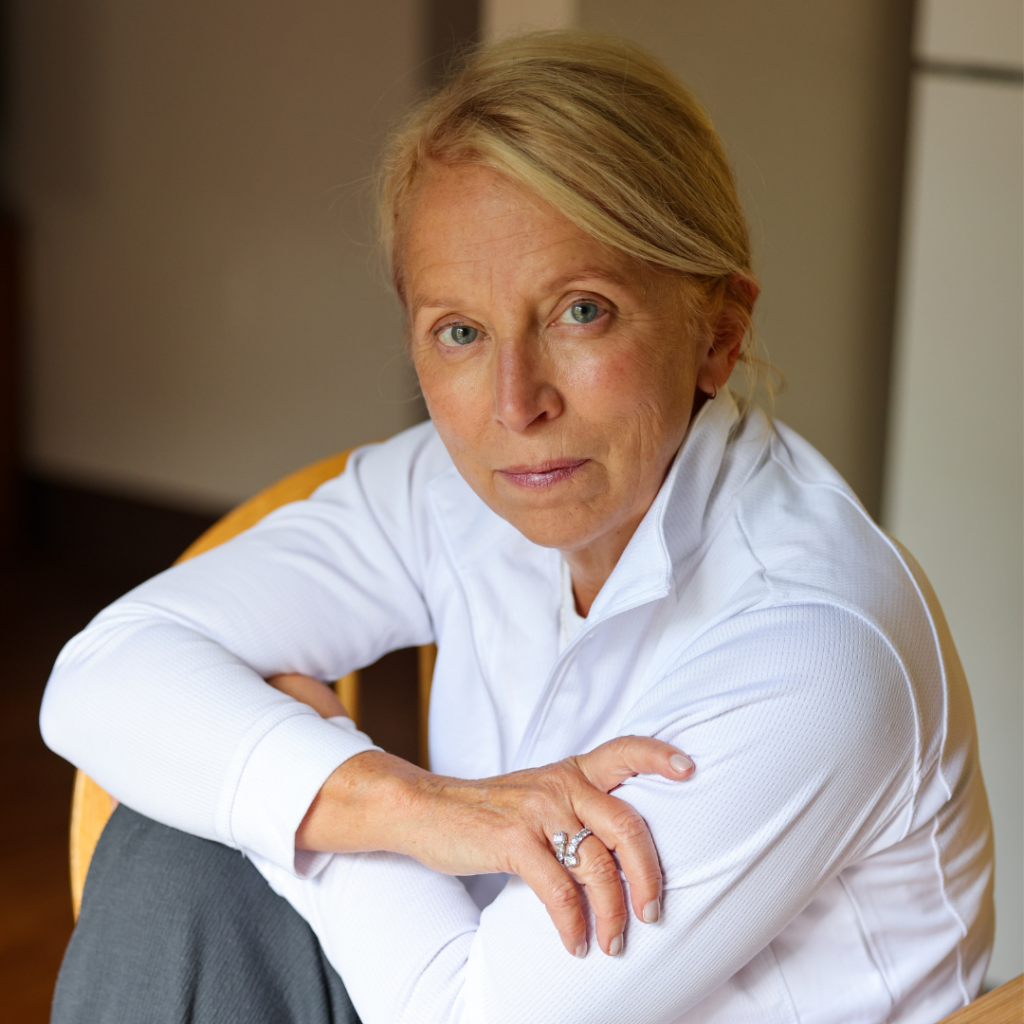
Liz Hofreuter
Founder GEN-Ed
Not your typical researcher or consultant, Liz connects lived experience to transformative leadership. To uncomplicate leadership and education, every story matters and she is just getting started.