Everything Else Comes Along

On June 4, 1944 Dwight D. Eisenhower told 150,000 troops, who were loaded onto ships and planes and prepared to storm the Normandy beaches…to wait. The weather was brutal, so the planned attack could not proceed, sending waves of dread through men who’d already said their goodbyes and steeled their nerves. Every voice screamed urgent concerns – the Germans might discover the delay, the troops’ morale was cracking, the tides wouldn’t be right again for weeks. One voice offered a sliver of possibility – a brief window of clearer weather on June 6. Eisenhower silenced them all to focus on a single important question: Do we go tomorrow, or do we wait?

Years later, he started thinking systematically about the difference between urgent and important, eventually creating a 2×2 decision matrix that bears his name and ultimately asks, “Are you spending your life on what matters, or just on what’s loud?”

Jonathan Strecker, Head of School at The Valley School of Ligonier, doesn’t need the matrix quite like the rest of us do. Life has imprinted on him what is important. He is not bothered by what’s loud.

Strecker
I have a unique perspective because I’ve battled health issues my entire life. Stage four cancer, cardiac arrest, and a lot of different events.

Liz
Oh, my goodness.

Jonathan
…and people normally respond like that. “Oh, I’m so sorry.” To which I respond, ‘No, it changed my life for the better.’

Liz
For the better?

Jonathan
Yeah. It’s that song, Live Like You are Dying. That’s exactly how I live my life.

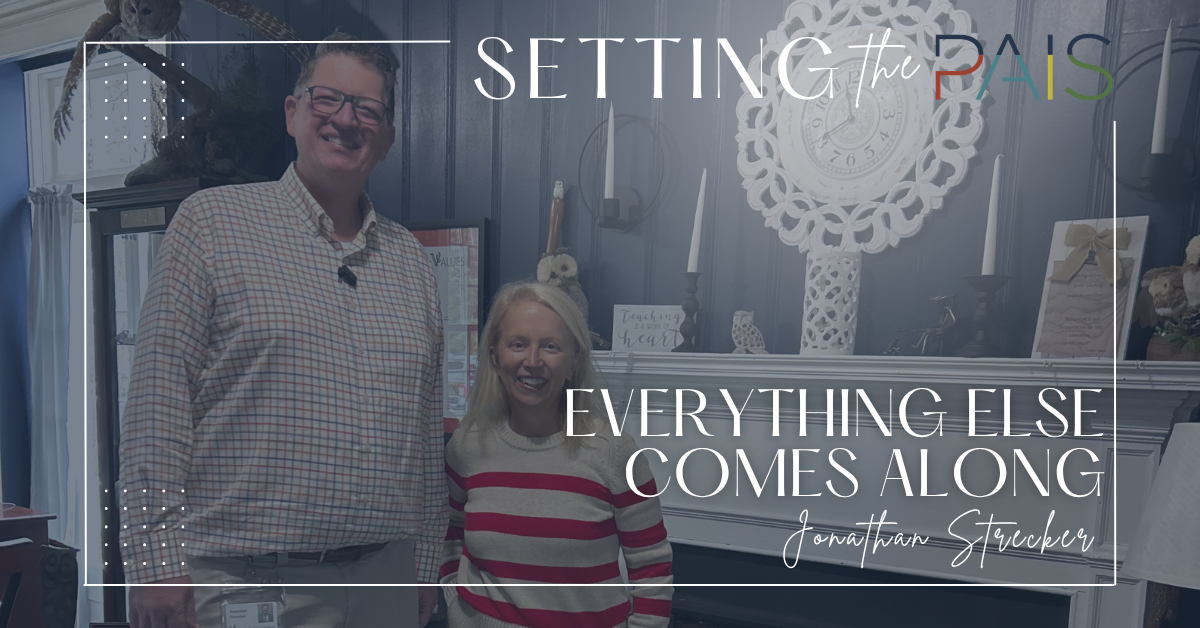
This gentle giant of a man, who stands 6’7, embodies an equanimity and grace that immediately put me at ease. It helped that our conversation began just after he lit a fire in his office. He had greeted me at the front door to the school. His silhouette took up the entire frame of the doorway with a smile to match. He told me that I could find him there at the front door every morning, greeting the children in this K-8 school … except when it snows… then you will find him with the kindergarteners sitting in front of his fire.

Jonathan
I don’t want to go into the whole story of the cardiac arrest incident, but what I will say is what I gleaned from that. Because the heart stopped, they had to shock me to bring me back. There was such a peace and tranquility that I had never felt before, that it really downshifted my perspective and gave me clarity on all decisions I needed to make. Life is now so much more about taking care of people and myself, and everything else comes along. The appreciation and the clarity you live with. If I’m pondering over an email I’m not like, ‘On my deathbed, will I really worry about which word I use? No, it’s fine. Let’s go. What is the purpose of the email? And let’s get that out.’

Liz
And the other person might not hear it the way you meant it, but that’s not the end of the world either.

Jonathan
It just opens up another conversation. I am truly blessed to be at this school, and this is a fantastic school.

And this school, tucked into the foot of the Laurel Highlands with Linn Run streaming through campus, is building a new playground. Not just any playground. A natural playground. In the woods. Actually elevated in the trees in the woods. I’ll let Jon tell you.

Jonathan
One of the most important aspects is that the children are outside playing, but in a way that is more like what we probably grew up with. We didn’t have all the distractions of technology and computers. And so as a result, we were outside all the time, climbing and jumping and having a good time. I’ve been playing with this idea that I think will be fantastic for the kids. And what I would love to do is create a nature playground where not only are they in the woods, but they’re elevated in the woods. They’re in the trees. They’re overlooking the pond.

Not pond. Ponds. Ponds with trout.

Jonathan
We’re outside all the time studying our fish. We raise our own trout from eggs in the classroom all the way until the children see them as these monsters. And of course, that’d be a great place to see those.

A treehouse playground so the children can better see the trout they raised. I want to be nine again. So did the architect.

Jonathan
We showed our original design to a bunch of tree house builders, and he was the first one to say, ‘If you guys want to build what’s on this piece of paper here, that’s fine. I’m just not the right person.’ He goes, ‘I want to dream. I want to envision.’ I’m like, ‘This is the guy.’ He is a child at heart. He’s going to create something that children love, not what we as adults love.

Children are at the heart of everything at Valley School of Ligonier. As they are at all of the schools within the PAIS independent school ecosystem. Jon worries about children today.

Jonathan
Over the course of the modern convenience taking root in our society, five different attributes that independent schools find vital to child development, are in decline.

  1. Our IQs are going down for the first time in human history.
  2. We are more antisocial than ever, even though we are able to communicate.
  3. Emotionally, there is a greater amount of anxiety and depression than we’ve ever had before.
  4. Ethically, we have created less trust by creating a me-first society, what’s in it for me rather than what’s in it for us.
  5. And then finally, one in five children has obesity in this country.

So all of our intelligences, intellectual, social, emotional, ethical, and physical intelligence, are all in decline. And we are only on the precipice of AI technology. So what are we going to do about it?

What is Jon going to do? He is writing a book. He samples the ideas on his YouTube channel. He wants to share with others what independent schools live every day.

Jonathan
In some schools, if there’s a child who’s experienced a math problem… they’ll say, math problem in, math solution out. Let’s give them more math. Let’s take away their recess. Let’s take away their social time.

There is an alternative.

Jonathan
We see there’s a math problem. Let’s figure out, based on these five intelligences, what is the actual cause. If a child doesn’t have friends or they’re emotionally stressed out by math, giving them more math is not going to solve that. It’s just a different way of looking at child development.

Liz
You’re right. It’s embedded in independent education. Because we know the child so well, and we care about all the different aspects you just talked about.

Jonathan
Independent educators, they understand that they’re responsible for all five of these attributes. It’s not just, ‘Well, I came here to teach history, and that’s all I’m doing.’ That never works in an independent school. We’re like, ‘No, you’re part of this family, and we expect you to help these children get to where they need to be.’ And as administrators, our job is to make sure the faculty and staff are taken care of along these five attributes as well.

Liz
Exactly. And that we’re taking care of ourselves.

Taking care of our faculty and ourselves. That hits the urgent and important quadrant in Eisenhower’s matrix.

Eisenhower forced himself past the noise to focus on one important question: is this weather window real enough to bet everything on? At 4:00 AM, he made the call: “OK, we’ll go.” It was, historians say, one of the gutsiest decisions of the war. The rest is history.

The urgent voices are loud: they need more math worksheets; they have too much recess; the school needs faster solutions, stronger gates, higher budgets, and tightened spending. The list goes on. Can we quietly turn from the noise to focus on what’s important? What does this child actually need? What do our teachers need? What do I need as a leader in education?

Jon Strecker knows a leader’s responsibilities are about taking care of people and oneself, “and everything else comes along.”

Showing Up

Before the White House, Theodore Roosevelt did something that shocked the corrupt establishment of 1890s New York, he showed up. On any given midnight, the young commissioner would walk the Manhattan beats himself and found officers asleep or drinking in saloons, or couldn’t find them at their posts altogether. He faced down his challenges …not by sitting back, but by rolling up his sleeves to do hard work himself.

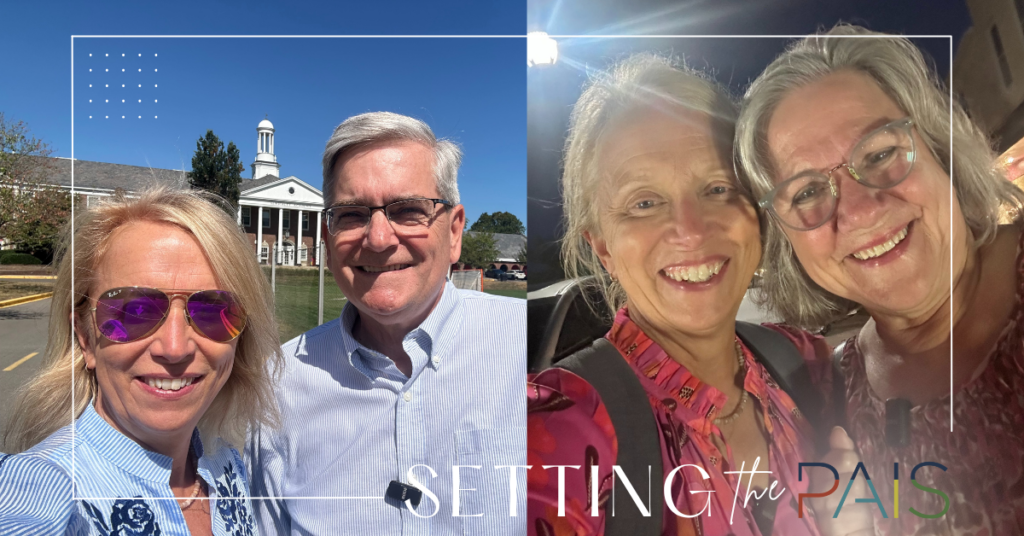
Why in the world does an introduction to the PAIS staff begin with a history lesson on Theodore Roosevelt? Simple. I learned something new when I walked with Jay Harvey, who has a keen interest in the presidents. He taught me this fact about young Roosevelt and I wanted to share it with you. That … and the fact that these four incredible individuals themselves are known to show up, roll up their sleeves and support schools so children and adults can thrive. Side note…I am not a fan of the term “thrive” – it doesn’t quite capture the essence of what we mean – nor do its synonyms. For now it is “good enough”…which by the way is never enough…but I digress. Back to Teddy Roosevelt…the man in the arena.

Jay: I just think that’s a critical value to understand people. And I think it jumps right into why I feel so passionate about visiting schools, because you have to understand and appreciate what the place looks like, what the feel is…try to get a snapshot of the culture…try to meet some of the people… you can’t do that by sitting in your office on Zoom. You can get the facts. You can go to the website, but…

I felt in reading a lot about Teddy Roosevelt, that the stories of him as police commissioner going out under cover at 2:00 in the morning to see exactly what the cops were doing because of what he was hearing… I take much from that.

Jay Harvey, PAIS Director of Accreditation, is an avid reader of presidential biographies. He has his favorites. You will have to ask him next time you see him. You might assume that he was a history teacher, but no… only as an elective…a passion project about the presidents as you could have guessed. Jay was a math teacher. Deb Borden, PAIS Director of Programs and Research, and I share that profession on our resumes. We were all teachers: Math, Science and English respectively.

Liz: Do you miss the classroom?

Jay: Absolutely. It’s funny. My first year at PAIS, they needed an elective teacher for the fall. It was a math elective – business math. I created these electives in my last two or three years for seniors because all of a sudden, college guidance was telling everybody they had to have four years of math. And obviously, not every school has kids that should be going to pre-Calc after algebra. So I went in and taught it… I just like being in a classroom. Absolutely. I think that’s also what drives me to get out and visit schools so much.

Liz: Is it the kids that you miss? And if so, is there an age group of kids?

Deb: Yeah, middle school.

Liz: It’s middle? Oh, wow. You are a special being.

Deb: I love middle schoolers. I was the head of a middle school, and I love middle schoolers. It’s absolutely my favorite age span.

I just miss their energy, and they’re still malleable, tremendously so in middle school. And they are going through so much with their hormones and friendships and figuring out who they are. They really need adults in their lives who love them. They’re so fun and funny. And I loved the discipline piece.

Liz: Really?

Deb: Loved it. Loved it, loved it. I wouldn’t give it to anyone… because it’s just an age where they make mistakes and make poor decisions. And I just wanted them to know that it’s okay. You made a bad decision. We’re not judging you for it. You’re learning from it.

Liz: I used to say, if your kid hasn’t failed in a big way by the time they leave our school, we’ve done something wrong because this is the safe place to make a big mistake.

Deb: Yeah. And to give them the power to make decisions, right?

Liz: And to do it in such a way that when they are on their own in the high school hallway or college campus, they know how to quickly think through consequences and choices.

Deb: And how to restore friendships… if you’ve made a mistake in that way. You can’t ignore or run away from the impact you’ve had on whatever decision you’ve made, but everything can be solved and resolved. But you have to work at it, and the work is worth it.

Deb’s account makes me miss working with children. There’s a particular purpose that comes from working with students. It’s not found in the lesson plans or curriculum maps, but in being woven so authentically into their growth and development. You get to bear witness to all that unfolding potential and pass on guidance that might just echo in another life for decades. It is generational work after all. It is a profound and humbling moment when you realize you matter to someone’s journey in ways you’ll never fully know.

Jay: I just think people, right? Education is such a people-business. It’s always fighting that fight between community and business,

Of course, you can find this moment as readily on the playing field as you can in the classroom. For Char Barwis, PAIS Business and Office Manager, that field is the pitch of field hockey.

Liz: Why do you love field hockey so much?

Char: So funny story. I played field hockey, and in middle school, my husband’s mom was the middle school coach. He was two years older than us, and he would come to see his mom, and all the girls would be like, “Oh, he’s so cute. He’s so cute.” … I ended up marrying him, which is funny. But yeah, so I played and my sister played field hockey… around us, it wasn’t a big sport, and my kids started off in soccer like every other kid around us at four years old. As a parent, you follow the trends and blah, blah, blah. Because somebody tells you you have to…all the pressure. Your kids have to get involved. That fear. Yeah, the fear. So we did the soccer thing, and then someone said, Oh, there’s a field hockey rec league. And I’m like, Get the heck out of here.

So I ended up signing them up, and they loved it, and they just went with it.

Liz: Is it only a female sport?

Char: Yes. I do believe that boys can play if they wear a skirt. But it is traditionally a girls’ sport. What’s funny is it’s huge in the European countries, and that’s more boys.

There’s something uniquely American about field hockey—not the sport itself, which is played by both men and women across the globe, from India to the Netherlands to Australia—but the way it carved out space in our athletic landscape as predominantly a girls’ sport without a boys’ equivalent. That matters in ways we don’t talk about enough. It created a rare territory where girls owned the field and proudly played in a skirt – a pleated tradition dating back to the Victorian era that stuck, but only just recently changed in 2023.

Char: In the United States, it’s all girls. So my girls, they started going with it. They loved it. It has taught them so much, just even being a captain and with the drama and shutting things down and how they are to the little kids that are coming up and the intimidation that some of those kids are feeling and how they talk to the coach and communicate with the coach and the team and the grit and the hard work. They might not get the recognition, but they still go out there and try their best every day.

Nobody said parenting was going to be easy. We give our children the opportunities we can and try to allow for challenges as well, but watching them navigate those challenges can be harder than expected. And then there is…

Liz: …mother and daughter relationships…those are really unique.

Char: It’s funny when you said, “My daughter doesn’t always like me that much.” And I’m thinking, “Oh, my God, these high school years… “ I warn Mary all the time, and she’s like, “Oh, my God, it’s going to get worse?” Her daughter’s six.

Mary: We keep trying her in all these different sports, and she’s doing cartwheels or picking flowers… On the funny, today, she has Cheer after school. It’s an after-school club. Again, that’s not like I have no… I never have an experience in that…

Liz: I was a cheer coach for six years.

Mary: Oh, so you could…

Liz: No, I can’t help. It was because I was a young woman on an independent school campus, and that meant-

Mary: And they needed a cheer coach. Are you serious?

Liz: I had the right gender and no family. So that made me qualified.

Mary: Oh, my God. That’s so funny. Well, right. That’s how it works.

While she wasn’t a teacher, Mary McAndrew, PAIS Director of Communications, understands independent schools and the families that choose them. She gets it – parenting is an epic love story. It is no short sprint. What is it they say …the days are long but the years are short. Indeed, all five of us are parents. It makes us more empathetic in these positions in ways we should explore further. Moreover, Deb and Jay have the gift of being grandparents as well.

Liz: What’s the best part about being a grandma?

Deb: Oh, gosh. I think reliving your parenting of your own children, but more relaxed and also not feeling that big weight of responsibility. But it is just the best. It was very cool also to see Amanda as a mother…she’s such a good mom. So that was really special, too. And I love babies. So in that baby stage, I could sit and hold a newborn baby all day. Love it.

Liz: What would be your advice for a new grandma?

Deb: Just really appreciate the moments because they grow so fast. And that’s one of the biggest reasons why we moved closer to them. They also both, Reese and Finn, think my husband and I are really cool right now, too . Last week, I took Reese to soccer practice… at the end of soccer practice, all the kids and the coaches get together and they do a little cheer. And she’s like, “Lovey, come on, come on. Come out to the huddle”. And I’m like, “No, no, no, no, I’m not doing that.” And she’s like, “No, it’s okay. I asked if you could come out,” and I didn’t because I’m like, I’m not going to be the grandma that goes out in the middle of the field…but she wanted me out there.

Liz: Oh, that’s priceless.

Deb: It is priceless. Yeah, it’s really nice.

I started this series… Setting the PAIS… with the PAIS staff because I wanted to get to know them better. I wanted them to get to know me better. For example, Char loves to plan events which is the reason she knows, “They love taking the desserts. Always have to have Diet Coke at every single meeting we’re ever at. Everybody loves diet coke.”

Liz: And it’s easy for you?

Char: I think one of my strong points is I’m super organized – I write everything down. So I don’t like letting anything linger. And at times, you’ll see, sometimes that can be annoying. If something is lingering, I’ll keep following up on it…and then when it executes well, it’s very rewarding.

Liz: Are you a zero mailbox person? You have to go through all the mail or you don’t feel like you can’t leave something?

Char: Yes and if it can stay in my inbox, I need to categorize it into… I have different follow-up folders. I can’t have anything unopened in my inbox. It has to be put somewhere, deleted or put somewhere.

In walking with our staff, I also wanted to pull back the curtain a bit – humanize the people behind the programs, the emails, the visits… the people who show up for member schools and walk with them on their journey to impact the lives of the next generation.

Liz: So you put on tennis shoes?

Mary: I don’t get out and play tennis, but they’re kinda tennis shoes. Yeah.

Liz: See, I’m so old that everything that’s like this is tennis shoes.

Mary: What do you call them? I thought you meant like these are like a general-

Liz: Wait, is that West Coast, Pennsylvania…East Coast, Pennsylvania thing?

Is it soda or pop?

Mary: Soda.

Liz: I think I say pop. I’m not pop.

Mary: Do you say hoagie?

Liz: I think we actually say coke for everything. Do you want a Coke? I have Dr. Pepper.

Mary: Okay. No, I would say sneakers. Yeah, I put on sneakers.

Liz: I don’t think I’ve ever said sneakers.

Mary: Oh, definitely. Yeah. I thought you meant legitimately that I’m wearing tennis shoes.

Liz: I’ll come back to… Do I say hoagies? I don’t think so. I think I just say subs.

Mary: Subs? Or some people say a grinder at different places, grinders.

Liz: Yeah, I’ve never said Grinder.

So this Pennsylvania west coaster who cheers for the Pittsburgh Steelers will try to represent while donning my tennis shoes with these amazing east coasters. Afterall, I am the newbie… and everything feels new – not just our vocabulary differences. I cherish this position as learner. I want to show up as my authentic self and ask real questions, so I can learn and maybe we can all question assumptions. Jay said it best when he said, our work is

Jay: …really about uplifting and celebrating schools. That’s what it should be for the most part.

And there it is—the Roosevelt connection with which I started.

Theodore Roosevelt didn’t reform the New York Police Department from behind a desk. He pulled on his coat at midnight and walked into the dark streets himself. Not to catch officers in the act for punishment’s sake, but to understand what was actually happening. To see it. To ask questions. To show up.

A century and some change later, Jay Harvey does the same thing. So does Deb. So does Char. So does Mary. They don’t support schools from a distance or through reports and spreadsheets alone. They pull on their tennis shoes and walk through the doors.

That’s connection. That’s service. That’s PAIS.