My daughter was four when the first signs of dyslexia appeared. By the end of middle school, I thought she had made it through.
So when she started coming home junior year with stories that made the educator in me sit up straight while the mother in me wanted to look away, I didn’t know which voice to trust. Was someone just asking her to be compliant and she didn’t want to be? Or had she been coping so beautifully for so long that I’d mistaken survival for thriving?
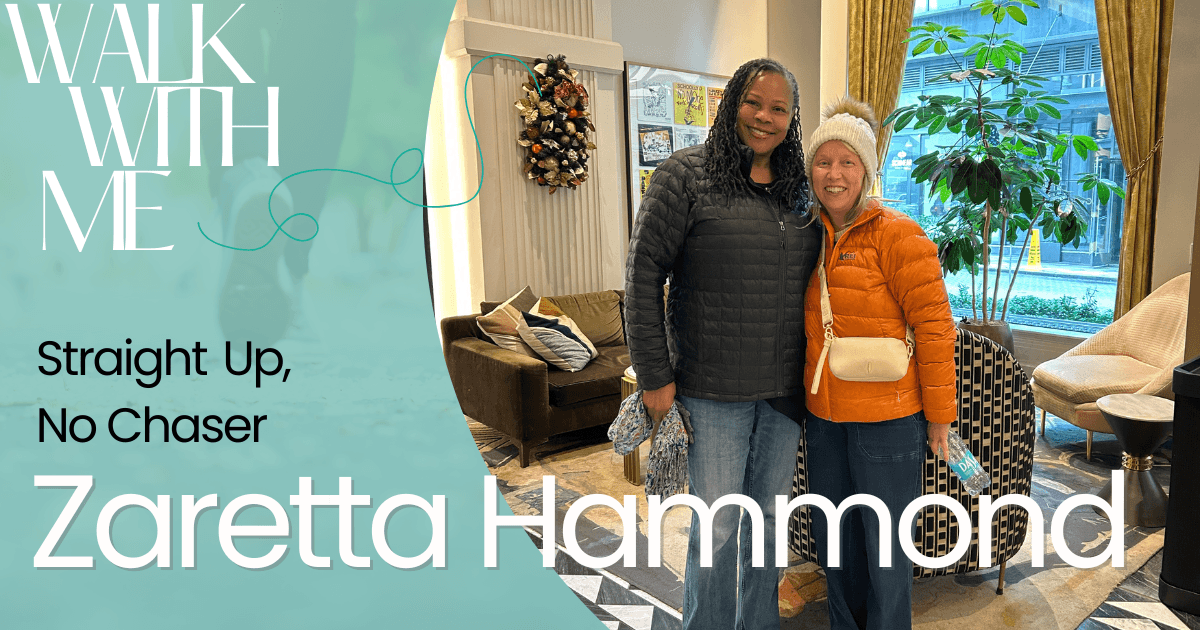
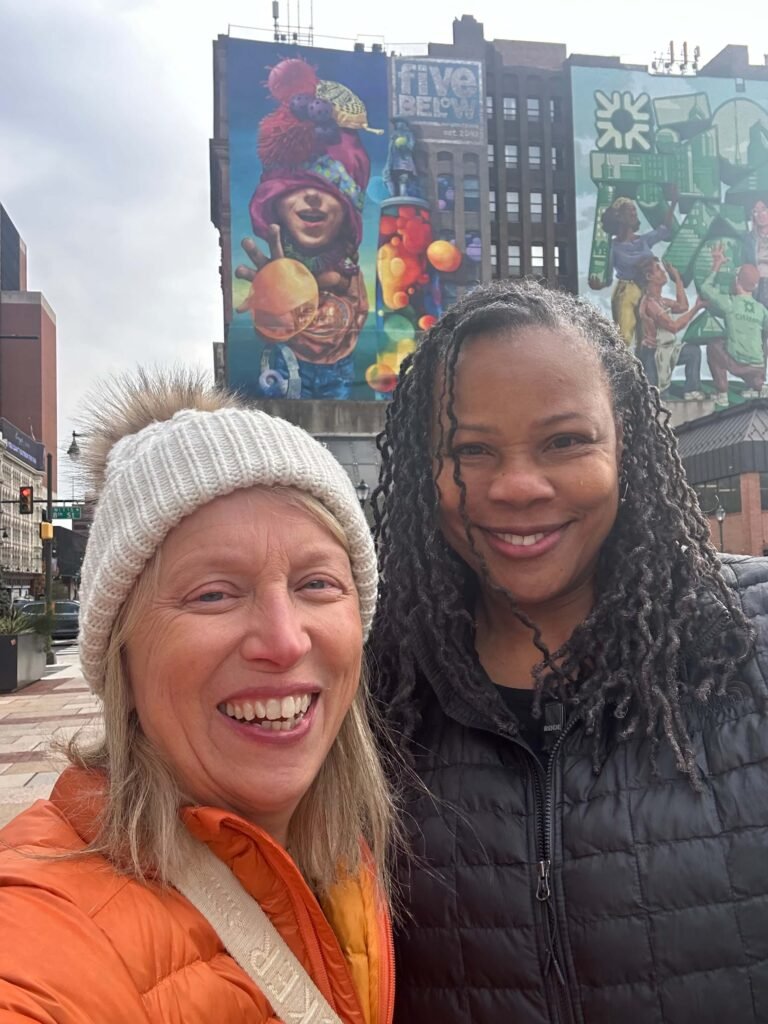
I carried that question along with a dozen others into a walk through downtown Philadelphia with Zaretta Hammond. If you know Zaretta, you know what happened next. If you don’t, let me tell you: she took every one of those questions, turned them sideways, and gave it to me straight… made me think… with no chaser.
But I’m getting ahead of myself.
I first met Zaretta in a group Zoom call full of innovative educational entrepreneurs. I needed a listener. She needed nothing from me. And yet she pulled our conversation out of that crowded digital room and became a personal advocate, a mentor, and what she would call a thought partner.
Zaretta: I call it thought partnership. We don’t make enough time for that because we live in such a transactional world that the degree to which we don’t see the immediate return from something gets problematic. I would say it is a core value for me.
Liz: There’s grace in what you said. If it’s not transactional, then you don’t have to carry this weight that I owe you.
Zaretta: Absolutely.
Liz: Every conversation that I sit and listen and offer to be a thought partner, I get a gain, too.
Zaretta: That’s right. We all get smarter in the process. But I also think there’s an element of freedom in it. I say my middle name is Straight up, No Chaser, and this brown liquid just might burn your throat going down. So I reserve the right to tell the truth and ‘shame the devil,’ as my grandmother would call it. And I think that is what makes partnership powerful, as someone is willing to tell you what you need to hear because you’ve left yourself open. The intent is to invite them to reframe it.
I used to thank people for asking good questions to clarify my thinking. I would amend that now that I know Zaretta to invite others to ask me real questions to reframe my thinking. Trust me, there are few people better at that than Zaretta Hammond, a best-selling author and a champion for equity, literacy and the science of learning.
And boy did I have questions for her. Each of the following topics we discussed could be the fodder for a full blog on its own. For instance, after 17 years why is my daughter, who seemed to overcome challenges with dyslexia, once again struggling as a junior in high school? …or… What would it cost independent schools—really cost them—to choose equity? …or … How do you take care of yourself in your grief?… or … When your son’s teacher insisted he sit in a circle instead of reading, what message did that send?
And she lent her own questions to the conversation: If we stopped talking about management and assessment, what would we talk about instead? … or … What’s the difference between a teacher learning something and a teacher being transformed by it?
Contained in our dialogue is a wealth of insights for any of us in education to glean greater wisdom. If this were a live blog, you could tell me where to start. You could click on the question that invigorates you. Instead, you will have to comment on what seems pertinent to you. Maybe there are multiple blogs that come from this one. In the meantime, I will follow my own heart, which will not surprise you, and we will start with my daughter.
Liz: Now, as a junior in high school, she’s coming home and telling me things that the intellectual and the educator knows, ‘Oh, that is a red flag.’ And as a mom, I keep asking myself, ‘Wait, is someone just really asking her to be compliant and she can’t be? Or is there really something going on that started back when she was four and she’s just really done well coping all these years?’
Zaretta: You’ve been an observer of that child for a very long time. So what we also know is whatever those coping mechanisms, as the cognitive load gets greater, which it does by junior year, it’s going to then leap forward again in the middle of freshman year. This is why more schizophrenia happens for young adults, because they go to college and they think, ‘Oh, I’ve got this wonderful social life,’ but if they are underprepared for the cognitive load, then it is going to put a stressor on their brain in a way that disrupts.
Liz: I have never heard it explained that well before.
Zaretta: The research is really clear.
Liz: I’ve had so many people talk to me about why 25-year-olds have mental health crises, but you just made it really clear.
Zaretta: And what we don’t do is we don’t teach them the craftsmanship of learning… when we’re learning in the wild and it gets to be too much, we go back a step. We sit that down like, ‘Okay, I haven’t understood this. I’m at my point of frustration.’ But we’ve told kids, particularly high-achieving kids, ‘Oh, you can keep taking all the classes.’ The idea of taking less classes means somehow I’m less capable. So we’re selling them this at the expense of their mental and physical health. And they see their peers doing that, and they don’t want to lose a step.
This disconnect between how we naturally learn and the forced conditions of schooling creates an anxiety that lives in a student’s body and mind in ways we can’t always see. I think about the students who can’t sleep, who develop headaches, who sit in class exhausted but keep pushing because slowing down feels like falling behind. What breaks my heart is how they start to override their own internal wisdom—that quiet voice that says “this is too much” gets drowned out by the louder message that more is always better.
I had to walk out of the Head of School’s office to finally learn that more is nothing but… more.
Taking an advanced class schedule was never a discussed goal in our home. Spending your time to fill all of the blanks on the college application was not a spoken priority. Not for Grace. Not for Ella. But even without that dialogue, the unspoken expectation was there. I have to pause and unwind my own thinking as a parent to learn to reset the mindset.
There are a lot of common mindsets that Zaretta’s work resets. She urges us to question. Her words compel us to think critically, to challenge the status quo…and when we do that, it can be uncomfortable, but growth and learning often are.
Liz: In the simplest of terms, do you see a way forward for independent education to get it more “right?”
Zaretta: That’s a complicated question.
Liz: Oh, yes, I know.
Zaretta: Because the answer requires people to do things that they’re not willing to do. So the path is clear, but it means you’re going to have to change your behaviors. I have continued to work with independent schools all the way up to last year. I have continued to consult, provide professional learning. But the prestige that people think they have because they’re an independent school prevents them from making changes to accommodate the diversity. We’d like to talk about neurodiverse, gender fluidity, and economic diversity, and their accommodations around that. Independent schools still have a long way to go to talk about the racial rebalancing that needs to happen in terms of who can come, who can succeed and how teachers respond to students who are performing the same but happen to have different racial backgrounds. That is different, more complicated, because white progressive educators are not acknowledging what it means to be socialized into whiteness and how that then flows into our systems. It’s complicated.
In all those examples of diversity, it is complicated for teachers and leaders to know what a child is experiencing. I didn’t even know what my own daughter was experiencing.
Zaretta: All brains survey. Meaning you let stimuli in. You have filters for what you don’t pay attention to. For certain people to not pay attention to certain things can be dangerous. Emmett Till. You don’t pay attention to these rules. These rules aren’t designed to keep you in the box. Black people didn’t design those rules. Black people learned. You do these things, white people interpret that and you may lose your life. Same thing with reading. ‘Don’t look like you can’t read that note. You got to keep that under cover.’
What Zaretta is naming here is something most of us don’t want to look at directly: we’re all walking around with filters or bias shaped by our lived experience, by what we’ve had to pay attention to in order to be safe, to belong, to survive. Those filters are the architecture of how we make sense of the world. For some students, noticing certain things, reading certain social cues, staying hypervigilant to particular dynamics isn’t optional; it’s survival. For others, those same things can remain invisible their whole lives without consequence. This matters enormously when we think about learning because what we notice, what we filter out, what we believe to be true based on our experience—all of that becomes the foundation, the schema, through which we understand new information. We don’t come to learning as blank slates. We come with these deeply ingrained patterns of what to pay attention to and what we’ve learned it’s safe to ignore.
If we’re not aware of our own filters, if we’re teaching from our own unexamined schema, we can’t possibly create the conditions where all students can actually learn.
Zaretta: When you understand how the brain learns, culture is called schema. Meaning this is the knowledge tree. All that we’re taking in, we assign it meaning, and we put it in a place. That is what culture is.
Liz: And you don’t learn anything without bringing what you already know to it.
Zaretta: More importantly, all new learning must be coupled with existing learning. So when you want to learn something new, your brain opens up the synapses because you now started thinking about, ‘What do I already know about that? I heard that in a movie.’ You don’t even have to know exact definitions. You now just are making a connection to, ‘I saw that word before.’ Now your brain literally opens up the synapse, and there’s a chemical reaction where it’s ready to receive new information. All new learning must be coupled. It’s not like it’s a nice thing. It’s essential if you want it to be retained and for new meaning and new understanding to develop. So what ends up happening is because we teach without the science of learning, we’re just covering content.
Certainly, content has its place, but “covering content” is not synonymous with learning.
Zaretta: When I do training, sometimes I start with the game Taboo, one of my favorite games of all time.
Liz: Me too. I love taboo. Worst buzzer, though.
Zaretta: It really is. But the reality about Taboo is a fairly cognitively complicated game. And I have people play it and then we break it down. Like, what did you have to do first? You have to access your schema because now it’s telling you, ‘Oh, here’s the word. Oh, what do I know about that?’ Now you have to look at the five words that you cannot say. So you have to go back to your schema, the branches of your knowledge tree, and say, ‘What’s another way? What’s another branch or understanding or set of schemas that actually are about that, right?’ And now, when you’re able to do that, you have to now look at someone else and say, ‘Where is our communal schema, right?’
Liz: Our schemas have to match for me to guess your word?
Zaretta: It doesn’t have to just match. I have to know where our communal schema is. So I actually… this is the responsive part. In order to help you move forward to get unconfused, I have to sync up our schema, but I have to know where to locate us. It’s not your job as a learner. That’s the responsive part. This is where knowing how you make meaning …what’s going to help you break your cognitive log jam. That is the piece people miss about culturally responsive teaching.
Liz: The metaphor you gave me for Taboo works so well for me to see that what I bring to connect new learning isn’t what my student brings to connect new learning.
Zaretta: Well, here’s the thing. I think that is very true, but I don’t think it’s the whole thing, because then you’re going to discount what you bring. Your communal shared schema is why you want to build relationship, because the more we talk, the more we’re going to see that. These are actually things in Culturally Responsive Teaching and the Brain that I break down that come from other fields.
We have a tendency to keep thinking this is something unique to education that we have to learn. All humans do this. When you meet somebody on the plane, all that small talk is to figure out where our shared schema is.
This is what thought partnership looks like when someone is willing to tell you the truth with no chaser. Zaretta doesn’t just hand you frameworks and research—though she does that brilliantly—she hands you a mirror and asks if you’re ready to look at what you’ve been avoiding. She connects the dots between a mother’s worry about her daughter, the architecture of our schools, the filters we carry from our lived experience, and the neural pathways that make learning possible. And she does it with such clarity, such compassion, and such unflinching honesty that you can’t help but be changed by it.
I walked into our conversation carrying questions about my own child, about the work I’m trying to do at PAIS, about equity in independent education. I walked away understanding that all of those questions are actually the same question: are we willing to teach and lead from an examined communal schema, one that has room for every teacher’s and student’s humanity and every student’s brain?
Zaretta’s work—her books, her consulting, her willingness to be a friend and advocate—invites us into that reframing again and again…as many times as we need it. And for that gift, I am straight up grateful …beyond measure.
Building on the framework from her bestselling book Culturally Responsive Teaching and the Brain, Zaretta Hammond offers a brain-based approach to strengthening students’ cognitive abilities in Rebuilding Students’ Learning Power.

Liz Hofreuter
Founder GEN-Ed
Not your typical researcher or consultant, Liz connects lived experience to transformative leadership. To uncomplicate leadership and education, every story matters and she is just getting started.